Category: Non-Fiction
Reviewed by: Casey Suire
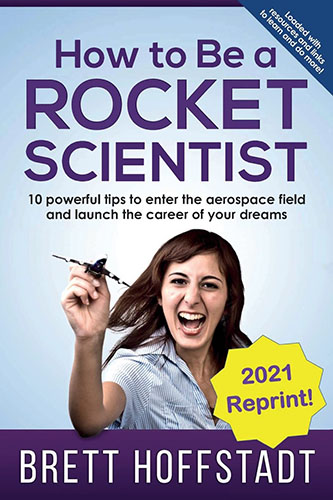
Title: How to Be a Rocket Scientist: 10 Powerful Tips to Enter the Aerospace Field and Launch the Career of Your Dreams
Author: Brett Hoffstadt
Format: Paperback
Pages: 52
Publisher: Aero Maestro
Date: October 2021
Retail price: $9.95
ISBN: 978-1956622027
Find this book
Brett Hoffstadt’s book How to Be a Rocket Scientist is a very brief work on how to start a career in aerospace. Given the small page count, the book is ideal for younger readers. Nevertheless, Hoffstadt manages to provide prospective rocket scientists with lots of meaningful advice.
The book uses an extremely broad definition of “rocket science.” Here, anyone who works in aerospace is considered to be a rocket scientist. This even applies to people who work on aircraft and not rockets. For space professionals, Hoffstadt notes that you can qualify as a rocket scientist with such examples as developing food for astronauts or designing sensors that search for Martian life.
Even YouTube stars can be rocket scientists under his definition. There is Tim Dodd, the former wedding photographer who started the popular YouTube channel Everyday Astronaut. (If you have never watched Everyday Astronaut, please check it out; there are lots of entertaining videos about space and rockets.) As long as you contribute to space exploration, this book claims that you can be called a rocket scientist. It doesn’t matter if you, like Dodd, take a non-traditional route.
The rest of the book gives readers several tips on how to make their rocket scientist dreams become a reality. Some of this advice can be applied to almost any career choice. Among them is networking with other people in the space field. Hoffstadt recommends getting involved in an organization that matches your interests and career goals. Several such groups, including the National Space Society, are listed in the book. Another useful tip is to take advantage of the many free education resources that exist on sites like YouTube and Vimeo. There are also MOOCs, or massive open online courses. These are free online courses that many universities offer.
Some of Hoffstadt’s tips seem a little unconventional, but they are still interesting. One suggestion is to watch movies about rocket science. He provides the reader with many great space films that capture the imagination. Such examples include The Right Stuff, Apollo 13, and the HBO miniseries From the Earth to the Moon. Interestingly, none of the films on Hoffstadt’s list were released after 1999. Hoffstadt makes the request that you contact him via email or social media if you have watched any other films that can be added to the list. Certainly, several wonderful space movies have been released in the last quarter century. NSS members should have no problem providing Hoffstadt with an updated film list!
Perhaps the most powerful content in the book can be found under Tip #8: Know how to apply for a job. Here, Hoffstadt gives advice on how to secure a position with an aerospace company. This can be a daunting task, as human resources (HR) recruiters can get nearly 100 applications per job posting. According to Hoffstadt, one of the best strategies around this is to “pick yourself.” If a company doesn’t hire you, take matters into your own hands and start doing meaningful work all by yourself. Suggestions include podcasting, online videos, and developing mobile apps. In the era of social media, this is now easier than ever before. Like Tim Dodd, you too can get people to notice your ideas without necessarily being “picked” by a space company. Don’t contact others. Make them contact you first. This “do it yourself” approach to getting involved in rocket science is the most compelling part of Hoffstadt’s book.
Overall, this is a very light read that can be completed in one sitting. If you ever had an interest having a space-related career, this book will probably have something for you. Space needs lots of talented people. In How to Be a Rocket Scientist, Hoffstadt provides a guide on how to develop those talents.
© 2024 Casey Suire