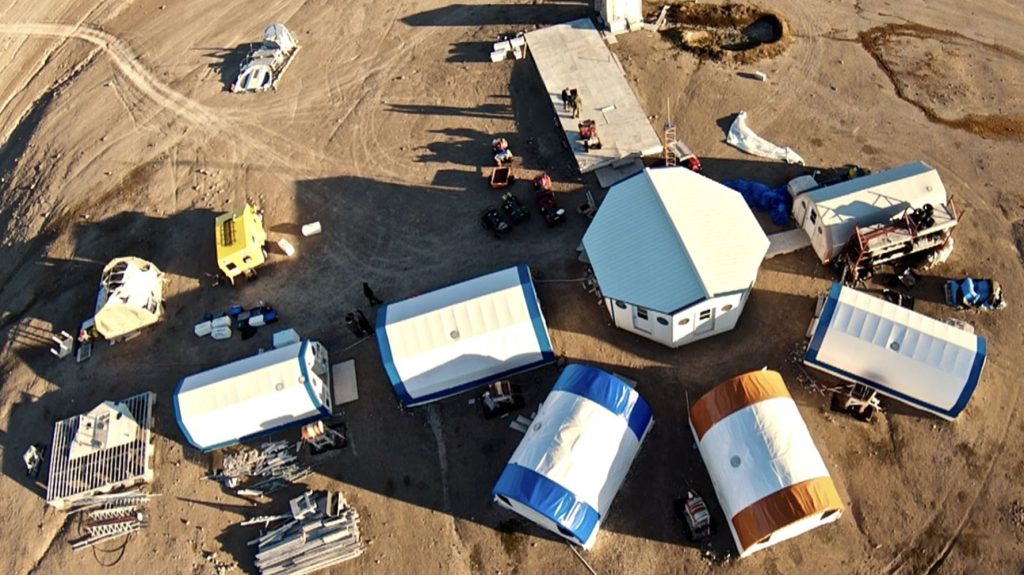
Image: Drone view of the Haughton-Mars Project Base Camp located on Devon Island in the High Arctic. Credit: HMP/Pascal Lee.
The National Space Society recently awarded a $15,000 grant to the Haughton-Mars Project (HMP) in support of their 2024 Apollo Fellowship and STEM (Science, Technology, Engineering and Mathematics) education activities. The NSS grant funds are derived from a 2019 grant to NSS from the Club For the Future.
The Haughton-Mars Project is a NASA and private sector-supported, U.S.-based international planetary analog field research project sited on Devon Island in the High Arctic. It is dedicated to advancing the future scientific exploration of the Moon and Mars by robotic systems and humans. Devon Island is the largest uninhabited island and largest single expanse of polar desert on our planet. The terrain is not snowy or icy in the project’s summer season, but rather a wide, largely lifeless expanse of red rock, physically mimicking the surface of Mars.
“The Haughton-Mars Project is a global leader in planetary analog field science and exploration, and I am glad that the NSS is able to contribute to, and partner in, the project’s Apollo Fellowship and other STEM education activities,” said Dale Skran, COO of the National Space Society. “Well-designed Mars analog field work supports both the exploration and eventual human settlement of Mars.”
Established in 1997, the HMP is led by Dr Pascal Lee, planetary scientist at the SETI Institute, Mars Institute, and NASA Ames Research Center, and professor of planetary sciences at Kepler Space University. Dr Lee is also a recipient of the NSS’s 2023 Space Pioneer Award for Mars Science and Engineering and is currently serving as a member of the National Academies’ Steering Committee on a Science Strategy for the Human Exploration of Mars.
The HMP-2024 Apollo Fellowship was awarded to Nicolas Mahoume, a master’s graduate student in aerospace engineering at the Technical University of Delft in the Netherlands. Mahoume and his academic advisor, Prof. Sebastiaan de Vet, are working with Lee to understand the nature and scale of geologic terrain features on Mars that would benefit the most from aerial exploration by robotic rotorcraft. The field research was conducted with customized drones.
“I’m grateful to the National Space Society for its generous support of the Haughton-Mars Project, our Apollo Fellowship program, and our other STEM education endeavors,” said Lee. “The success of humanity’s future on the Moon and Mars depends on training highly qualified explorers who will have acquired the needed experience in surviving, performing, and thriving in extreme environments, doing scientific fieldwork and advancing exploration.”
Other HMP-2024 STEM activities enabled by the NSS award include live interactions from the field with remote students across the U.S. and the anticipated presentation of the HMP-2024 Apollo Fellowship research results and STEM activities at the NSS’ International Space Development Conference (ISDC) in Orlando, Florida on June 19-22, 2025.
For more information on the Haughton-Mars Project and its Apollo Fellowship Program, visit their website or their NASA website.