
Share:

Facebook
X
Pinterest
LinkedIn

Previously, we looked at the Europeans Space Agency (ESA) and their ATV program, which is preparing to send their resupply spacecraft, Johannes Kepler, to the International Space Station on 15 February.

Now, we look at the Japanese Aerospace Exploration Agency (JAXA) and the recently completed launch and capture of the Kounotori spacecraft.

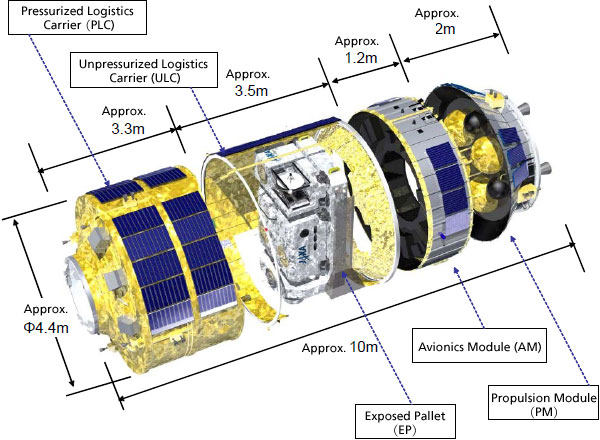
HTV-2 ATV-2
HTV-2 "Kounotori"
Image Credit: Japan Aerospace Exploration Agency (JAXA)

The external exposed cargo includes a Flex Hose Rotary Coupler and Cargo Transport Container. These spare parts will be transferred to External Logistics Carrier 4 after it is installed during the Discovery STS-133 mission.

The pressurized cargo space is carrying 2,928 kilograms of supplies and equipment:

  • 630 kilograms of crew provisions
  • 1,626 kilograms of research equipment and supplies
  • 609 kilograms) of station hardware
  • 49 kilograms of computers and supplies
  • 14 kilograms of spacewalking equipment and supplies

Among the new research equipment will be the Japanese Kobairo gradient heating furnace for generating high-quality crystals from melting materials, an Amine Swingbed technology demonstration that will look at ways to revitalize the air on space vehicles, and the International Space Station Agricultural Camera, which will take frequent images, in visible and infrared light, of vegetated areas on the Earth.

HTV2
Canadarm2 Captures HTV2
Image Credit: NASA

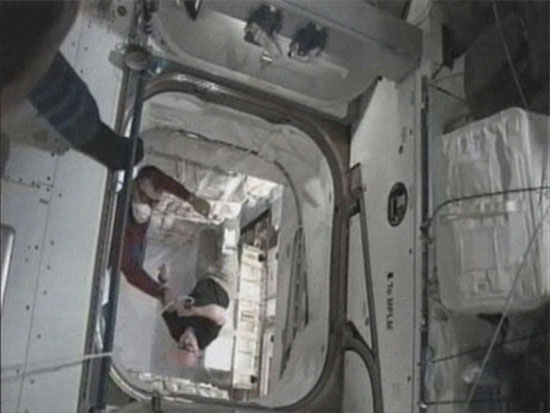
Hatch Open
Removing cargo through the hatch on HTV2
Image Credit: JAXA

Share:

Facebook
X
Pinterest
LinkedIn
Picture of By National Space Society

By National Space Society

1 thought on “Japan and Support of the International Space Station”

Leave a Comment

Don't Miss a Beat!

Be the first to know when new articles are posted!

Search
Categories

Follow Us On Social Media

JOIN THE
GREATEST ADVENTURE

Give The Gift Of Space: Membership For Friends and Family

Book Review

desigining farms in space

Book Review: Designing Farms in Space

Meyer’s academic textbook is loaded with numerous photographs, diagrams, charts, and graphs. There are chapters on subjects such as farm machines, animal and fungi production, plant and algae production, and space menus. The farming techniques outlined in the book can be applied to lunar, Martian, or rotating space settlements.

Read More »
Archives


Hilton McLean Tysons Corner, McLean, Virginia
June 4 - 7, 2026

Recent Blog Posts

Meyer’s academic textbook is loaded with numerous photographs, diagrams, charts, and graphs. There are chapters on subjects such as farm machines, animal and fungi production,...
The Tianwen-2 spacecraft at asteroid 469219 Kamoʻoalewa is reportedly positioned to begin the most critical phase of its deep-space mission, preparing to sample the asteroid....
NSS continued its commitment to developing the next generation of space leaders through two programs created specifically for university students and early-career professionals: Speed Mentoring...
The National Space Society’s annual International Space Development Conference concluded on June 7 and was widely praised by attendees, with one of the best domestic...
Apogee Books has reissued its volume on Surveyor for the program’s 60th anniversary. The book is a wonder, containing a veritable treasure trove of documents...
Each year, the “NSS 30 Under 30” program will honor 30 individuals under the age of 30 who are making meaningful contributions across the full...

The National Space Society invites you to the next Space Forum Thursday, June 18, 2026, 8:00 pm to 9:15 pm EST NOTE NEW TIME! The...

For the first time, the space elevator track at ISDC expanded to two sessions: the morning dedicated to powering the space elevator and the afternoon...

Your Doorway to New Worlds