
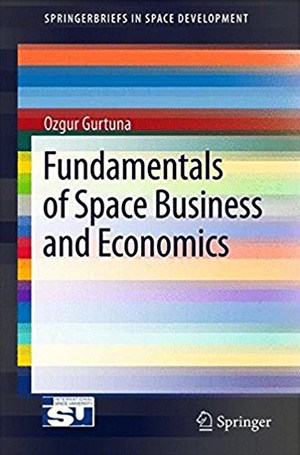
Category: Non-Fiction
Reviewed by: Jim Plaxco
From Ad Astra Winter 2013
Title: Fundamentals of Space Business and Economics
Author: Ozgur Gurtuna
NSS Amazon link for this book
Format: Paperback
Pages: 104
Publisher: Springer/Praxis
Date: April, 2013
Retail Price: $49.95
ISBN: 978-1461466956
Space is not just a frontier for exploration. It is also a frontier for business—a frontier composed of unique challenges that thus far have hindered growth. As the commercialization of space becomes increasingly important for the long-term growth of the industry, it follows that an understanding of the relevant economics and business challenges will be key to understanding that market’s dynamics. Published in collaboration with the International Space University, Fundamentals of Space Business and Economics by Dr. Ozgur Gurtuna is a step along that path of understanding.
In stating that “Physics enables, policies dictates, and economics sustains,” Gurtuna makes it clear that for private space to grow and prosper, it must make sense economically. Gurtuna is of the opinion that the space industry is on the verge of a new wave of growth thanks to a combination of globalization, the rise of the private sector, and emerging space markets. Emerging space markets are those markets that have not been a source of significant economic activity to date but which could be a source of significant growth in the future. Three leading emerging markets are space tourism, on-orbit satellite servicing, and private space exploration. The emergence of these markets has the potential to support a new wave of infrastructure investment and the development of innovative goods and services.
That a suborbital tourism market exists is evidenced by Virgin Galactic’s 625 customers who have made prepayments of $200,000 per seat. Numerous market studies on space tourism appear to indicate an optimum ticket price of $50,000 per ticket, which would maximize industry revenue at $785 million from approximately 16,000 customers. Questions remain as to the industry’s ability to sustain the necessary levels of ticket sales year after year, but the establishment of a suborbital tourist market could lead to the creation of a suborbital point-to-point transportation market. Whereas a traditional flight from New York to Tokyo takes 13 hours, a suborbital flight would be less than two hours. Economies of scale and increasing system efficiencies should drive down ticket prices, which will further enlarge the entire suborbital market.
Currently the lack of economies of scale is a key reason why the unit costs of space systems are extremely high compared to other technological products. Economies of scale is one of the most powerful forces in economics, allowing production costs, like one-time R&D, engineering, design, and commercialization, to be divided across many units of production.
The author identifies seven such distinguishing features of space business: its cyclic nature; its linkage to defense; reliance on the government as its main customer; the “destination” problem; limited competition; a long investment horizon; and the curse of the single unit of production. These factors are also interrelated. For example, difficulty in obtaining financing is due to factors like the lack of economies of scale, very long development cycles, technical risks, and strict government regulations.
The author defines the “destination” problem as the lack of a need to serve any specific destination in space on a regular basis. Without a clear commercial need to establish a sustained presence on the Moon, Mars, or other location, the case for high volume production of launch vehicles will be limited, which will adversely impact economies of scale and the ability to lower costs.
To tie together the key business and economic factors, Gurtuna offers as a case study the feasibility of developing an on-orbit satellite servicing business. This study is used to illustrate the role played by factors like market analysis, product pricing, and cost and risk management.
Gurtuna ends his book by telling us, “It’s not all about business. What we learn through space activities can be exactly what we need to benefit from the vast natural resources of the universe and further expand our civilization. Space can help us enormously in understanding Earth as a ‘system of systems’ and developing its resources in a sustainable manner.”
My only complaint about this book is that it wasn’t longer. I would have appreciated a more in-depth exploration of the business and economic factors covered. However, the book’s brevity is a factor in its readability. Though touted as written for space professionals and for those with a business and/or economics background, the content is presented in a very straightforward, understandable manner, making this book an ideal introduction to the topic.
© 2013 Jim Plaxco
Please use the NSS Amazon Link for all your book and other purchases. It helps NSS and does not cost you a cent! Bookmark this link for ALL your Amazon shopping!








1 thought on “Book Review: Fundamentals of Space Business and Economics”
I am an instructional specialist for Katy ISD CTE in Katy, Texas. In addition to our STEM courses aligning with the space industry, we are establishing a program to encourage our over 100 Career and Technical courses to seek opportunities to educated our students on the commercial aspect of space travel which are on the horizon and to look at the vast array of careers found in the space industry. Katy is a large school district of 83,000 students, 23,000 which participate in CTE courses. Our close proximity to Johnson Space Center puts us in a great position to take advantage of the resources available.
We would like help finding contacts which can help guide us in our development. We are already partnering with the Texas Space Grant Consortium to create opportunities for teachers to experience space exploration for themselves and their classrooms.
Thank you