Category: Non-Fiction
Reviewed by: Loretta Hidalgo Whitesides
Reprinted from Ad Astra Spring 2007
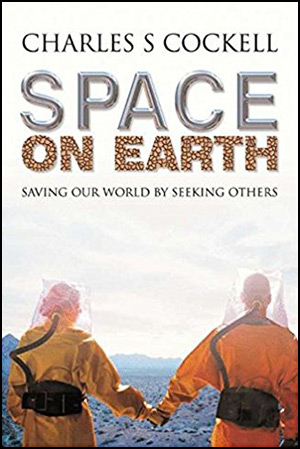
Title: Space on Earth: Saving Our World by Seeking Others
Author: Charles S. Cockell
NSS Amazon link for this book
Format: Hardcover
Pages: 186
Publisher: Macmillan
Date: 2007
Retail Price: $24.95
ISBN: 023000752X
“Environmentalists think that going into space detracts from solving problems here on Earth. Many space explorers feel that environmentalism hampers their exploration and settlement of space. Actually, environmentalism and space exploration have one and the same objective: to ensure humanity has a home.”
In the new book, Space on Earth, Saving Our World by Seeking Others, author Charlie Cockell explores one of the most under-addressed issues facing the space community today—the environment. What values will we take into space with us? How can we let the world know that space explorers care about saving the Earth too?
The first chapters of the book detail a variety of expeditions on Earth led by planetary scientists. These are great descriptions for the general space or science enthusiast who is interested in seeing what is being done in the field. Cockell uses this research to argue that space explorers should learn to love and protect Earth for its ability to offer humanity environments that it can use to prepare for the rigors of space; inform our search for extraterrestrial life and expand our understanding of planetary science.
Cockell then attempts to show why environmentalists should support space. He responsibly points out that while spinoffs don’t justify space, the things space exploration has made available, from communications to GPS and remote sensing, have made a huge difference not just in weather prediction (as Kennedy promised in 1961) but also in ozone monitoring and natural resource management. Examples are described such as the Guatemalan government’s deforestation tracking and the Los Angeles’ use of GPS detectors to study pre-earthquake activity. Although interesting, the section falls short of compelling environmentalists to support any activity in space beyond satellites.
What do both groups have in common? For one thing, these groups share the need to find sustainable ways to live. Cockell implores companies to make products hyper-energy efficient and from reusable or recyclable components that could be “dual use” for Earth and space, and to create homes that minimize toxic chemicals in the system. The book also looks at how space explorers can borrow legal language and framework from the environmentalists that could be used to keep space a green frontier.
The best part of the book is the “Greening of the Universe” chapter. It delves into the philosophical underpinnings of environmentalism and some interesting thought experiments on how far we should go with the conversation. It starts with a review of the major ideas, from the Romans’ view that life might have its own innate value beyond its perceived usefulness to humans, to the Christopher Stone’s idea that inanimateobjects such as rocks and rivers should be afforded legal rights. The chapter ends with a look at current planetary protection regulations developed by COSPAR and a look at the complexity of a decision to terraform Mars.
In the end, the book offers a few suggestions for how to expand the connections between the environment and space. The most interesting of these is to have the U.S. National Park Service designate areas as “Planetary Parks” to mark special regions of Yellowstone and Death Valley that are space analogues and share with visitors the area’s connection to outer space. Ultimately the goal is to create “Planetary Parks” in space to protect Martian poles, special lunar craters, Apollo landing sites, etc.
If you are interested in learning more about research being done in extreme environments, ways that space technology is being used to make a difference on Earth and the philosophical arguments that can be used to protect the rings of Saturn, you should read this book. Although not a complete answer to the question, Space on Earth goes a long way to reigniting an all-important discussion about space settlement and environmentalism—a discussion that couldn’t be any timelier.
© 2007 Loretta Hidalgo Whitesides
NSS Featured Review for May 2007
Please use the NSS Amazon Link for all your book and other purchases. It helps NSS and does not cost you a cent! Bookmark this link for ALL your Amazon shopping!