Category: Nonfiction
Reviewed by: Casey Suire
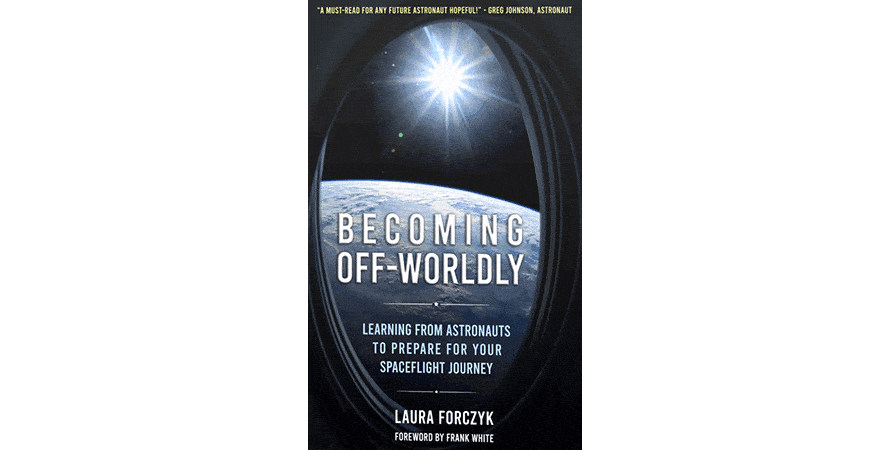
Title: Becoming Off-Worldly: Learning from Astronauts to Prepare for Your Spaceflight Journey
Author: Laura Forczyk
NSS Amazon link for this book
Format: Paperback/Kindle
Pages: 255 pages
Publisher: Astralytical
Date: January 2022
Retail price: $19.99/$9.99
ISBN: 978-1734462227
“If I can do this, you can do this.” That is what Hayley Arceneaux, a former patient and current physician assistant at St. Jude Children’s Research Hospital, told young patients about her historic Inspiration4 space mission. Anyone aspiring to follow in her footsteps should read Laura Forczyk’s book, Becoming Off-Worldly.
While short enough to read in one day, the book contains plenty of useful information for those wanting to personally experience either suborbital or orbital spaceflight. What will flying on a rocket be like? How about floating in a spacecraft while looking down at Earth? How will space affect me? How should I prepare? Forczyk, founder of the space consulting firm Astralytical, answers questions such as these throughout her book.
One intriguing topic Forczyk addresses early on is the definition of space itself. Where does it begin? What counts as a spaceflight? She notes that NASA, the FAA, and the United States Air Force all recognize an altitude of 50 miles (80 km) as the beginning of space. Others outside the United States use the Karman line, 100 km (62 miles) above the Earth’s surface. Interestingly, the original notes of Theodore von Karman, namesake of the Karman line, suggest the 80 km definition is more accurate. Some don’t bother with either definition. For example, Russia doesn’t consider suborbital missions to be real spaceflight.
Forczyk also gives her take on the word “astronaut.” Should passengers on private spaceships be given this title? Should another title like “space tourist” or “spaceflight participant” be used instead? In the book, she refers to all non-government space fliers as “private astronauts.” On occasions, she also uses “commercial astronauts.” In a century, it is her hope “that spaceflight becomes so accessible over time, we begin to think of space travel in the same terms as we do air travel: pilots, cabin crew, and passengers.”
Becoming Off-Worldly has two major attributes that make it worth reading. The first strength is the inclusion of current information on private spaceflight. Examples include Inspiration4 and William Shatner’s New Shepard flight, two events that occurred just months before the book’s publication. The second strength is that Forczyk interviewed an impressive collection of individuals that have either been to space or plan on going soon. Examples include NASA legends such as Story Musgrave, Eileen Collins, and Charles Bolden, early private spaceflight pioneers like Anousheh Ansari and Richard Garriott de Cayeux, and recent heroes like Wally Funk, Jared Isaacman, and Hayley Arceneaux. Many less famous figures are also interviewed, although their voices are just as important.
By interviewing actual space travelers, Forczyk has written a very credible book. Becoming Off-Worldly isn’t an opinion piece about the current state of spaceflight. Instead, readers will get an honest account of what space is really like. While the book generally has an upbeat tone about the spaceflight experience, it doesn’t hide some of the problems either. Some things, like objects floating away in microgravity, are just minor inconveniences. For example, Forczyk tells the story of how astronaut Cady Coleman lost a screwdriver aboard the International Space Station. Other aspects are more serious: How to mentally prepare yourself for the risk that comes with flying in space? What about the possibility of negative health effects? Forczyk admits she once got sick while flying on a zero-gravity aircraft.
She also does an excellent job of handling the controversy surrounding the “billionaire space race.” Early in the book, she acknowledges that the rich and well-connected will have an advantage over everybody else. However, she later criticizes “the ridiculous notion that billionaires want to escape Earth. That’s a science fiction movie, not the real world.” In the book’s media kit, Forczyk notes that only half of the private astronauts she interviewed were actually super wealthy. The other half were “researchers, science communicators, industry pioneers, and fortunate individuals.”
While it is true that private spaceflight will be very expensive for at least the immediate future, it can also create a lot more opportunities than a traditional government space program. One good example is scientific research. Space scientists don’t have to do all their work on the ground. Frequent private spaceflights can allow them to perform experiments while on location in space. Then there is age. Just last year alone, many records were broken for both the youngest and oldest individuals that have been to space. Another example is the relaxation of physical requirements. Before purchasing a seat on a Russian Soyuz vehicle, Richard Garriott de Cayeux was excluded from becoming a NASA astronaut simply for having poor eyesight. Times have changed dramatically since then. Forczyk briefly mentions Mission: AstroAccess, a venture aiming to fly disabled individuals on zero-gravity aircraft. Long-term, Mission: AstroAccess wants at least one of their team members to fly to space.
All private astronauts, regardless of the circumstances, must go through training. A training program for a suborbital flight might only last a few days. Preparation for an orbital mission is much longer, historically ranging from six months to two years. Whether one is in training or considering going up, it wouldn’t be a bad idea to read this book.
© 2022 Casey Suire
Please use the NSS Amazon Link for all your book and other purchases. It helps NSS and does not cost you a cent! Bookmark this link for ALL your Amazon shopping!