
By Dale Skran
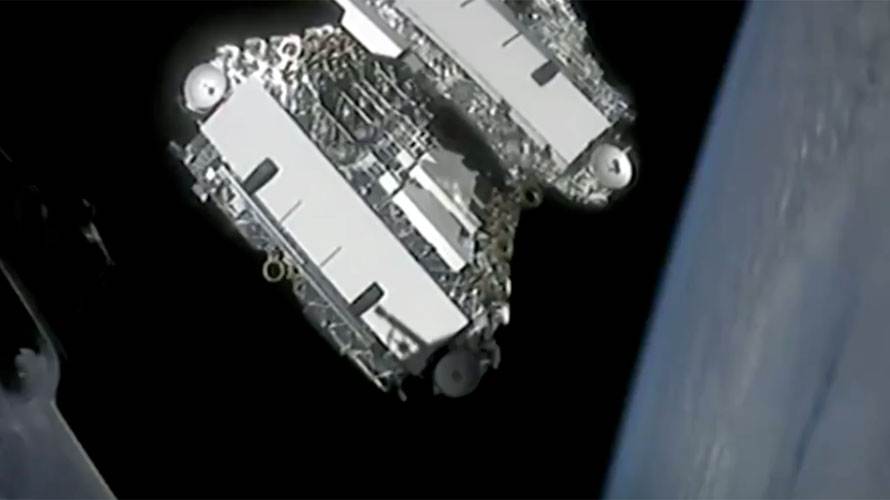
On Wednesday April 22 a SpaceX Falcon 9 launched another 60 Starlink satellites into orbit (see image above), bringing the total in the network to over 400, and allowing for initial service to northern latitudes. Other key facts on this launch include:
- This was the fourth flight of Falcon 9 first stage booster 1051.
- Both halves of the fairings on this flight were re-used from previous flights.
- So far this year, there have been seven Falcon 9 flights. NONE used a new first stage. There was 1 second flight, 1 third flight, 4 fourth flights, and 1 fifth flight.
- SpaceX has lost the first stage on the previous two Starlink flights, leading some to suspect that Starlink launches were “too hot” for routine first stage recovery via drone ship. With the successful landing at sea April 22 of the first stage, this streak was broken. Additionally, SpaceX announced the cause of the March 18th failure to recover the first stage—engine cleaning fluid got stuck in a crevice and later caught fire, leading to one engine shutting down. This kind of non-design problem is easily fixed.
Perhaps most significantly, this was the 84th Falcon 9 flight, making the Falcon 9 the most used operational U.S. launch vehicle, edging out the Atlas V. Fans of the Atlas V will point out that out that the two records are not identical—the Atlas V had one partial failure, while the Falcon 9 had one failure and one partial failure. Additionally, the Falcon 9 lost the Amos payload in a non-flight failure. Atlas V has had 73 successful flights since its partial failure, while Falcon 9 has had 56 successful flights since the Amos-6 loss in 2016. With the considerable difference in the Atlas V and Falcon 9 flight rates, we can anticipate that the Falcon 9 will pull even in the record of perfect launches, barring another failure, within no more than two years.
Fans of the Falcon 9 will respond that while becoming the most flown U.S. rocket, the Falcon 9 demonstrated operational first stage recovery, return to launch site first stage recovery, landing a first stage on a drone ship at sea, re-use of many first stages (one for five flights), fairing recovery and reuse, and significantly lower cost to reach orbit. The Falcon 9 is poised to return U.S. astronauts to space on May 27, 2020 with the first crewed Dragon 2 launch, yet another significant milestone for a vehicle sometimes derided by critics as Elon Musk’s “hobby rocket”.
©2020 Dale Skran













1 thought on “Milestones in the 84th Flight of Falcon 9”
“Hobby rocket” indeed. Some peoples’ “hobby rockets” are better than other peoples’ professional career rockets by far…. At last we’re getting CATS, Cheap Access to Space, something we hoped for, and reasonably EXPECTED fifty years ago! Reusability is the key to affordability. And that’s something that nasa’s billions of bucks didn’t give us. So sadddd to see they’re still in the game, working so hard with the old aerospace gluttons to keep the cost of lunar access out of the reach of us ordinary tax-paying people.