
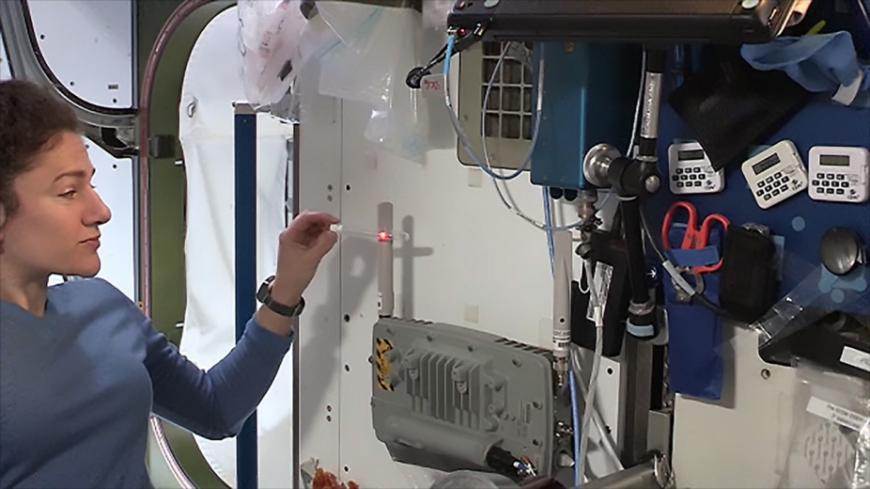
International Space Station astronaut Jessica Meir completed the first U.S. Naval Research Laboratory power-beaming demonstration in orbit February 12, 2020, using relatively simple components suitable for STEM activities.
Meir showed how NRL’s LEctenna™, a light-emitting rectifying antenna, converted a wireless network signal, similar to home networks, into electric power (see photo above and video below). While the current generated and light emitted was a small amount, the setup proved the concept in space.
“While this is a cool device on its own, our collaborators [at NRL] have begun investigating the wide range of possible applications for this technology in the real world,” Meir said. “We could find ways to wirelessly charge our mobile devices or remotely power drones. But one of the most interesting applications that they’re looking into is space-based solar panel arrays.”
4-minute video of wireless power-beaming demonstration on the ISS.
Led by electronics engineer Paul Jaffe, researchers at NRL are investigating space solar and power beaming as a potential source of clean energy for a variety of military and civilian applications.
Space solar is simply using solar panels in space to harvest the sun’s energy, where collecting rays would be unaffected by clouds or other interference. Power beaming would send the collected energy down to Earth, where it would be converted back—just like LEctenna™ did—to usable energy.
“Some people might know about power beaming, such as for their toothbrush, or putting their phones on a charging pad,” Jaffe said. “What’s really exciting about it though, is that power can be sent wirelessly over much larger distances.”
The LEctenna™ demonstration proved the concept of power beaming in space, but was primarily a STEM project to inspire the next generation of innovators launched by the Department of Defense Space Test Program mission. Its simple, relatively low-cost design to convert electromagnetic waves to electric power can be replicated by students.
“LEctenna™ was a cool demonstration to raise awareness,” said Elias Wilcoski, an NRL research physicist. “We want to show students that this is technology that they can do themselves. If we can get them excited about it and space solar and power beaming, we can help bring more scientists and engineers into the fields to ensure the viability of our future.”
See 3-minute video from the Naval Research Laboratory on how to build your own LEctenna for yourself or for school projects.






2 thoughts on “Power-Beaming Demonstrated on International Space Station”
Very cool technology with huge potential for relatively “green” power!
Perhaps this option has already been explored but even so I hope to invite some new discussion. Would it be wise and/or feasible to first focus on placing and using strategically located cislunar solar power satellites (or even nuclear power satellites) to beam power to electrically propelled spacecraft as they travel between the Earth and Moon, rather than initially directing that power to Earth? My understanding is that current electric propulsion technology can generate useful delta-v and that the Russians have been using electric propulsion on their satellites for years. With the quantity of electrical power a solar power satellite could provide without a big increase in spacecraft mass (as with on-board nuclear generators or big solar panels) perhaps other, more effective electrical propulsion methods could be used. Also, mass reduction could be achieved if consumable propulsion elements (for electrothermal propulsion systems) were available for “re-fueling” in orbit from Moon industrial activity. Minimizing the mass of a spacecraft by using an external power source would seem to be an advantage. If nothing else, providing power for satellites and eliminating the lift-weight and expense of on-board solar panels or power generators might be a way to cost justify building a solar power satellite in the short term. Thoughts?