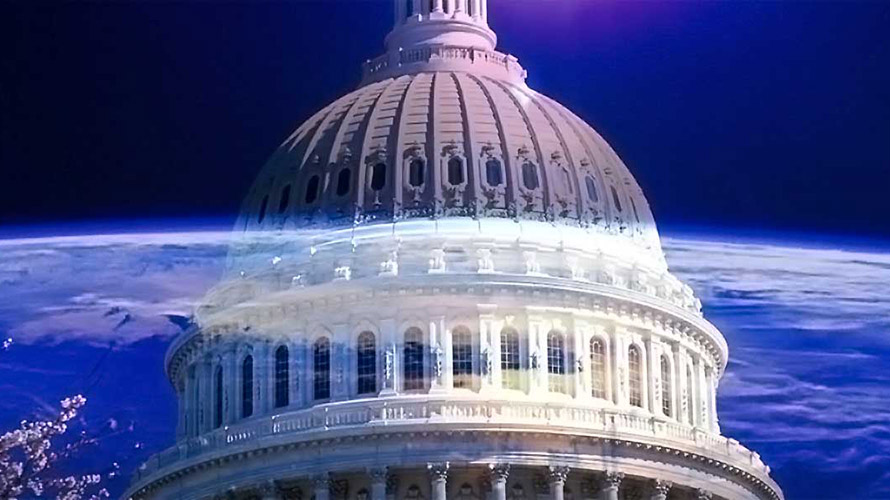
(Washington, DC) — On July 12 the House Committee on Science, Space, and Technology’s Subcommittee on Space and Aeronautics held a hearing entitled, “Spurring Economic Growth and Competitiveness through NASA Derived Technologies.” The purpose of the hearing was to highlight the direct economic and societal benefits that investment in NASA has generated and to examine how best to ensure that continued investments will maintain a pipeline for future economic growth. Testifying before the Subcommittee were Dr. Mason Peck, Chief Technologist at the National Aeronautics and Space Administration (NASA); Mr. George Beck, Chief Clinical and Technology Officer at Impact Instrumentation, Inc.; Mr. Brian Russell, Chief Executive Officer of Zephyr Technology; Mr. John Vilja, Vice President for Strategy, Innovation and Growth at Pratt & Whitney Rocketdyne; and Dr. Richard Aubrecht, Vice President at Moog Inc.
The technical challenges of NASA’s space exploration, space science, and aeronautics missions have necessitated the development of unique skills and capabilities and required significant technological advances. These advances have contributed directly and indirectly to America’s economic strength, capacity for innovation, and global competitiveness by permeating our everyday lives in ways that are not readily apparent to all Americans.
“This hearing serves as an opportunity to remind the public on the connection between the federal government’s investments in space and the benefits to society,” said Ranking Member Jerry F. Costello (D-IL) in his prepared statement. “These contributions developed important products, such as satellite radio, medical diagnostics and aeronautical advances that have improved the safety, and fuel-efficiency performance of both commercial and military aircraft. In carrying out its missions and developing these technologies, NASA also has inspired young people to enter educational and career paths in science, technology, engineering and mathematics.”
In addition, NASA investments have helped fuel the innovation economy by expanding the knowledge base of scientists and engineers who are building the technologies of the future. “Knowledge provided by weather and navigational spacecraft, efficiency improvements in both ground and air transportation, super computers, solar- and wind-generated energy, the cameras found in many of today’s cell phones, improved biomedical applications including advanced medical imaging and even more nutritious infant formula, as well as the protective gear that keeps our military, firefighters and police safe, have all benefitted from our nation’s investments in aerospace technology,” stated Dr. Peck.
Industry also benefits from continued investments in NASA, applying the knowledge used to create new technologies and the derivative technologies themselves to create new commercial opportunities. “NASA has played a very significant role in the development of leading edge technologies,” said Dr. Aubrecht. “These core technologies and knowledge have enabled much economic growth in the USA, not only in aerospace industries but in many other sectors of the economy who benefit from the new technologies. The model of NASA investing in really hard problems and challenging American companies has enabled the development of many core, pre-competitive technologies. This model is an example of where a Federal investment in technology development has an enormous impact on the overall economy.”
Focusing on how NASA could expand partnerships, such as that between the agency and General Motors, which resulted in such innovative technologies as the robotic glove, Rep. Clarke (D-MI) urged NASA to seek opportunities to partner with small businesses, academic institutions, and economic development organizations. Congressman Clarke also questioned witnesses on how start-up companies might engage with NASA. “There are many start-up companies in Detroit, Michigan that are eager to partner with NASA to create jobs,” stated Congressman Clarke. “I look forward to working with NASA to facilitate that collaboration and spur economic growth in metro Detroit.”