Category: Nonfiction
Reviewed by: Douglas G. Adler
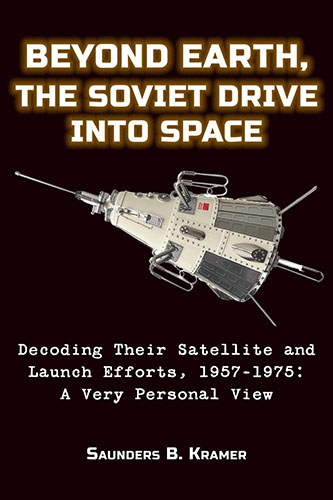
Title: Beyond Earth, the Soviet Drive into Space: Decoding Their Satellite and Launch Efforts, 1957-1975: A Very Personal View
Author: Saunders B. Kramer
Format: Softcover
Pages: 398
Publisher: Spacehistory101.com press
Date: July 2025
Retail price: $34.95
ISBN: 978-1887022897
Find this book
As someone who grew up enthralled by the exploits of NASA astronauts, the Soviet space program always held a special allure. While NASA went out of its way to provide copious information to the media and the press (as well as any youngster who wrote to them and asked for educational materials), the Soviet space program was shrouded in mystery. Little data was forthcoming (and what was revealed to the public was often viewed with skepticism), and there were very few books available to those who wanted to do a deep dive on space-related happenings on the other side of the iron curtain. Even now, over three decades after the fall of the Iron Curtain, only a small number of high-quality books on the Soviet space program are available in the West.
Enter into this fray, Beyond Earth, The Soviet Drive into Space: Decoding Their Satellite and Launch Efforts, 1957-1975: A Very Personal View by Saunders B. Kramer. Kramer, who passed away in 2005, was an engineer who worked in the aerospace industry and held a patent for an early space station design. The book is, essentially, Kramer’s diary and journal of Soviet space activity from the program’s inception until 1975.
Details of every Soviet launch, manned and unmanned, from this period are covered in significant detail. The information about launches is interspersed with details of his day-to-day life, interpersonal meetings, thoughts, ruminations, and conversations between Kramer and other people working in the aerospace community (both in the USA and the USSR), as well as observations, guesses, extrapolations, and interpretations of available information.
As the book essentially ends in the mid-1970s, there is no coverage of the later Salyut space stations, Mir, or the International Space Station (ISS). The Soviet Space Shuttle program is only touched on in the briefest of terms as it had not come to fruition during the period the book covers. Some of the information in the book has never been seen before and is very interesting, while other topics contain incomplete, or what would now be recognized as incorrect, information in light of what has been revealed in other books that have documented the Soviet space program after more information has become available.
Kramer was a dedicated chronicler of Soviet space efforts, and the amount of detailed information in the book is impressive to behold. Information about orbital inclinations, apogee and perigee, payload weights, and other details are produced for most flights, to the point that it can be overwhelming at times. Sometimes so many details are presented for the unmanned flights that the reader is left wondering what to do with, say, the 65-degree orbital inclination angle of the Kosmos 47 mission from 1964.
The fact that the book is both a chronicle of space missions and the author’s personal diary makes it lack a consistent tone. The reader bounces back and forth between dinner engagements with friends, the occasional self-promotion, asides on mathematics with equations covering a few pages at a time, and his opinions on different orbital trajectories so quickly that at times one can lose track of what type of book you are actually reading.
The book shines when discussing the Venera missions to Venus and the Lunokhod landers and rovers that the Soviets sent to the Moon. Discussion of the early Salyut space stations and the missions to them is also well done. The coverage of maneuverable satellites and anti-satellite weapons was also very interesting to read.
Overall, this is a dense book for a very niche audience – serious adult readers interested in the early Soviet space program, especially those who are interested in unmanned missions and hunger for a lot of technical details. As the period the book covers ended literally 50 years ago, there is likely little of interest here for younger readers or those who want a broad overview of Soviet and later Russian space missions.
© 2026 Douglas G. Adler