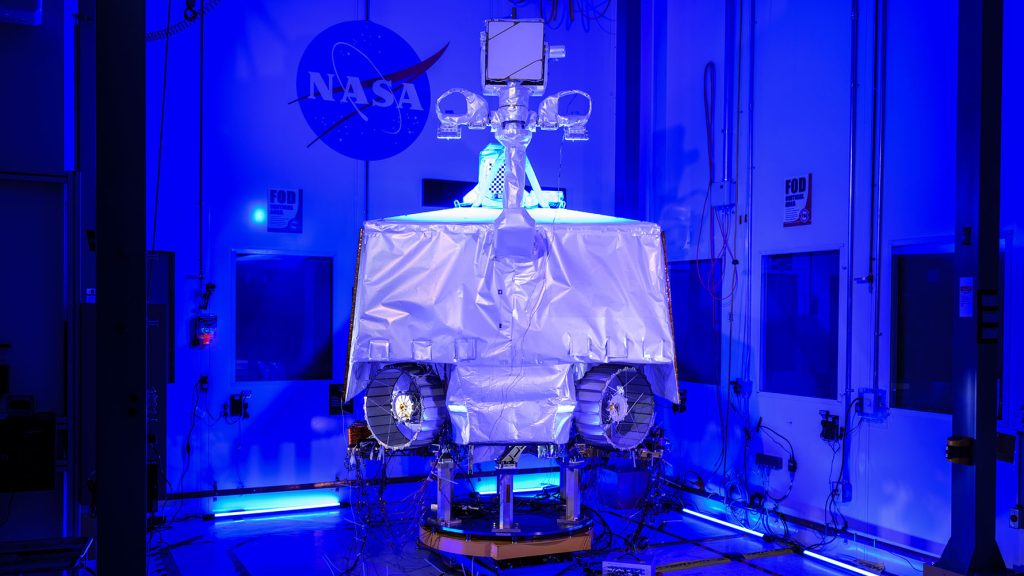
NASA’s VIPER — short for the Volatiles Investigating Polar Exploration Rover — sits assembled inside the cleanroom at the agency’s Johnson Space Center. Credit: NASA.
The National Space Society (NSS) celebrates NASA’s announcement that Blue Origin has been selected to deliver the Volatiles Investigating Polar Exploration Rover (VIPER – pictured above) to the lunar south pole. This decision ensures that one of NASA’s most important science and exploration missions will move forward, advancing humanity’s understanding of lunar resources and laying the groundwork for a sustainable human presence on the Moon.
VIPER is a cornerstone of NASA’s Artemis program, designed to locate and analyze water ice and other volatiles critical for in-situ resource utilization (ISRU). These resources will be essential for supporting long-duration lunar missions. NSS has long championed the continuation of VIPER, recognizing its transformative role in moving Artemis beyond a symbolic return to the Moon and toward a permanent, sustainable foothold in space.
In 2024, when NASA announced plans to cancel VIPER due to cost overruns and delays, NSS responded swiftly with its position paper, Supporting a Resilient ISRU Development Strategy after VIPER Cancellation. The Society urged NASA and Congress to preserve VIPER’s mission objectives, whether through NASA leadership or partnerships with commercial providers. NSS also advocated for a broader strategy that includes multiple small, low-cost rovers sourced from diverse providers, ensuring resiliency, redundancy, and expanded coverage of the lunar surface. This approach, aligned with NASA’s Commercial Lunar Payload Services (CLPS) program, reduces the risks of single-point failure while fostering innovation and entrepreneurship in the commercial space sector.
“The selection of Blue Origin to deliver VIPER is a victory for science, lunar exploration, and U.S. leadership in space,” said Grant Henriksen, Chair of the NSS Policy Committee. “It demonstrates the power of public-private partnerships to overcome challenges and keep critical missions alive. NSS is proud to have stood firmly for VIPER when its future was uncertain, and we will continue to advocate for resilient, cost-effective strategies that ensure the success of Artemis and the development of lunar resources.”
NSS also calls for continued investment in CLPS (Commercial Lunar Payload Services) missions, iterative rover development, and NASA’s commitment to purchasing ISRU-derived materials. These steps will accelerate the creation of a robust lunar economy, attract private investment, and ensure that the U.S. remains at the forefront of space development and exploration.
With VIPER now set to ride aboard Blue Origin’s Blue Moon Mark 1 lunar lander in 2027, NSS looks forward to the groundbreaking science and exploration that will follow. This mission will not only map and characterize lunar resources, but will also help to inspire the next generation of explorers and innovators who will carry humanity deeper into the solar system.









2 thoughts on “NSS Applauds NASA’s Selection of Blue Origin to Deliver VIPER to the Moon”
Congratulations Blue Origin for getting the opportunity to deliver the VIPER rover to the Lunar south pole. The VIPER is needed to obtain data on the amount and distribution of water in the Lunar regolith.
Water is a necessity for sustainability of life on any lunar base. Congrats to NASA, Blue Origin, and NSS. I continue to pray to the success of Artemis Program. -Dr. Sammy