The National Space Society takes great pleasure in awarding its 2014 Space Pioneer Award for the Science and Engineering category to the (Mercury) MESSENGER Team. MESSENGER stands for MErcury Surface, Space ENvironment, GEochemistry, and Ranging. This spacecraft entered an orbit around the planet Mercury and conducted an extensive scientific survey of the entire planet, the first human object to do so. With this award, NSS recognizes both the importance of the first dedicated probe to orbit Mercury and the significance of the scientific results already released.
The National Space Society will present the Space Pioneer Award to MESSENGER project representatives Drs. Sean C. Solomon, Larry R. Nittler and Ralph McNutt at NSS’s annual conference, the 2014 International Space Development Conference (ISDC). The conference will be held at the Sheraton Gateway Hotel in Los Angeles, CA. The ISDC will run from May 14-18, 2014.
About the MESSENGER Team:
The Principal Investigator for the Messenger Team is Dr. Sean C. Solomon. He also directs the prestigious Lamont-Doherty Earth Observatory at Columbia University. Dr. Larry R. Nittler is MESSENGER’s Deputy Principal Investigator. Dr. Ralph McNutt is MESSENGER’s Project Scientist. The historic achievements of the MESSENGER Team (after construction and launch of the spacecraft) include successfully placing the spacecraft accurately into its intended orbit around Mercury on March 18, 2011, after a series of six critical flybys of the Earth, Venus, and Mercury itself. Besides the critical contribution of accurately mapping Mercury’s surface, the science results have confirmed the presence of water ice and organic chemicals at the poles, and the fact that Mercury’s magnetic field is offset to the north substantially from its equator.
About the MESSENGER Mission:
MESSENGER confirmed suspicions of major regional volcanism and mapped global patterns of thrust fault scarps that show Mercury has contracted several times more than Mariner 10 data indicated. Global elemental and mineralogical mapping confirmed Mercury has a low-iron crustal mineralogy, but unexpectedly showed sulfur, potassium and other volatile elements are abundant, upsetting high temperature models of Mercury’s formation. MESSENGER has discovered pitted “hollows” with bright halos, found in many craters, which appear to involve volatile loss but their formation mechanism remains enigmatic.
About the Space Pioneer Award:
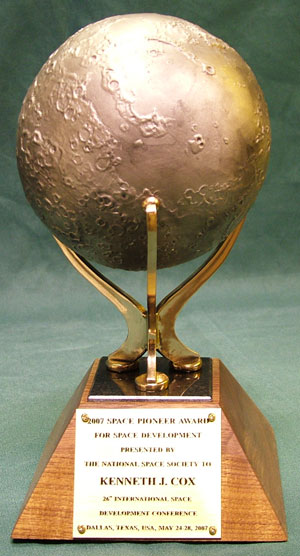 The Space Pioneer Award consists of a silvery pewter Moon globe cast by the Baker Art Foundry in Placerville, California, from a sculpture originally created by Don Davis, the well-known space and astronomical artist. The globe, as shown at right, which represents multiple space mission destinations and goals, sits freely on a brass support with a wooden base and brass plaque, which are created by Michael Hall’s Studio Foundry of Driftwood, TX. There are several different categories under which the award is presented each year, starting in 1988. The NSS Awards Committee has been chaired by John Strickland since 2007 and its members seek prestigious award candidates on a continual basis.
About the ISDC: The International Space Development Conference (ISDC) is the annual conference of the National Space Society bringing together NSS leaders and members with leading managers, engineers, scientists, educators, and business people from civilian, military, commercial, entrepreneurial, and grassroots advocacy space sectors.