
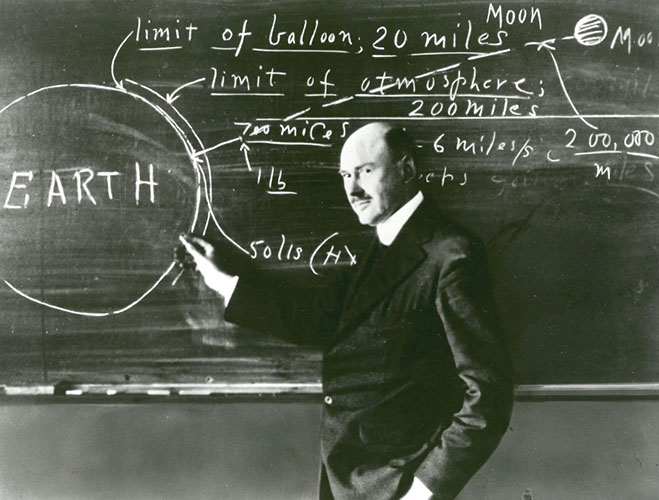
On July 17, 1969, The New York Times published one of the most unusual corrections in its history. Forty-nine years earlier the paper had mocked physicist Robert H. Goddard for suggesting that rockets could travel through the vacuum of space. As Apollo 11 was on its way to the Moon, the paper quietly acknowledged its mistake and noted that rockets could indeed function in a vacuum. The Times concluded simply: “The Times regrets the error.”
It was a remarkable moment of irony. As humanity began its first journey to another world, the newspaper that had once ridiculed one of America’s earliest rocket pioneers was forced to admit that he had been right all along.
The correction came far too late for Goddard, who had died in 1945. Even in 1969 many Americans, except those connected to science and engineering—would not have recognized his name. Much of his work had been conducted quietly and away from public attention, and during his lifetime he remained largely unknown outside technical circles. NASA did honor him by naming its Goddard Space Flight Center in Maryland after him in 1959.
One hundred years ago today, on March 16, 1926, that same quiet pioneer conducted an experiment that would ultimately change the course of human history.
A Short Flight That Changed Everything
On a snow-covered cabbage field belonging to his Aunt Effie Ward in Auburn, Massachusetts, Goddard launched the world’s first liquid-fueled rocket. It rose only 41 feet, traveled 184 feet, and remained in flight for just 2.5 seconds. Yet in that brief moment the foundations of modern rocketry were established.
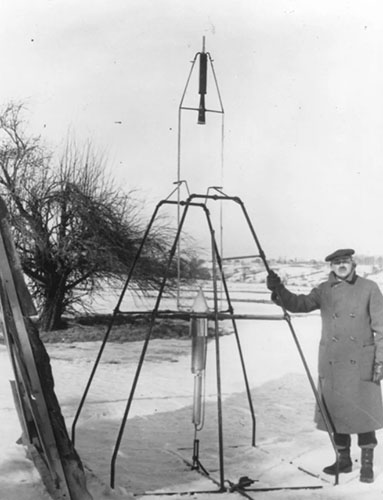
The rocket itself was modest by any measure. Fueled by gasoline and liquid oxygen, it weighed about ten pounds and stood roughly ten feet tall. The engine and nozzle were mounted at the top, with the propellant tanks below. Goddard believed this configuration would provide greater stability, somewhat like balancing a stick on a fingertip.
When the rocket finally lifted from the launch frame, it accelerated quickly before curving into a nearby patch of snow and ice, ending its short but historic flight.
Goddard recorded the event with characteristic understatement in his diary: “Tried rocket at 2.30. It rose 41 feet & went 184 feet, in 2.5 seconds.”
Those few seconds quietly marked the birth of liquid-fueled rocketry. Rockets that followed, from the German V-2 of World War II to the Saturn V that carried Apollo astronauts to the Moon, and today’s Space Launch System that will return astronauts there—rely on principles first demonstrated in that early experiment.
Vision Before the Technology
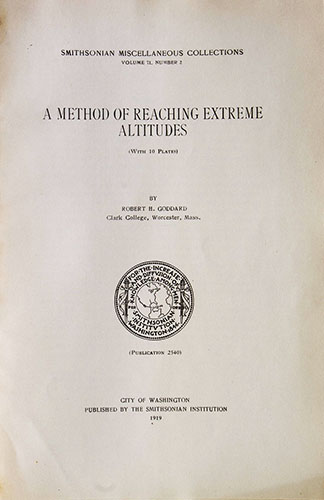
Goddard’s ideas had been developing for years before that flight. In 1919 he published a Smithsonian paper titled A Method of Reaching Extreme Altitudes. In it he examined the physics of rocket propulsion and calculated how rockets could reach extremely high altitudes. The paper even considered the possibility of sending a rocket to the Moon carrying a flash powder that could be seen through a telescope. The technical work was sound, but the suggestion of a lunar rocket captured the imagination of the press.
On January 13, 1920, The New York Times ran an editorial titled “A Severe Strain on Credulity.” The article mocked Goddard and suggested that he did not understand the basic physics of rocket propulsion. The paper argued that rockets could not operate in the vacuum of space because there would be nothing for them to push against.
The criticism reflected a misunderstanding of Newton’s Third Law. Rockets do not need air to push against. They work by expelling mass in one direction, producing an equal and opposite reaction that propels the vehicle forward. This principle works equally well in a vacuum.
The editorial became one of the most famous scientific misjudgments in journalism. For Goddard, however, the impact was personal. Already a reserved individual, he became even more cautious about publicizing his work. Much of his later research took place quietly, often with limited funding and little public recognition.
A Lifetime of Innovation
Despite these challenges, Goddard continued to pursue the technology he believed would eventually open the door to space.
Over the course of his career he secured 214 patents related to rocket propulsion and guidance systems. Forty-eight were issued during his lifetime, and an additional 131 were granted after his death based on the detailed notes and designs he left behind.
Many of the concepts that define modern rocketry first appeared in Goddard’s work. These included liquid-propellant engines, multi-stage rockets, gyroscopic guidance systems, turbopumps for feeding propellants into combustion chambers, and cooling systems that allow rocket engines to withstand extreme temperatures.
Taken together, these innovations form the engineering foundation of modern launch vehicles.
The Dream Begins in a Cherry Tree
Goddard’s interest in space began long before his Auburn experiments. In October 1899, when he was seventeen years old, he climbed a cherry tree in his yard to prune dead branches. While sitting in the tree he looked across the countryside and imagined building a machine that could travel to Mars.
The moment left such an impression on him that he later referred to October 19 as his personal “Anniversary Day.” From that point forward he dedicated his life to developing the technology that might make such journeys possible. At the time the dream of spaceflight seemed far removed from practical engineering. Yet Goddard believed rockets offered a path forward.
Goddard’s path to rocketry ran through physics and teaching. He earned his bachelor’s degree from Worcester Polytechnic Institute in 1908 and later completed his master’s and doctorate at Clark University in Worcester. After joining Clark’s faculty, he began turning his theoretical work into practical experiments, building and testing rocket components while continuing his research and teaching. It was during these years that the ideas outlined in his 1919 Smithsonian paper began to evolve from calculations into working hardware. While at Clark, Goddard even conducted early rocket experiments on campus, once launching a small powder rocket from the basement of the physics building.
Roswell and the Road to Modern Rockets
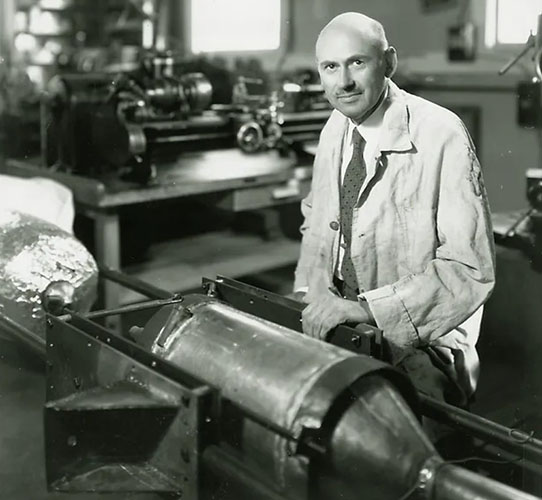
In the 1930s Goddard moved his research operations to Roswell, New Mexico, where the open terrain and clear skies allowed him to conduct more ambitious experiments. There he launched a series of increasingly advanced rockets. Some achieved supersonic speeds and demonstrated active guidance systems capable of controlling a rocket’s trajectory during flight.
One of the individuals who recognized the importance of Goddard’s work was Charles Lindbergh. After learning about the rocket experiments, Lindbergh visited Goddard and helped secure financial support from the Guggenheim family. The funding allowed Goddard to expand his research program in New Mexico and continue developing the technologies that would later become standard in rocket engineering. Although much of his work remained little known to the public, it laid important groundwork for later developments in rocketry.
The Path to the Moon
The connection between Goddard’s early experiments and later space achievements is unmistakable. When Apollo 11 astronauts traveled to the Moon in 1969, they were flying atop the Saturn V, a massive liquid-fueled rocket that relied on many of the same principles Goddard had explored decades earlier.
Buzz Aldrin carried a small copy of Goddard’s autobiography to the lunar surface as a tribute to the pioneer whose work had helped make the mission possible. By that point the scale of rocketry had grown dramatically. Goddard’s first rocket weighed about ten pounds. The Saturn V weighed more than six million pounds at liftoff. Yet the underlying physics remained the same. In a very real sense, the Saturn rockets were descendants of that small vehicle launched from the Auburn cabbage field.
A Foundation for the Future
For Goddard, rockets were never the final goal. They were tools that might someday allow humanity to explore beyond Earth. A century after his first liquid-fueled rocket rose briefly into the Massachusetts sky, the trajectory he began continues to shape the future of space exploration. The rockets that launch today are larger and more capable, but they still rely on the principles he demonstrated in 1926.
Today we are entering a new era of exploration. Missions are preparing to return astronauts to the Moon, new spacecraft are being developed to explore our solar system, and commercial companies are expanding access to space in ways that were once unimaginable. These efforts build upon the engineering foundations that Goddard helped establish a century ago.
The centennial of Goddard’s first rocket flight is also being marked in ways that look toward the future. To celebrate the anniversary, the National Space Society helped launch the Goddard 100 Student Contest, inviting students to explore the history and future of rocketry through research, design, and creative projects. The goal is not only to commemorate Goddard’s achievement, but also to encourage the next generation of scientists, engineers, and explorers who will build upon the foundations he established a century ago.
For organizations such as the National Space Society, that future includes the long-term goal of humanity becoming a true spacefaring civilization, expanding human presence throughout the solar system.
Goddard understood how new ideas are often received. He once wrote, “Every vision is a joke until the first man accomplishes it; once realized, it becomes commonplace.” A hundred years after that first rocket flight, the vision he pursued so patiently continues to move humanity outward toward the future he imagined.






3 thoughts on “Goddard’s First Liquid-Fueled Rocket Turns 100”
If you want to learn more about the Goddard 100 Student Contest – go to – https://www.goddard100.org/
Lt Col Scott Royce, who founded our air museum worked on the Apollo Moon rocket. He also said he met Goddard over the subject of guidance many years ago. Since Scott was an aircraft designer and flew B24s during WW2 it may be true.
Wonderfully written article, thank you.