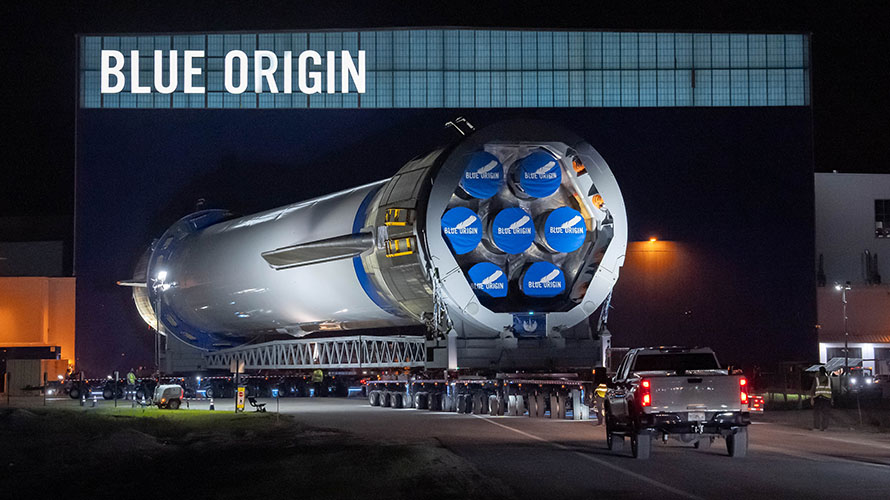
Image: New Glenn first stage (courtesy Blue Origin)
By Burt Dicht
NSS Managing Director of Membership
In the early hours of January 16, I stood among fellow space enthusiasts on the shore in Cocoa Beach, about to witness something truly special—the first launch of Blue Origin’s New Glenn rocket. As the countdown reached zero at 2:03 a.m. EST, the night sky erupted in light. The sheer power, the sensory overload of sight and sound—it’s an experience that, for me, never gets old.

This was my third first flight—having previously witnessed SLS Artemis I in 2022 and the ULA Vulcan last year—but the thrill remains indescribable. Every rocket launch is a feast for the senses, an overwhelming blend of engineering, technology, raw power, and beauty. Yet, there’s something profoundly different about watching a first launch—the moment a new vehicle transitions from concept to reality, marking a milestone in spaceflight history. As New Glenn roared into the sky, the crowd erupted in joy and celebration.
Named after John Glenn, the first American to orbit Earth, New Glenn is Blue Origin’s heavy-lift vehicle, designed for reusability and high-capacity payload delivery. It boasts impressive capabilities:
- Payload Capacity: Over 13 metric tons to geostationary transfer orbit (GTO) and 45 metric tons to low Earth orbit (LEO).
- Reusability: The first stage is designed for a minimum of 25 flights.
- Engines: Seven BE-4 engines, each providing 550,000 lbs of thrust.
- Payload Fairing: At 7 meters in diameter, it offers twice the volume of traditional 5-meter fairings.
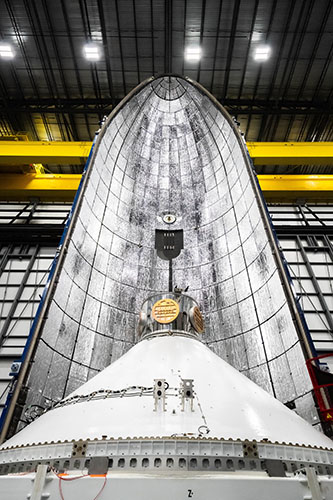
Towering at 321 feet, New Glenn is one of the largest rockets in existence. Its first stage BE-4 engines use liquid oxygen (LOX) and liquefied natural gas (LNG), while the second stage, powered by two restartable BE-3U engines (each producing 320,000 lbs of thrust), runs on LOX and liquid hydrogen (LH₂).
For its maiden voyage, New Glenn had two primary goals:
- Achieve orbit – a critical milestone for any new launch vehicle.
- Test the Blue Ring Pathfinder – an experimental payload platform for future missions.
Blue Origin confirmed that New Glenn’s second stage successfully reached its final orbit following two burns of the BE-3U engines. The Blue Ring Pathfinder is performing well and receiving data.
While the first-stage booster was intended to land on a recovery vessel, it unfortunately did not make it. However, this does not diminish the mission’s historic success—a new heavy-lift rocket has officially entered the market.
Blue Origin CEO Dave Limp reflected on the mission, saying:
“I’m incredibly proud New Glenn achieved orbit on its first attempt. We knew landing our booster, So You’re Telling Me There’s a Chance, on the first try was an ambitious goal. We’ll learn a lot from today and try again at our next launch this spring. Thank you to all of Team Blue for this incredible milestone.”
New Glenn lifted off from Space Launch Complex 36 (SLC-36) at Cape Canaveral Space Force Station. This 306-acre launch complex, just nine miles from Blue Origin’s manufacturing site, was rebuilt from the ground up with over $1 billion in investment. Completed in 2021, SLC-36 is the first newly rebuilt launch complex since the 1960s and has a storied history—hosting over 140 Atlas II/III launches, including the Mariner, Pioneer, and Surveyor missions. Today, it serves as the home of New Glenn’s launch pad, vehicle integration, and propellant facilities.


With New Glenn now in orbit, Blue Origin has taken a major step toward expanding commercial and deep-space launch capabilities. Its large payload capacity, reusable first stage, and innovative design position it as a strong competitor in the growing government and commercial spaceflight sector.
Congratulations to Team Blue on this incredible achievement! Spaceflight is hard, and first launches are never perfect—but what matters is progress. The journey of New Glenn has only just begun.
As I watched the rocket disappear into the clouds, I was reminded once again why I love spaceflight. The raw power, the anticipation, the excitement, and the history unfolding in real time—it never ceases to amaze me. Standing on the beach, feeling the shockwaves ripple through the air, is an experience that words can barely capture.