
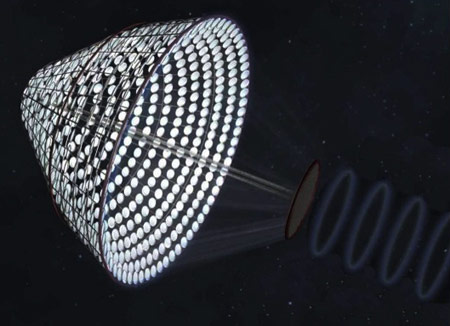
The NASA Innovative Advanced Concepts (NIAC) program has issued a grant to John Mankins of Artemis Innovation Management Solutions for a study of space solar power. SPS-ALPHA (Solar Power Satellite via Arbitrarily Large Phased Array) is a novel, bio-mimetic approach to the challenge of space solar power. If successful, this project will make possible the construction of huge platforms from tens of thousands of small elements that can deliver remotely and affordably 10s to 1000s of megawatts using wireless power transmission to markets on Earth and missions in space. The selected NIAC project will enlist the support of a world-class international team to determine the conceptual feasiblity of the SPS-ALPHA by means of integrated systems analyses, supported by selected “proof-of-concept” technology experiments.







1 thought on “SPS-ALPHA: The First Practical Solar Power Satellite via Arbitrarily Large PHased Array”
I’m still waiting for John to explain how he’s going to avoid causing a Kessler syndrome in GEO.
For those of you who are not aware of the problem, GEO is filled with junk that periodically crashes into working satellites. When that happens, new junk is spalled off that crashes into other satellites. Although the problem isn’t as bad as it is at LEO (or sun synch), its still bad. Bad enough that Donald Kessler (yes, THAT guy), has essentially stated that SPS’s are a huge risk. Or to quote him exactly:
“Some of the most environmentally dangerous activities in space include large constellations such as those initially proposed by the Strategic Defense Initiative in the mid-1980s, large structures such as those considered in the late-1970s for building solar power stations in Earth orbit”
I sent John all the figures, and his response suggested that he abandoned LEO-to-GEO spiralling launches for that reason. But even if you go straight to GEO, at enormous cost, you’re only delaying the inevitable. We’re talking about *very* short expected lifetimes, and then *pow*.
I find it ironic that the NSS would support a project who’s successful placement would almost be certain to render future manned space exploration too risky to contemplate.