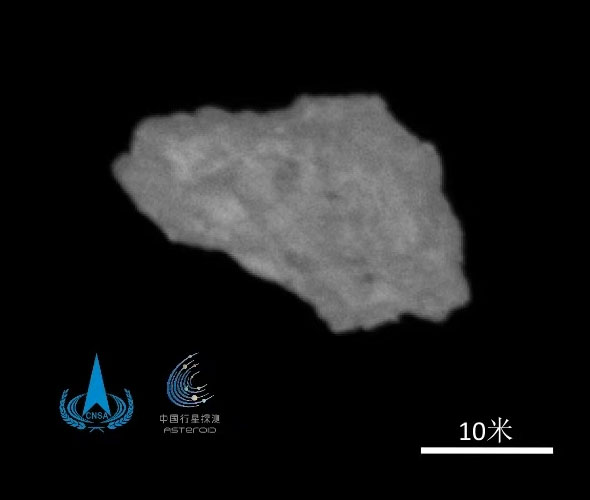
The National Space Society (NSS) congratulates the Japan Aerospace Exploration Agency (JAXA) on the successful launch of Hayabusa 2 December 2, 2014, at 11:22 PM EST on the Japanese H-IIA booster. Hayabusa 2 is planned to arrive at asteroid 1999 JU3 in July 2018, gather samples for about a year and one half, and return those samples to the Earth in 2020. The first Hayabusa craft gathered samples from the Asteroid Itokawa in September 2006 and returned them to Earth in 2010. Hayabusa 2 sports many improvements over the first probe, and carries a MASCOT Lander and three MINERVA Rovers.
Asteroid Itokawa is an S-type asteroid, meaning that it was of stony composition. A sample return from Asteroid 1999 JU3, a C-type (carbonaceous) asteroid, represents a major advance in our understanding of the availability and distribution of resources in the solar system. C-type asteroids are dark relative to other asteroids, and are believed to contain sources of water. Water can be used both to sustain human life in space, as well as to provide rocket fuel and store energy for later generation of electricity via fuel cells.
The utilization of asteroidal resources is a key step toward space settlement as described in the NSS Roadmap to Space Settlement which can be found at: nss.org/settlement/roadmap. The success of the Hayabusa 2 will represent a significant step toward the realization of the NSS Roadmap, and will help allow asteroid mining companies such as Planetary Resources (planetaryresources.com) and Deep Space Industries (deepspaceindustries.com) to advance their plans more quickly.
Hayabusa’s characterization of a C-type asteroid will also aid in deflecting similar asteroids should one threaten Earth. The data gathered will help understand the structure of such asteroids which is key to choosing a deflection technology. This contributes to the goals of the NSS policy on defense from cosmic threats described in the position paper at tinyurl.com/planetarydefense.
NSS Executive Vice President Paul Werbos summed up the situation: “We congratulate JAXA on the successful launch of Hayabusa 2, and wish them much success on this vital mission. Japan is to be commended for a steady focus on challenging robotic asteroid missions that are helping to bring the human settlement of space a bit closer.” Paul Werbos’ biography can be found at nss.org/about/bios/werbos.html.