
By Alfred Anzaldua
NSS Executive Vice President
The National Space Society (NSS) notes the groundswell of space advocacy groups and entities decrying the lack of commercial provisions in House NASA Authorization bill (H.R. 5666). Provisions for flexibly leveraging commercial space companies are crucial for making the U.S. space effort dynamic and sustainable. The following are four examples of recent documents from space advocacy leaders pointing out crucial flaws in H.R. 5666:
- The Commercial Spaceflight Federation, representing over 85 member companies in a January 27 letter to the House
- Letter from 17 concerned scientists posted January 31
- A February 1 Daily Kos article: “There’s a bipartisan bill authorizing NASA to go to Mars … it deserves a bipartisan defeat”
- NSS January 27 Press Release
NSS again joins others in noting that the terms of H.R.5666 are overly prescriptive and ignore the enormous potential of our dynamic commercial space industry, which, if fully and wisely utilized, could speed humans on to the Moon, Mars, and the rest of the solar system to tap into the vast resources of space.
We call on the U.S. House Committee on Science, Space, and Technology to engage in a transparent process with NASA, industry, academia, and space advocates to formulate a bill that will unleash the creativity and dynamism of our burgeoning commercial space industry for social and economic benefit. We stand ready to work with House members for that purpose.
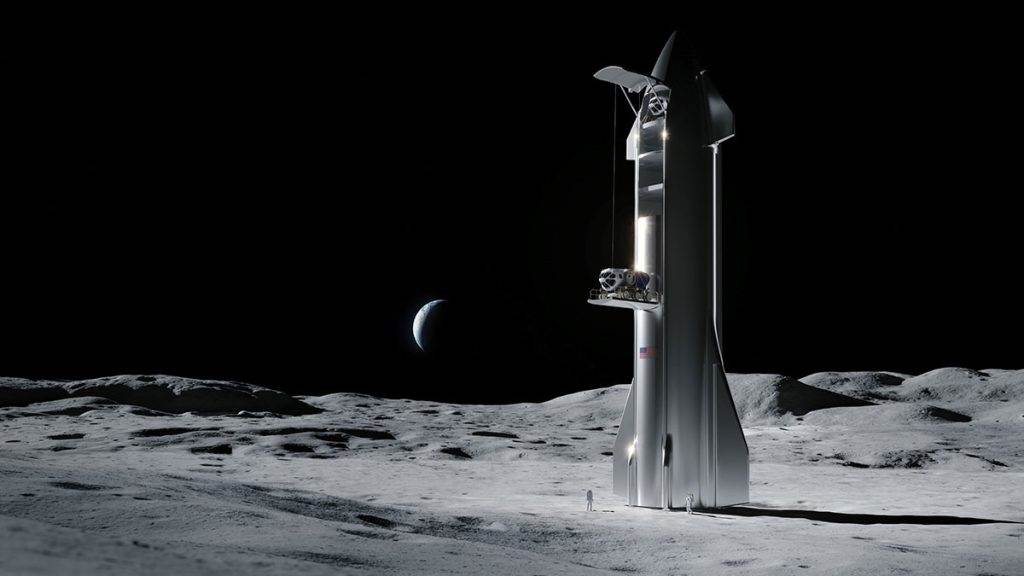
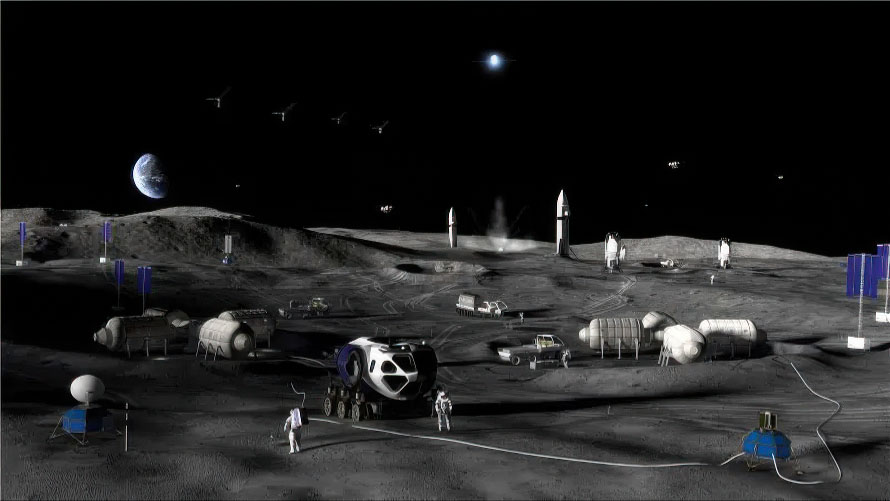
Image: SpaceX concept for Commercial Lunar Payload Services







6 thoughts on “Groundswell Critical of House NASA Authorization Bill H.R. 5666”
A commercial space industry as envisioned by millions of people over the decades will enable people of all backgrounds to see the wonders of space for themselves.
Many of us have looked up at night, with our own eyes and sometimes a telescope, and imagined what it must be like to circle the Earth at Low Earth Orbit and witness the marvels of space minus lights and noise.
Cost will always be an impediment if options are not available that would allow people to visit space. Humans are explorers by nature as evident by our accomplishments over centuries. Where a handful will lead, others will follow.
Nice pic. Needs 4 or 5 landing pads, which can be built from local dirt by early Artemis crews.
Space development cannot continue as an act of charity on behalf of Congress. We need an economic basis which the Moon can provide. The resources of the Moon can drastically lower the cost of entering space and open the way for space tourism. The raw material of the Moon can be processed in space to provide us with low cost solar cells. On the ground these cells can provide daytime energy conserving our Natural Gas supply and extending the life of our Gas powered electric generators. In time we will be able to broadcast power from space at a cost competitive with nuclear power.
I agree we need an economic basis to create incentives to develop space travel capabilities, but I don’t see how the US government going back to the Moon (as opposed to going to Mars) provides that. If companies see a way to extract resources from the Moon, I don’t see a reason they would need a US space station on the Moon to exploit them.
On the other hand, a one-way mission to Mars creating a permanent human colony there – which would grow over time – would inherently create more economic demand from the public to travel to Mars, and would give Mars a population interested in developing and exploiting Martian resources for their own use.
They would develop habitats and settlements there, and private citizens from Earth may even be interested in traveling there. And Mars has a lot more of the resources and circumstances needed to sustain a permanent human settlement than the Moon.
It’s true that the Martian colony would need supply shipments from Earth for a while to become more self-sustaining; but that’s part of the beauty of the plan: people of Earth wouldn’t want to leave Martian colonists stranded there. There would be a humanitarian need to send supplies there, and that would increase political support for providing funding for additional trips to Mars to send supplies.
At some point the Martian colony would become self-sufficient and would grow in population until it was a sufficient size that there would be a desire for interplanetary commerce, which would provide more economic motivation to develop private space travel capabilities.
Space must be a philosophical and political commitment, initially by the few in power, later by the general population. It will not be inexpensive or fast, and pretending otherwise would be either naive or a lie.
It COULD be done quickly if there was the political will to do so. The reason it is proceeding slowly is because the general population just doesn’t care that much.