Category: Non-Fiction
Reviewed by: Jeff Foust
Courtesy of The Space Review
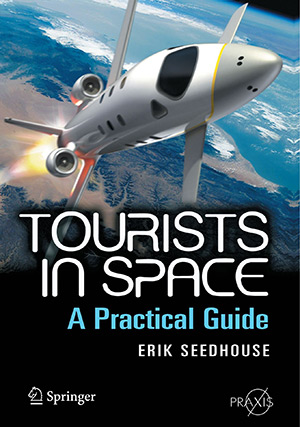
Title: Tourists in Space: A Practical Guide
Author: Erik Seedhouse
NSS Amazon link for this book
Format: Paperback
Pages: 314
Publisher: Spinger-Praxis
Date: March, 2008
Retail Price: $34.95
ISBN: 0387746439
Over the last several years, the concept of personal spaceflight (aka space tourism) has gained acceptance from the broader public, even if the development of the vehicles intended to serve this new market has lagged. What was once treated with winks and giggles and guffaws is now given serious consideration not just by the space industry but the much larger travel and tourism industry as well. So much so that someone can publish a book with the title Tourists in Space: A Practical Guide and have it treated as just that: a nuts-and-bolts look at suborbital and orbital space tourism, particularly for those people considering signing up for a ride into space.
The book’s author, Erik Seedhouse, sports impressive credentials: he has a Ph.D. in physiology, served in the Canadian Navy, was an astronaut training consultant to Bigelow Aerospace, and is a world-class athlete to boot. Given that background, it’s not surprising he spends much of the book examining the human factors issues associated with spaceflight. While he does provide some background and history about space tourism, and profiles some of the leading developers and operators of commercial orbital and suborbital flights (as well as, at the end of the book, looks at what the future of space tourism might hold, in the form of journeys to Mars and other solar system destinations), the bulk of the book goes into considerable detail about what sort of training prospective spaceflight participants (to use the official FAA terminology, as Seedhouse does in the book) should undergo, and why.
Seedhouse goes beyond simply describing the training process: he includes in the book detailed, albeit notional, training schedules for both suborbital and orbital spaceflights. For suborbital flights, he includes a five-day training syllabus that includes classroom instruction, centrifuge and hyperbaric training, and a zero-g aircraft flight, concluding on the fifth day with the actual suborbital spaceflight. The orbital training syllabus, by comparison, lasts five weeks, and includes additional classroom work, simulator runs, and even survival training. To indicate the level of detail he has put into these syllabi, the schedules he includes in the book include details as small as when lunch and coffee breaks occur. A large chunk of the book—nearly 150 pages—is devoted to the materials for the orbital flight training alone.
If there’s one flaw in Tourists in Space: A Practical Guide, it’s that the training materials are too detailed. The personal spaceflight industry is still in its earliest stages, and the companies, organizations, and regulatory agencies involved are still figuring out what level of training is necessary for spaceflight participants, and how to go about providing that training. Moreover, any thought of any kind of standardized training is still many years down the road. However, for those particularly curious about space tourism—curious enough, and wealthy enough, to consider plunking down $200,000 or $25 million or more for a flight—Tourists in Space: A Practical Guide may be a good investment to see what they’re getting into.
© 2008 Jeff Foust
Jeff Foust is the editor and publisher of The Space Review.
Please use the NSS Amazon Link for all your book and other purchases. It helps NSS and does not cost you a cent! Bookmark this link for ALL your Amazon shopping!