Category: Non-Fiction
Reviewed by: John F. Kross
Reprinted from Ad Astra Fall 2005
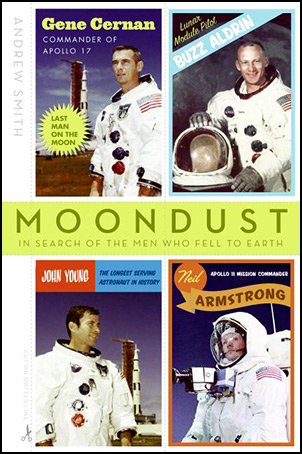
Title: Moondust: In Search of the Men Who Fell to Earth
Author: Andrew Smith
NSS Amazon link for this book
Format: Hardbound
Pages: 372
Publisher: HarperCollins
Date: November, 2005
Retail Price: $24.95
ISBN: 0007155417
In his book, Moondust, Andrew Smith serves up a perfectly executed, astute and moving meditation on the meaning of that vivid, psychedelic period from 1969 to 1972 when a dozen men walked on another world. Through a crisply dramatic account—part memoir, part social commentary, and part manhunt—the author pokes at the faintly glowing embers of a generation that grew up being promised the Moon, but had to settle for monotonous orbital pole sitting instead.
The bones of Apollo have been picked cleaned for 30 years with every rivet and resolution catalogued. But Smith is after bigger quarry—the meaning of Apollo—and launches a search for the men at its center. Smith’s mission—splendidly realized in this hypnotic book—is to seek out the surviving moonwalkers.
Their clouds of glory have faded and the clouds of Moon dust lay still but Smith tracks them down, and confirms the 60’s era slogan, “Eagles never flock.” Nor does it seem do they play well together. Most still eye each other warily across the gulf of thirty years.
They peck and flap an occasional wing at each other, but still impress the lesser flocks, including the author. They are, in fact, an imposing lot, Smith writes, and, astonishingly, came back from the Moon more like they already were. “Whatever they took with them,” writes Smith, “they brought back ten-fold, like coals crushed to diamond.” Yet for most, the pull of the Moon remains and tugs gently—sometimes wistfully—on their minds, souls, and imagination.
There’s Ed Mitchell still exploring the benign “noetic” resonance he experienced, and Buzz Aldrin and John Young with their prosaic plans to return. There are Al Bean’s acres of painted canvases trying to recapture “what it was really like” to stand there and Gene Cernan’s rehashing his memoirs endless memory loop for another audience.
Even Jack Schmidt, the un-emotive geologist, yearns to exploit Helium 3 captured in the lunar soil. But it is Only in Dave Scott and, ironically, Neil Armstrong who according to the author, no longer seem to feel does the attraction of the Moon appear to have waned, not waxed. Armstrong, Smith observes, has spent thirty-five years running from us and it though the first man on the Moon does sally forth occasionally to support space and aviation initiatives he favors.
The author describes his encounter with each moonwalker in mesmerizing—sometimes poignant—detail with an artist’s eye for eccentricity (Young sits “like a chameleon hunched on a branch” during an interview). Thus, it’s all the more jarring when Smith commits factual errors, having Ed White die mere months after his spacewalk on Gemini 4, when, in fact, he lived another year and half in the rarified air of training for the first Apollo mission before he and his fellow astronauts Roger Chaffee and Virgil “Gus” Grissom perished succumbing to the combustible atmosphere inside his in the Apollo 1 capsule fire in 1967.
But such discrepancies aside, Smith is after bigger game, namely, what did Apollo really mean and why does it—and these men—still fascinate?
It’s hard to re-create those times now, the times that shaped Apollo and our reaction to it. In fact, Smith hints that the task is harder still because the cultural scene changed—some would say transmogrified—over the decade of the 60s. By the time Armstrong and Aldrin landed on the moon, Normal Mailer could credibly claim that Apollo was a psychedelic experience that connected earnest young engineers and hippies because “both had no atmosphere surrounding them,” by which he meant that they had lost their connection to the Earth.
In a way, Apollo was full of contradictions, Smith writes. The first and “most fundamental…being that the war against tyrannical communism was designed and built by…an amoral opportunist” (an uncharitable swipe at von Braun).
But Smith doesn’t stop there, decrying the 60s-era “planned obsolescence” of Apollo which “killed ‘manned’ deep-space exploration, stone dead, for at least the next four decades and probably many more.” If those contradictions weren’t enough, Smith casts Apollo as a cautionary tale “about that most fundamentally human of human tragedies…wanting something so badly that you end up destroying it.”
Yet for all that, Apollo remains irresistible to the author. Like life and death and sex and art, Apollo can repel, but ultimately attracts. “For all Apollo’s technological wonder” Smith writes, “it was as primitive as a song. It meant nothing. And everything.”
The product of scientists and engineers and their lean rationality was like a great work of art that transcended the logic at its core. The “childish wonder” of Apollo, far from being an impediment to understanding, had been the whole point of it. And the moonwalkers? They were, in Smith’s eyes, mirrors in which we reflected our own childish delight and wonder, and that fascination says more about us—the lesser flocks—than the dozen eagles that landed there.
© 2005 John F. Kross
See also Tierney O’Dea’s review of the book
Please use the NSS Amazon Link for all your book and other purchases. It helps NSS and does not cost you a cent! Bookmark this link for ALL your Amazon shopping!