Category: Nonfiction
Reviewed by: Clifford R. McMurray
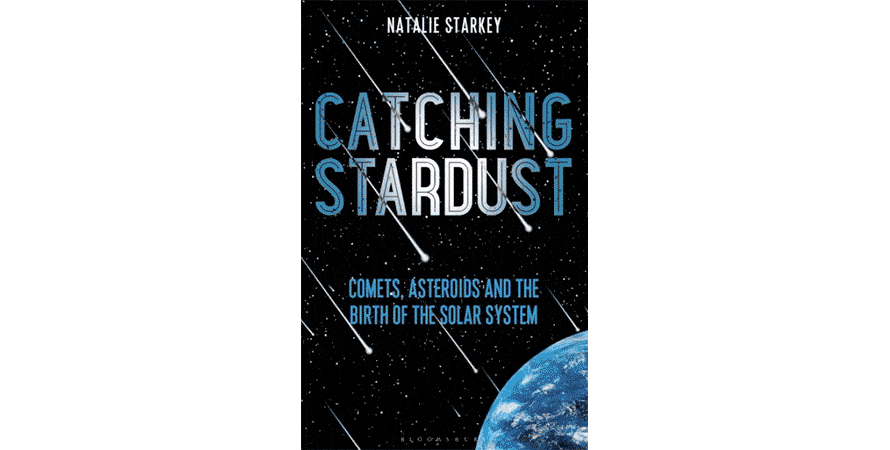
Title: Catching Stardust: Comets, Asteroids and the Birth of the Solar System
Author: Natalie Starkey
NSS Amazon link for this book
Format: Hardcover, Kindle
Pages: 256
Publisher: Bloomsbury Sigma
Date: June 2018
Retail Price: $27.00/$9.99
ISBN: 978-1472944009
Asteroids and comets are the keys to our past and our future. They are the last relatively pristine samples of the nebula of interstellar gas and dust from which our solar system was formed, they are full of the resources we’ll need to settle the solar system, and unless we learn how to deflect them when their orbits inevitably intersect with Earth, they’ll eventually become the instruments of our extinction, as they have already been for most of the species that have lived on Earth in the past.
Natalie Starkey is a geochemist who has analyzed samples collected by the NASA Stardust mission to a comet and the Japanese Space Agency (JAXA) Hayabusa sample return from asteroid Itokawa. She was a co-investigator for one of the instruments on European Space Agency (ESA) Rosetta probe, the first mission to land on a comet. In this book she shares her enthusiasm for the scientific investigation of these bodies, and what they tell us about our own origin.
Before we were able to send probes out to take close-up measurements of asteroids and comets, and even return samples for study on Earth, scientists had to work with the limited information they could get through telescopes and the bits of cosmic debris that survive passage through our atmosphere. The samples were heavily biased in favor of stones that could survive the heat of passage through Earth’s atmosphere at several miles per second. We knew that asteroids and comets contain water and organic chemicals—in fact, the Late Heavy Bombardment phase of solar system formation, in which many comets and asteroids were swept up by the planets, may have seeded Earth with water and the building blocks of life. But those parts of the meteors, still falling to Earth at the rate of about 100 tons per day, are vaporized before they get to the ground. Now, with probes and sample return missions such as those in which Starkey has participated, we get to see unaltered fossils of the first solidified bits of the solar nebula. The solar system is over four billion years old, but these bits date back to the first few tens of millions of years in our history.
Starkey first takes us through the story of the formation of the solar system as scientists understand it, and then shows how the space missions of the last few decades have changed what they thought they knew, and threw complications and questions into simple theories. The plot has thickened considerably. Objects thought to have formed in one part of the solar nebula may have formed somewhere else entirely before migrating to the places we find them today. That even goes for the biggest objects in the solar system, the gas giant planets, including Jupiter.
The missions Starkey describes show the adventure of science, as well as some of the unforeseen problems that can arise when doing things for the first time. The Hayabusa sample collection device didn’t trigger at the right time, so it captured a much smaller sample than scientists had hoped for. Yet the instruments that could be brought to bear on this tiny sample when it got back to Earth were so powerful that they could learn a lot. Likewise, the Philae lander on the Rosetta mission to Comet Churyumov-Gerasimenko hit its planned touchdown point perfectly, but the surface was unexpectedly hard, so it bounced back into space and landed at a shadowed location so its solar cells couldn’t recharge its batteries. Nevertheless, it managed to return some useful data.
This is an interesting book that could have been better in the hands of a better writer. Starkey’s prose is at times clumsy and annoyingly repetitive. She’s no Carl Sagan. The subject matter is sufficiently compelling to make this only a minor irritation, but it doesn’t stop me from noticing, and wishing for a more skilled narrator. For the time being, this book is the best account we have of some of these pioneering missions.
© 2018 Clifford R. McMurray
Please use the NSS Amazon Link for all your book and other purchases. It helps NSS and does not cost you a cent! Bookmark this link for ALL your Amazon shopping!