Category: Nonfiction
Reviewed by: Peter Spasov
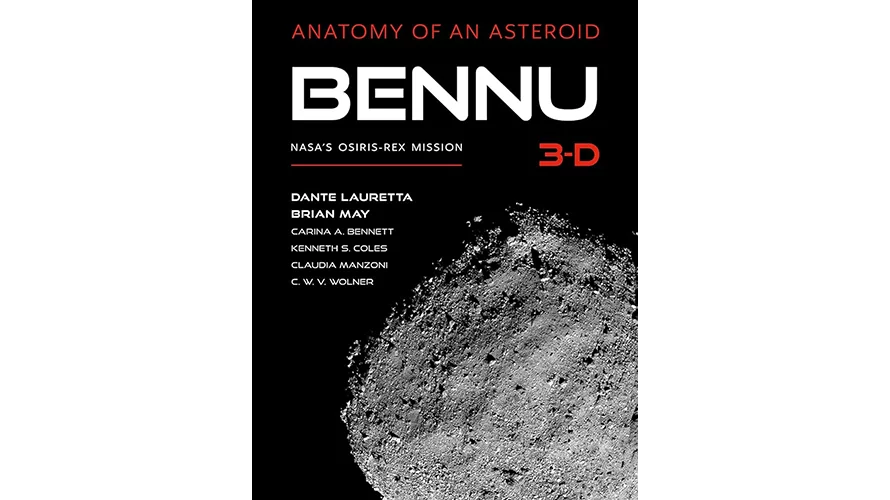
Title: Bennu 3-D: Anatomy of an Asteroid
Authors: Dante S. Lauretta, Brian May, Carina A. Bennett, Kenneth S. Coles, Claudia Manzoni, Catherine W. V. Wolner
Format: Hardcover, Kindle
Pages: 208
Publisher: University of Arizona Press
Date: July 2023
Retail Price: $50.00/$40.00
ISBN: 978-0816551767
Find this book
On September 24, 2023, the OSIRIS-Rex mission successfully delivered a sample of the asteroid Bennu to Earth.
This book allows the general reader to learn more about this fascinating world. Bennu 3-D: Anatomy of an Asteroid chronicles the mission and highlights features of the asteroid. The book’s back cover includes a 3D viewer with which the reader may view the stereo images taken by the spacecraft while it orbited Bennu.
Bennu is the most studied asteroid to date, a seventy-three billion kilogram globe of rubble held together by tenuous gravity. Over months, NASA’s un-crewed OSIRIS-REx spacecraft mapped its surface features to a precision of five centimeters per pixel.
This is a very foreign world. Walking upon the surface would be akin to stepping into a playpen of plastic balls. Regolith tends to slide ‘uphill’ towards the bulging equator because the centrifugal forces are nearly as strong as the low gravity there. As well, OSIRIS has detected organic molecules, implying that earlier Earth-colliding asteroids could have contributed to the origin of life. But, this asteroid may also become a destroyer of life. Bennu’s orbit crosses that of the Earth with a ‘slight’ chance of impacting our planet in 2182. Such a collision would release more energy than three times all the nuclear weapon detonations in history.
The book begins with a primer about asteroids. In particular, one section highlights the Yarkovsky effect, when sunlight affects the motion of asteroids. Next, chapter 2 introduces the sample and return mission, covering the extensive flight systems of the spacecraft. OSIRIS-REx stands for Origins, Spectral Interpretation, Resource Identification, and Security-Regolith Explorer. This seven-year mission launched on September 8, 2016 and involved an Earth slingshot maneuver in order to match the plane of Bennu’s orbital inclination. After orbital insertion, the spacecraft continually circled Bennu in a manner akin to weaving a virtual web in order to map the asteroid’s surface.
Chapter 3 describes Bennu itself, such as how the asteroid’s composition is determined by spectral emission techniques. Science has hypothesized that Bennu, with a nominal diameter of 484 meters, originated from a larger asteroid in orbit between Jupiter and Mars. About a billion years ago, a collision shattered this large asteroid to form smaller asteroids such as Bennu, consisting of fragments that have coalesced into a rubble pile held together by microgravity. Eventually, with the assistance of the fore-mentioned Yarkovsky effect, gravitational resonance flung Bennu towards its present-day Earth-crossing orbit. Pending collisions with Earth, Venus or Mercury, Bennu’s ultimate fate will be to spiral towards the Sun.
The following chapter extensively highlights various ‘named’ features photographed in high resolution, being larger boulders or craters. For instance, the boulder BenBen Saxum, at nearly forty meters high, protrudes well above the horizon. Another chapter takes the reader through an extensive search for a suitable sampling site. Prior to launch, the mission planners had designed for a suitable sandy site. Alas, upon arriving at Bennu, no such site was to be found. Few offered sufficient clearance from obstacles and larger rocks which could jam the sampling mechanism. Eventually a primary and backup site was chosen. The latter was necessary because an initial failure would stir up too much debris for another attempt at the same site.
A highlight of the OSIRIS mission was using the Touch-and-Go Sample Acquisition Mechanism (TAGSAM) when the spacecraft collected a sample of rock and dust. After a time-consuming descent and several adjustments, the TAGSAM touched down to penetrate the regolith and fired a burst of nitrogen gas to agitate the surface, hence directing regolith particles into a collection head. Six seconds later, after firing thrusters to begin the ascent, Bennu’s surface was disturbed even more than expected. Operations were fully autonomous. At mission’s end, a capsule would break away from the craft to return the sample to Earth’s surface (we now know successfully).
The final chapter, titled Atlas of Bennu, overviews the data collection methodology for building the basemap made from stitching together over two thousand images, while taking into account lighting, surface reflectivity and other factors. Following the chapter are twenty-eight high resolution photograph sections which make up the basemap.
The book contains extensive references, such as a surface features index, tables of Bennu’s properties, a list of references, and a glossary. Primary author Danate Lauretta is a Regents Professor in the Lunar and Planetary Laboratory at the University of Arizona, and Brian May is a visiting researcher of astrophysics and astronomy at Imperial College London (he is also the lead guitarist for Queen!). Carina Bennett, Kenneth Coles, Claudia Manzoni and Catherine Wolner have also contributed. This atlas, in this reviewer’s opinion, serves brilliantly as a treasured reference for armchair travelling among the asteroids.
© 2023 Peter Spasov