By Burt Dicht
NSS Space Coast Correspondent

HEADING HOME
Flight Day 8 in deep space
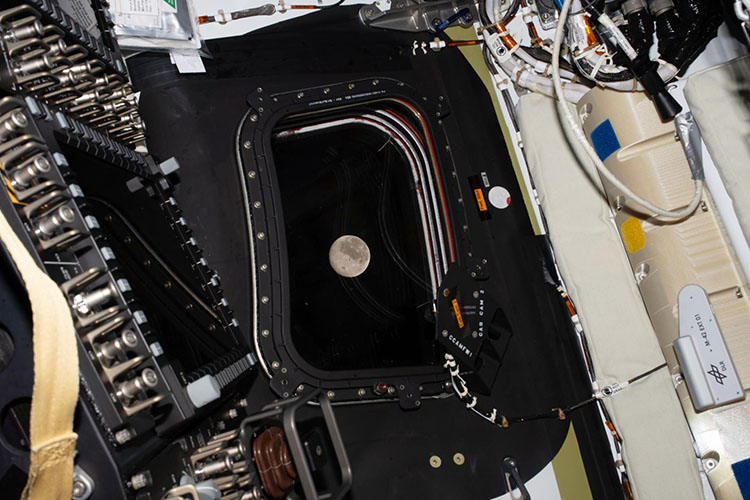
The Artemis II crew began Flight Day 8 at 200,278 miles from Earth, waking to “Under Pressure” by Queen and David Bowie. The day’s two primary test objectives were the orthostatic intolerance garment evaluation and a manual piloting demonstration, though flight controllers elected to forgo the manual piloting demo after a liquid oxygen pressurization issue in the service module was flagged for troubleshooting. The radiation shielding demonstration also stood down to allow the crew to begin preparing the cabin for reentry, with the team starting to stow equipment and install seats. The day closed with a 20-minute crew press conference, during which the astronauts reflected on the mission’s most memorable moments ahead of Friday’s splashdown off the coast of San Diego.
PILOTING DEMO SCRUBBED DUE TO TECHNICAL ISSUE
The second manual piloting demonstration, which was planned for Wednesday evening and would have involved all four crew members, was called off to give flight controllers time to troubleshoot a liquid oxygen pressurization issue in the crew ship’s service module that cropped up shortly after launch. Like many spacecraft, Orion uses pressurized helium to force propellants to rocket engines and thrusters. For redundancy, Orion is equipped with two interconnected oxygen manifolds, either of which can be isolated if problems develop.
RADIATION SHELTER — ALSO STOOD DOWN
To prepare the cabin for entry, teams opted to forgo the originally planned radiation shielding deployment demonstration. With reentry preparations now the priority, the cabin configuration needed to remain in order ahead of splashdown. The crew has also been preparing the cabin, studying entry procedures, stowing equipment, and installing their seats to make sure everything is secured for reentry.
ORTHOSTATIC GARMENT TEST — COMPLETE
All four crew members took turns testing and evaluating the orthostatic intolerance garment, designed to apply lower-body compression and stave off dizziness and fainting during their transition back to Earth’s gravity.
ORION — NO CONCERNS FOR REENTRY
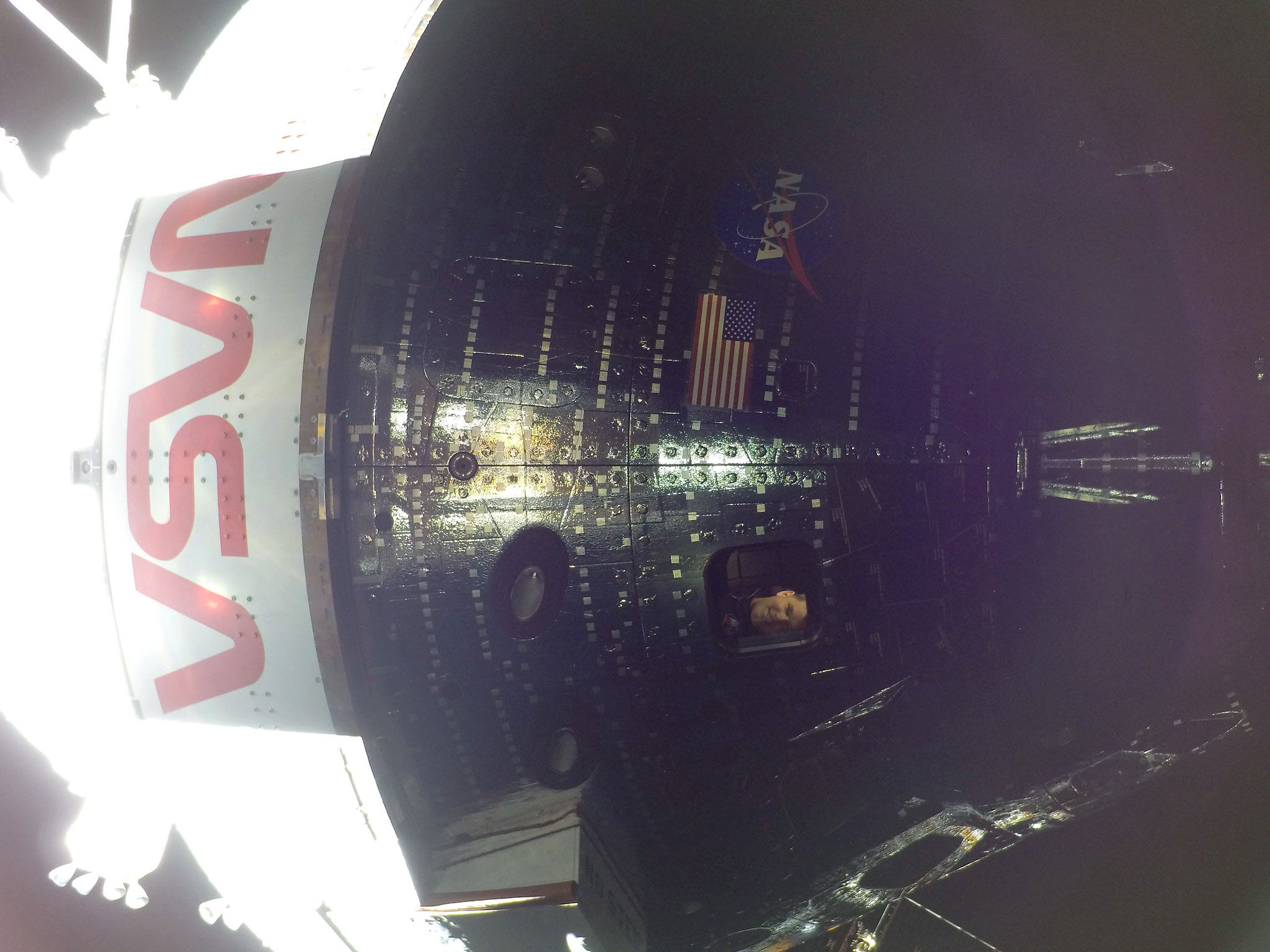
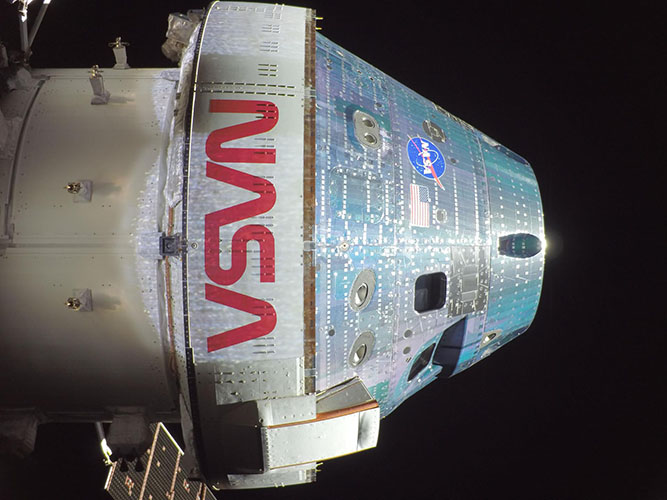
Engineers recently completed a final inspection of the Orion crew module, reviewing imagery of the spacecraft’s surface. NASA reports “no concerns” and “no issues” that would impact reentry. The spacecraft is expected to reach a maximum speed of about 34,965 feet per second during reentry, and astronauts can experience up to 3.9 Gs of force.
CREW PRESS CONFERENCE — EMOTIONAL AND REFLECTIVE
The crew held a 20-minute virtual news conference at 10:45 p.m. EDT Wednesday as they continued their journey toward Earth. It produced some of the most candid and moving moments of the entire mission.

Commander Wiseman opened up about the Carroll crater naming, which his crewmates had secretly planned during pre-launch quarantine. “I couldn’t give the speech,” Wiseman recalled. “And Jeremy, the kind of guy he is, he said he would do it. When Jeremy spelled Carroll’s name… that’s when I was overwhelmed with emotion. I looked over and Christina was crying. I put my hand down on Jeremy’s hand as he was still talking. I could just tell he was trembling. We all pretty much broke down right there.”
Wiseman described it as “the pinnacle moment of the mission,” saying it was “where the four of us were the most forged, the most bonded.”
Pilot Victor Glover reflected on the mission’s broader message: “It doesn’t change it — it absolutely reaffirms that we live on a fragile planet in the vacuum of space.”
Koch said the crew has been focused throughout on the next crew: “We are always thinking from the perspective of what is the next crew going to think about this. How will this help them to succeed?”
Wiseman acknowledged the crew has barely begun to process everything. “There’s so much data that you’ve seen already, but all the good stuff is coming back with us. There’s so many more pictures, so many more stories,” he said. “Riding a fireball through the atmosphere is profound as well. I can tell you it’s a lot, and lifelong memories I’m going to be thinking about and talking about for the rest of my life.”
BEHIND THE GLASS: HOW THREE CONTROL ROOMS FLY ARTEMIS II
For Artemis II, the room everyone recognizes is still Mission Control — the iconic front-row stage where flight controllers monitor the spacecraft and direct the mission in real time.
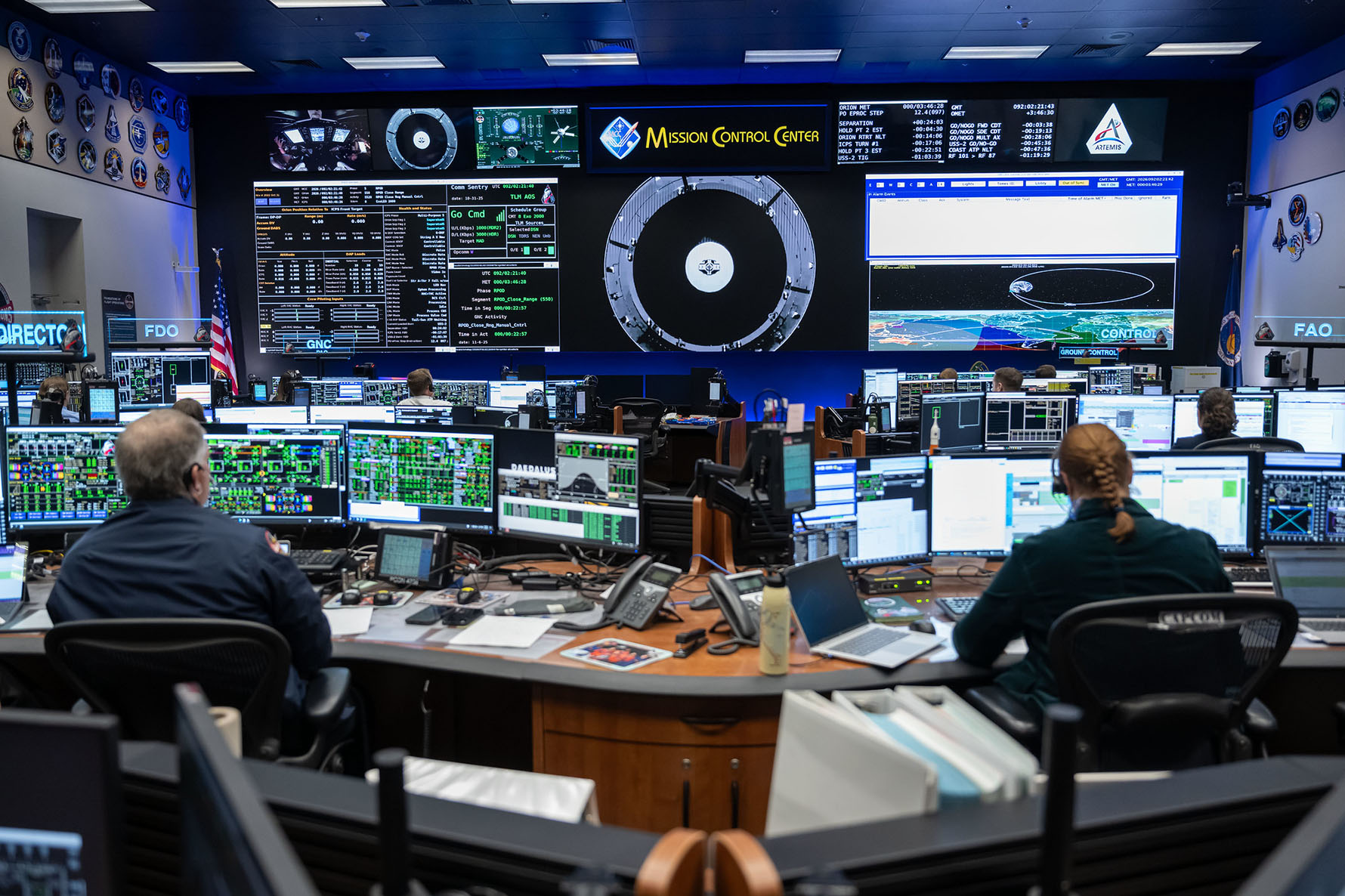
But behind that familiar view is a deeper, layered architecture that most people never see: a dedicated engineering back room for Orion and a new set of science control rooms developed for Artemis lunar operations.
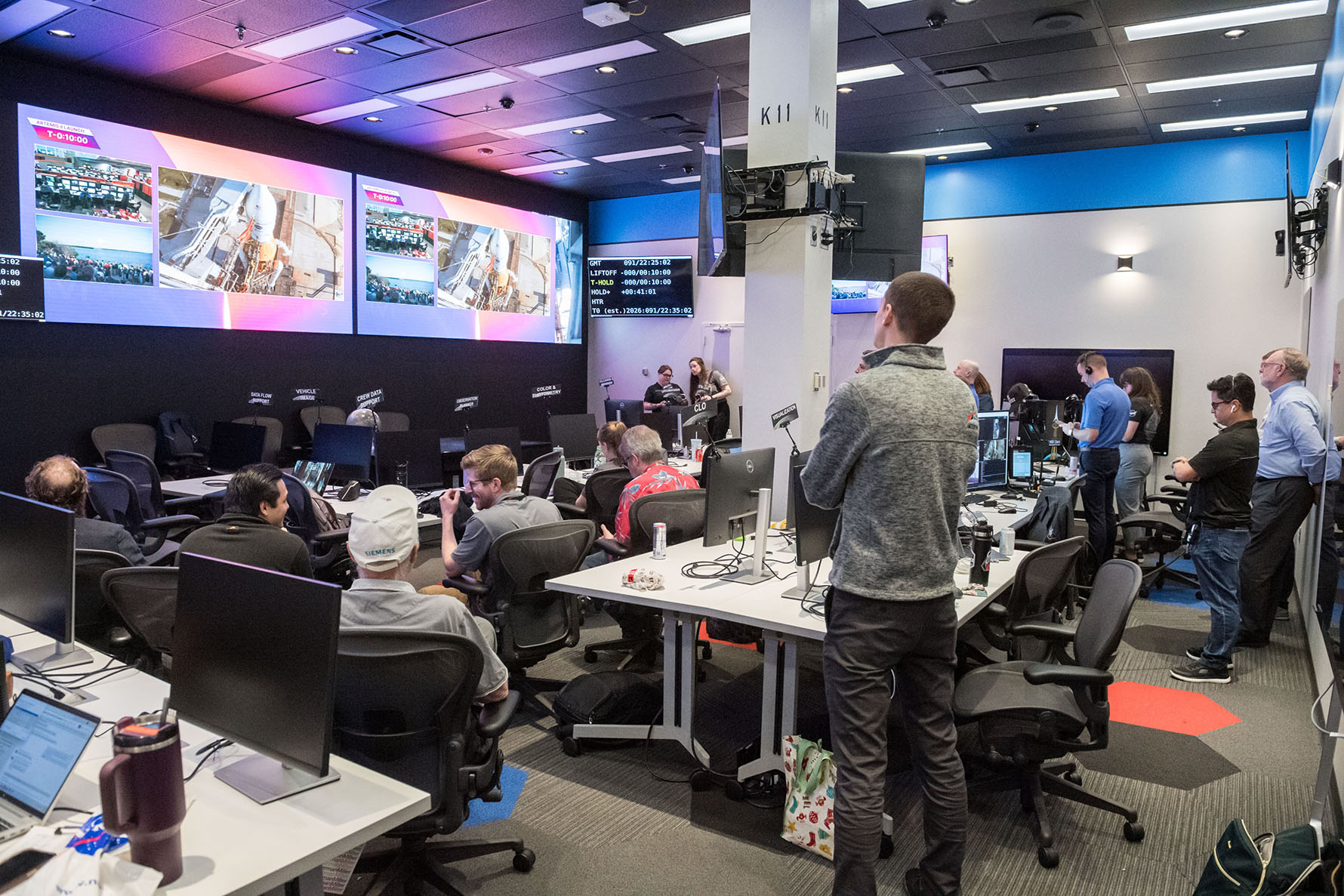
Mission Control’s job is to keep the crew safe, the spacecraft healthy, and the timeline on track. Controllers at each console watch their systems second by second, send commands, and manage procedures, while the flight director orchestrates the overall mission. Under normal operations, the crew hears only one voice from the ground: the CAPCOM, who serves as the single communicator between Mission Control and the astronauts.
In that sense, Artemis II still looks familiar to anyone who followed the Apollo program, the Space Shuttle, or International Space Station operations.
What is less visible but just as vital — is the Orion Mission Evaluation Room, or MER, sitting just behind Mission Control. If Mission Control is the front room, the MER is the engineering brain just behind the glass. It is staffed by the people who know Orion’s hardware and software in exhaustive detail: NASA engineers and industry partners from Lockheed Martin, the European Space Agency, and Airbus.
While the front room manages the moment-to-moment demands of flight, MER teams quietly compare real-time data to models, simulations, and years of qualification testing, looking for subtle trends and edge of the envelope behavior.
That back-room concept had roots in Apollo, when engineers in support rooms worked problems and passed solutions up to the flight controllers. But for Artemis II it is more formal, more integrated, and focused on a single, highly complex spacecraft.
“The operations team is flying the spacecraft, but they are relying on the Mission Evaluation Room’s reachback engineering capability from the NASA, industry, and international Orion team that has designed, built, and tested this spacecraft.” Trey Perryman, Lead for Orion Mission and Systems Integration at NASA Johnson
If something unexpected appears on a Mission Control console, the flight director turns to the MER for options. The MER could recommend a different configuration, revised limits, or adjustments to the timeline giving Mission Control vetted choices that protects the crew while preserving the mission’s test objectives.
Layered onto that familiar operations stack is something genuinely new: dedicated science control rooms and a science officer on console in Mission Control itself.
Although Artemis II is not a landing mission, it is the first time a crew flew NASA’s modern lunar architecture around the Moon, and NASA treated it as a rehearsal for future surface expeditions. To support that goal, NASA created a Science Evaluation Room and a science mission operations back room, where lunar scientists tracked every image, observation, and crew report as the mission unfolded.
From the crew’s perspective, communications still flowed through the CAPCOM. During the lunar flyby, however, the Science Officer played a much more active role behind the scenes, helping translate the priorities of the science rooms into real-time observation requests as the crew viewed the Moon. When the astronauts described surface features, captured images, or reported changing lighting conditions, that information flowed not only to Mission Control but into the science rooms as well, where specialists could rapidly interpret what was being seen and refine observation priorities on the fly.
Put together, Artemis II is operating with a three-layer support structure that most viewers never see: Mission Control to command and communicate, the MER to think deeply about Orion’s engineering, and the science rooms to extract maximum scientific value from every minute near the Moon.
It is the classic mission operations model people remembered from Apollo — updated for a new era, with engineering and science back rooms functioning as full partners in preparing for the more ambitious Artemis missions to come.
WHAT’S NEXT — FLIGHT DAY 9 PREVIEW
Thursday, April 9, 2026
The day will primarily focus on packing and stowing equipment aboard Integrity in preparation for reentry. Space.com The crew will also review and study entry procedures, finalize cabin configuration, and prepare mentally and physically for tomorrow’s high-speed plunge back through Earth’s atmosphere. A third and final return trajectory correction burn is expected today to ensure Orion remains precisely on course for the San Diego splashdown zone.