Reviewed by: Mark Lardas
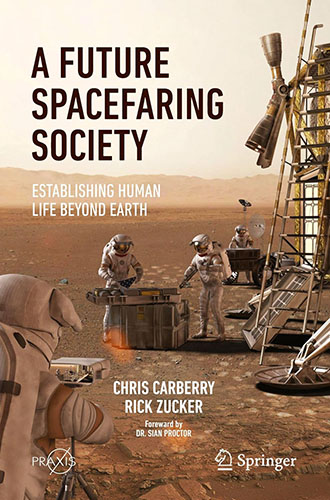
Title: A Future Spacefaring Society: Establishing Human Life Beyond Earth
Author: Chris Carberry and Rick Zucker (Editors)
Format: Paperback
Pages: 367
Publisher: Springer
Date: May, 2026
Retail Price: $32.99
ISBN: 978-3032114655
Find this book
What will it take to make humans a spacefaring society? We are at the cusp of having people leave Earth in numbers, building an orbital industrial infrastructure and establishing human settlements in space. This book investigates what it takes to do that.
The book, edited by Chris Carberry and Rick Zucker, with chapters written by leading experts in their fields, attempts a complete examination of the various factors required to create a spacefaring society.
It has three sections. “Entering the Golden Age of Space Exploration” speculates on the directions and technologies we must go. “Creating Sustainability in Space” examines the technologies required for space travel and settlement. “Achieving Civilization in Space” discuss the nuts and bolts of permanently settling space.
The first section of the book is its weakest. Some of the chapters seem overtaken by events. This is not the fault of their authors, but rather an artifact of the publishing cycle, which takes a year or more. Cancellation of Lunar Gateway and a reshuffle of NASA priorities with a new U.S. Administration affected several chapters.
The chapter on the U.S. Space Force was particularly affected. The author based his assumptions on the space polices of the previous Administration (as shown examining the footnotes). The current Administration made significant changes in direction. Additionally, military events in 2026 reveal China’s military threat to have been grossly exaggerated. This is not to say the author did a bad job. Rather, his recommendations read like a roadmap for the current Administration.
The authors institutional preferences are displayed in this section. They assume government will lead space development, with commercial space following. There is also an emphasis on high-level centralization of space exploration and development. Yet the throw-weight revolution created by SpaceX’s Falcon and Starship launch vehicles undercuts many of these assumptions. With high launch costs, internationalism and cooperation were mandatory to build ISS. Low launch cost allows independent actors to plan big. Starlink was a purely private sector initiative.
If history is any judge, free enterprise in space and decentralized government control will prove more successful than a centralized, bureaucratized approach. Spanish and French New World settlements were centralized and government-run. English settlements were private ventures. The latter ultimately dominated world culture, while the Spanish and French settlements never achieved the same level of influence.
The middle section is the book’s strongest. This book is worth getting just for those chapters. Hard science and engineering explorations of the technologies needed, they provide detailed looks at power generation, on-site construction, life support (including food) communications and AI, robotics and computing. There are also chapters on medicine and health, gravity effects and biology.
Some of these discussions explore unexpected areas, delightfully so. This includes examination of means of generating artificial gravity, growing artificial meat, and space agriculture. The importance of these things often seems obvious in retrospect. You may not agree with the authors and their conclusions, but they are thought-provoking and merit consideration.
The final third is mixed, but interesting. It explores the art of living in space. Not mere survival, but having fulfilling lives. These include chapters on building towns, and the infrastructure for these settlements, the challenges of human reproduction, and various social aspects. They offer discussions of education and legal systems, and cultural aspects, including music, sports and developing a convivial culture. The general rule seems to be the more closely a chapter is linked to hard sciences or actual activities, the stronger it seems.
The chapter on surface construction focuses as much on architecture as engineering, exploring what makes a habitat livable rather than just survivable. Similarly, chapters on music and sports are fascinating explorations of the possibilities offered in a space environment.
The chapters on education and space law seem weakened by author’s institutional preferences for strong centralized systems. The education chapter neglects homeschooling. It seemingly favors recreating the U.S. public education system (which is dysfunctional) on Mars. The chapter on space law blandly assumes having a legal system in place will suffice to bring order.
The book makes frequent appeals to the importance of Diversity, Equity and Inclusion, although space cares nothing about a spacefarer’s race, religion, gender or sexual orientation. It punishes errors made, up to and including death, regardless of DEI characteristics.
There are gaps, especially about religion. Mentions of religion are few, fleeting, and mostly negative, such as worries about religious observations taking time away from a devout astronaut’s work or inbreeding among the Amish. There is also a brief acknowledgement that religion historically motivated settlement on Earth, and wondering if the same might happen in space. (Spoiler alert: it almost certainly will.) Despite the book’s focus on building community, it neglects the community-developing aspect of church, mosque, and synagogue. With multiple chapters on sports, arts, and music, not one focused on religion. Curious and revealing.
Despite these criticisms, anyone interested in challenges of settling space will find this book is well worth reading. The hard science sections read like a how-to roadmap. Sections with which readers might have disagreement are well thought out. They also provide a nearly comprehensive syllabus of issues that must be considered to create a true spacefaring society.
© 2026 Mark Lardas