
By Burt Dicht
NSS Managing Director of Membership
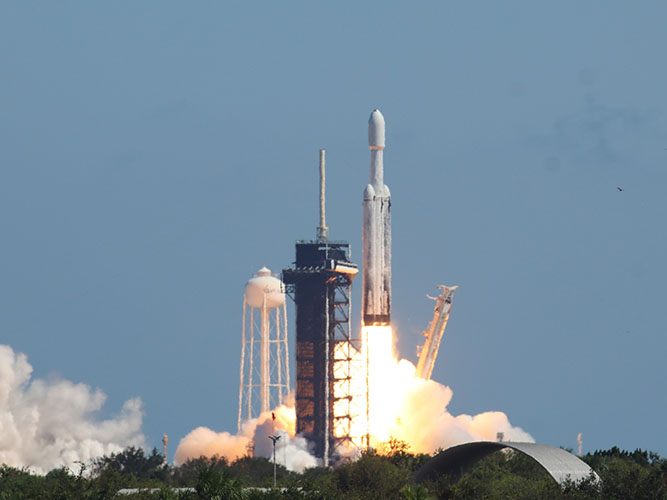
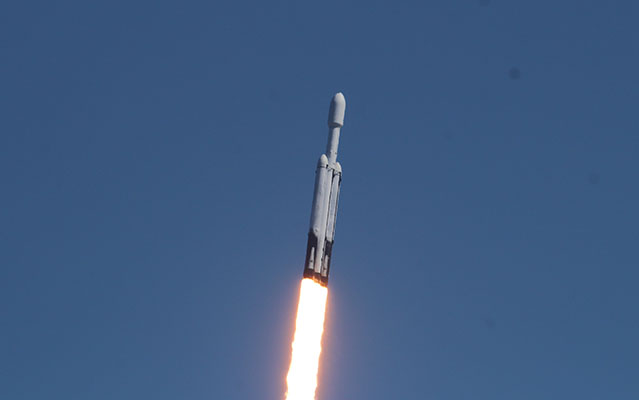
The Europa Clipper began its 1.8-billion-mile, 5½-year journey to Jupiter with a flawless launch from LC-39A at Kennedy Space Center at 12:06 p.m. EDT on October 14, 2024 (see photo above by Burt Dicht). The weather couldn’t have been better, with a 99% chance of favorable conditions. Against a brilliant blue sky, the SpaceX Falcon Heavy soared, leaving behind a stunning contrast as it climbed toward space (photo below by Burt Dicht).
This mission marks NASA’s bold attempt to study Europa, Jupiter’s intriguing ocean moon. Previous missions, such as the Galileo probe, found strong evidence of a salty ocean beneath Europa’s thick ice crust. Scientists believe that organic compounds—vital ingredients for life—may be hiding there. To uncover Europa’s secrets, the Europa Clipper carries NASA’s most advanced suite of scientific instruments, designed to study the moon’s interior structure, composition, and geology.
The Jet Propulsion Laboratory (JPL) spearheaded the mission’s development, working closely with the Johns Hopkins Applied Physics Laboratory (APL). Key contributions also came from NASA’s Goddard Space Flight Center, Marshall Space Flight Center, and the Kennedy Space Center. International partners played an essential role too: Airbus built the solar arrays in the Netherlands, and critical instrument testing took place in Germany. In total, over 4,000 people from across the globe contributed to launching Europa Clipper toward its distant target.
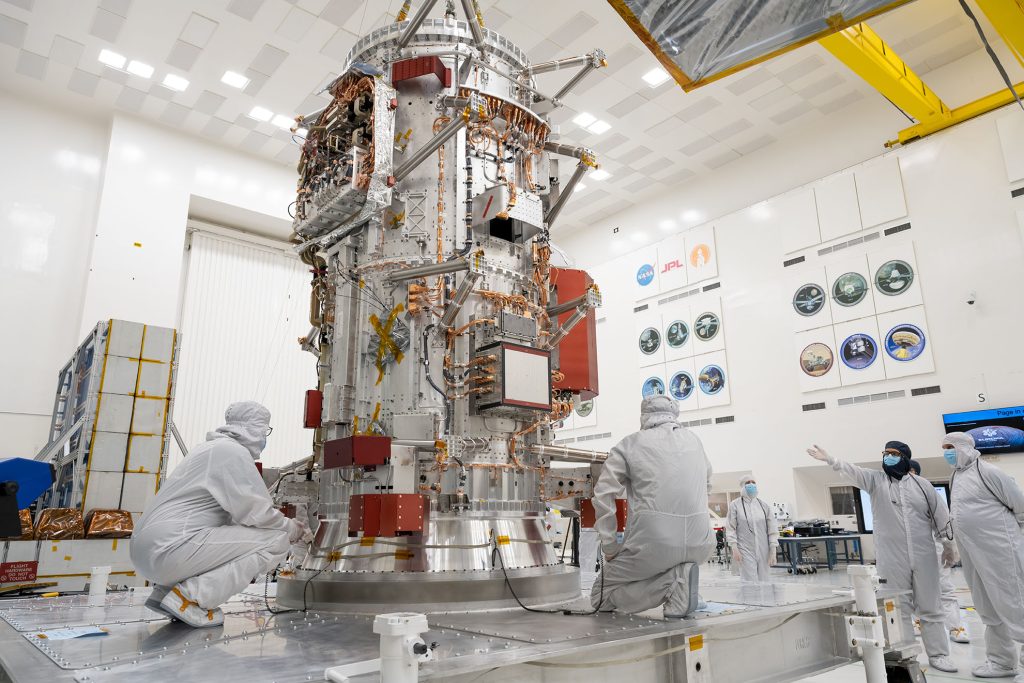
One of the most exciting tools aboard the spacecraft is an ice-penetrating radar system called the “Radar for Europa Assessment and Sounding: Ocean to Near-surface”—or REASON, as NASA’s fondness for acronyms dictates. This instrument will bounce radar waves off any liquid water under the ice, generating a detailed, CT scan-like view of Europa’s frozen shell. The spacecraft also carries a mass spectrometer to sample and analyze the moon’s atmosphere and a magnetometer to study Jupiter’s magnetic field as it interacts with Europa.
With its antennas and solar arrays deployed, Europa Clipper will be the largest spacecraft NASA has ever built for planetary exploration—stretching over 100 feet in length and 58 feet across. The massive solar arrays are essential to power the spacecraft’s systems, as sunlight at Jupiter is only 4% as strong as what reaches Earth.
During the 5½-year journey, mission teams will test and calibrate Europa Clipper’s instruments and subsystems to ensure everything works perfectly when it reaches Jupiter. A direct route isn’t possible, so the spacecraft will use gravity assists from Mars and Earth to gain the speed needed to arrive in April 2030. One of the toughest challenges of the mission is surviving Jupiter’s magnetic field, which is 20,000 times stronger than Earth’s and will bombard the spacecraft with high doses of radiation.
To protect Europa Clipper’s sensitive electronics, engineers developed a specially shielded vault to house the critical components. Even with this defense, the spacecraft will still experience radiation exposure equivalent to millions of chest X-rays. Time spent within Jupiter’s radiation belt will be carefully limited to extend the mission’s lifespan.
The launch of Europa Clipper marks the start of an ambitious quest to answer one of humanity’s most profound questions: Does life exist beyond our Earth? This mission is not just a marvel of engineering but a testament to global collaboration and scientific curiosity, bringing together thousands of people from around the world to push the frontiers of space exploration.
When Europa Clipper arrives at Jupiter in 2030, it won’t simply be another spacecraft exploring a distant moon. It will carry with it the hopes and dreams of everyone who believes in exploration—and the idea that our greatest discoveries are still waiting just beyond the horizon.
Witnessing Europa Clipper’s historic launch, especially with my engineering background, was a powerful reminder that humanity’s finest achievements stem from curiosity, perseverance, and the shared belief that the next great discovery is always just within reach. Go Europa Clipper!













2 thoughts on “Europa Clipper’s Mission of Discovery”
Great reporting and pictures! Thanks Burt.
A booster fly back would be nice to see, but the he Clipper needed every bit of thrust to make sure the journey. Nice report Burt, thanks