A newly published book reclaims the three Apollo 1 astronauts from tragedy.
The following article addresses the Apollo 1 fire and the loss of its three astronauts. Some readers may find descriptions of the accident and its aftermath distressing.
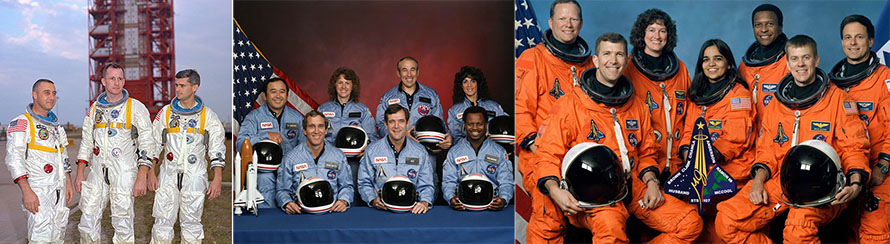
Here’s what most people know about the three Apollo 1 crew members, commander Virgil I. “Gus” Grissom, senior pilot Ed White, and pilot Roger Chaffee: they died in a flash fire on the evening of January 27, 1967. And that’s it. It has been nearly 59 years since this tragedy unfolded, and not much has changed yet regarding these public memories of the crew; they’re permanently and proverbially stuck in amber at 6:31:19 p.m. Eastern time on that day, never getting any older. That’s when the future – multiple futures, really – came to a halt.
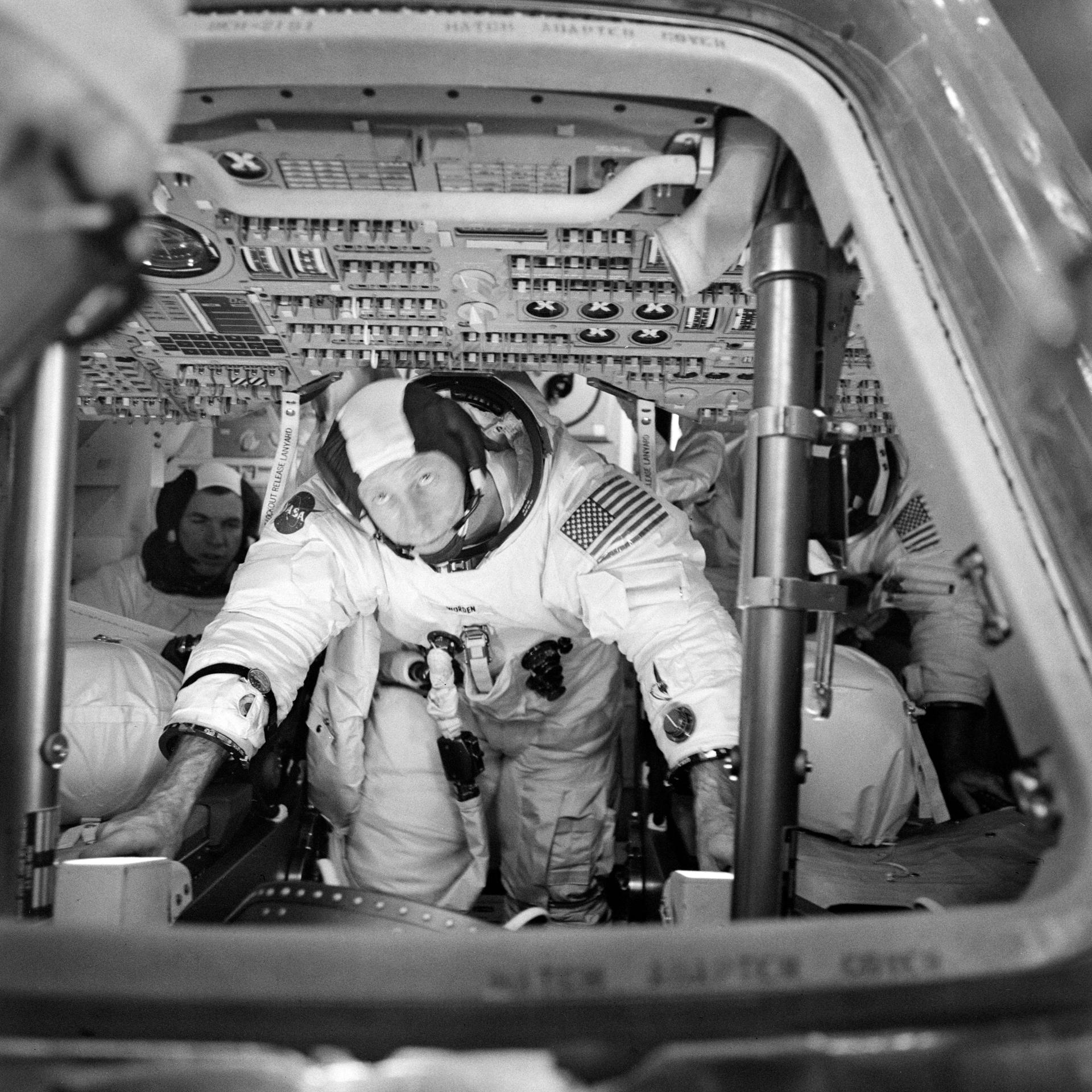
When these three astronauts died public deaths atop a Saturn IB at the Cape’s Launch Complex 34, their narratives from that point on tended to be conflated with the tragic ends of their lives, which is unfortunate. But the newly released Apollo 1 in Photographs: The Apollo Photo Archive, by J.L. Pickering and John Bisney with Ed Hengeveld, sets out to remember the crew differently, defined by their all-too-short lives and pioneering accomplishments. In addition, the book features many rare views not just of the crew, but the backup crew, associated Apollo crews, Cape Canaveral workers, and ultimately of the investigative process that got the Apollo program back on its feet and to the Moon before the end of the 1960s.
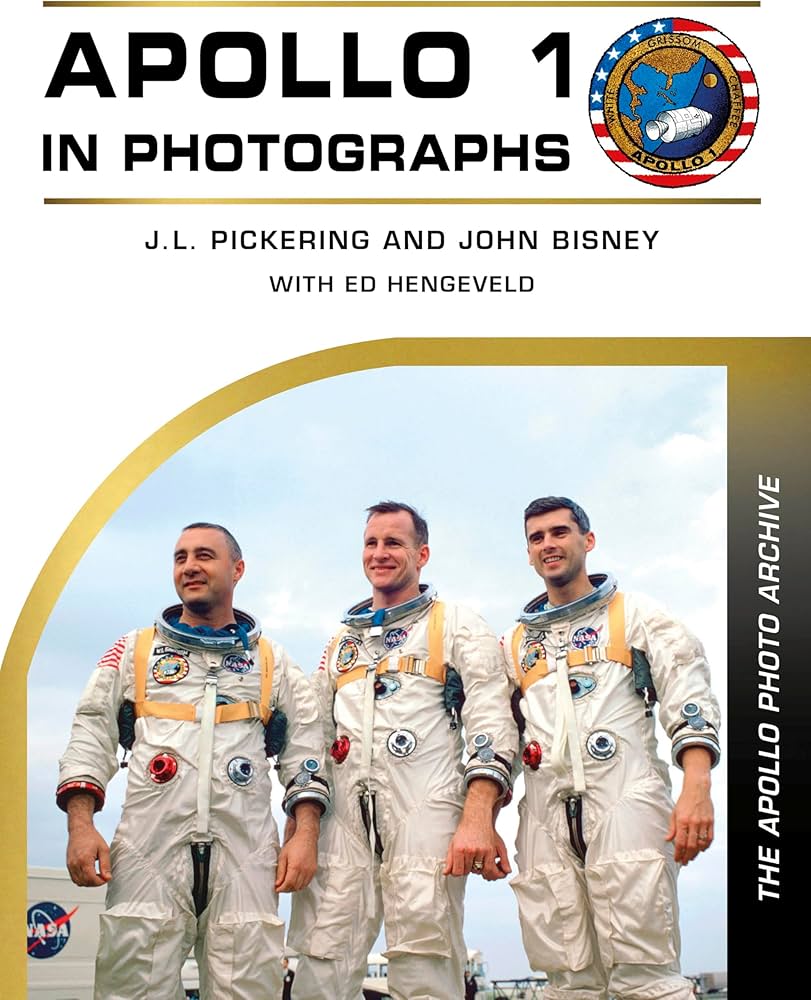
Pickering and Bisney have released several other incredible photographic volumes that capture each facet of NASA’s history from Mercury through the early Space Shuttle program, but in many ways, the Apollo 1 volume is the most respectful and extensive. Because of the frankly terrible nature of the tragedy that defined the mission and time period, the story could easily become tasteless and morbid in the wrong hands. Again, some tend to conflate Apollo 1 with tragedy only.
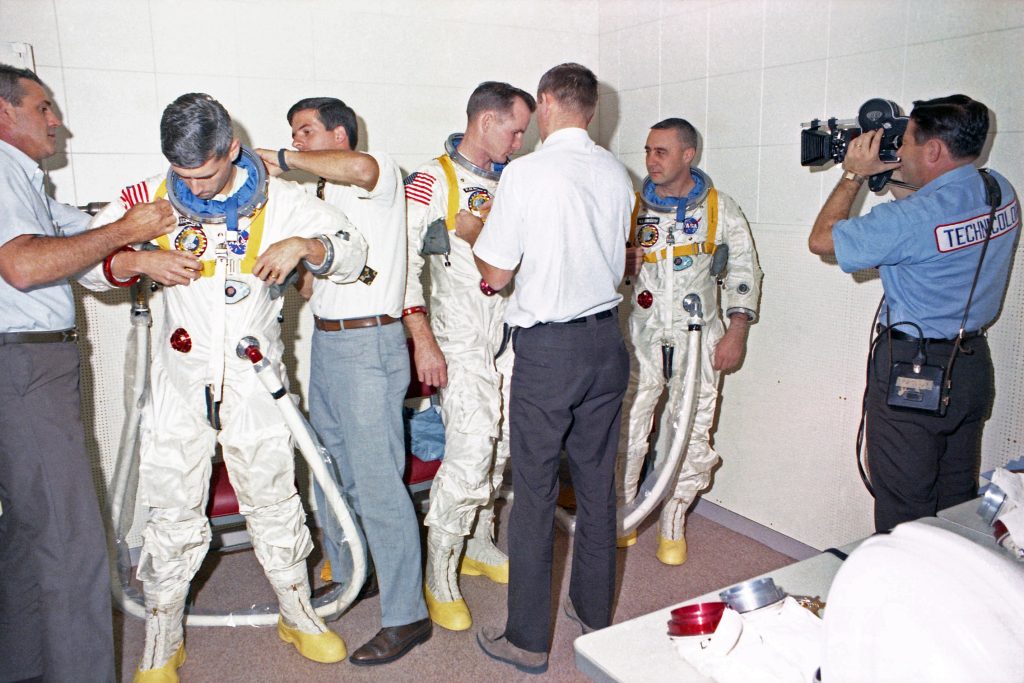
This volume is anything but; instead, it favors a chronological, understated approach. The book shows mission preparations, featuring not only wonderful photos of what appears to be a hopeful, upbeat crew but also the early Apollo infrastructure of launch pads and space vehicles coming together. The mood isn’t necessarily one of oncoming doom, but of mid-century Moon-gaga optimism. The “we can do anything” feeling of the early space program resounds in the pre-accident photos. Just days before the launchpad fire, the crew is shown jokingly inflating their suits’ flotation devices during what appears to be a laidback, jocular press availability at LC-34.
Apollo 1 in Photographs does address the events of January 27th and their aftermath, and its view of those days and weeks is unflinching. For what might be the first time, we see many post-accident spacecraft images, memorial services, and the efforts of investigators – most notably fellow astronaut and future Apollo 8 commander Frank Borman – depicted honestly. The accident is, unfortunately, part of the mission’s fabric and must be examined, but again, the book is respectful. While the details of the accident are not remotely pleasant, Apollo 1 in Photographs beckons the reader to stay with the story and fully understand its implications, past, present, and future.
The feeling after taking in Apollo 1 in Photographs isn’t necessarily one of depression and sadness, which is a massive testament to the work of its authors, because the whole story is undeniably heavy. It’s pride in the efforts of everyone involved in the mission and its aftermath. The only sadness lingering in the book’s wake is perhaps the fact that we didn’t just get robbed of three futures with the launchpad fire – we were robbed of multiple futures. It’s not hard to imagine Grissom proudly walking on the Moon, the patriotic White becoming a U.S. senator, or Chaffee jauntily helming one of the first Shuttle missions. Or maybe all three were meant to do combinations of these things. These possibilities are enticing if you’re into alternate histories à la For All Mankind, and one wistfully wishes – in a different universe – Apollo 1 in Photographs had ended with all of these possible scenarios.
In this universe, the truth is that we will never know what Grissom, White, and Chaffee may have accomplished beyond January 1967. But Apollo 1 in Photographs makes sure their lives and legacies – individually and as a group – aren’t easily forgotten. It’s an essential read.
Apollo 1 in Photographs was published by Schiffer Publishing in late 2025 and is available at all major booksellers.
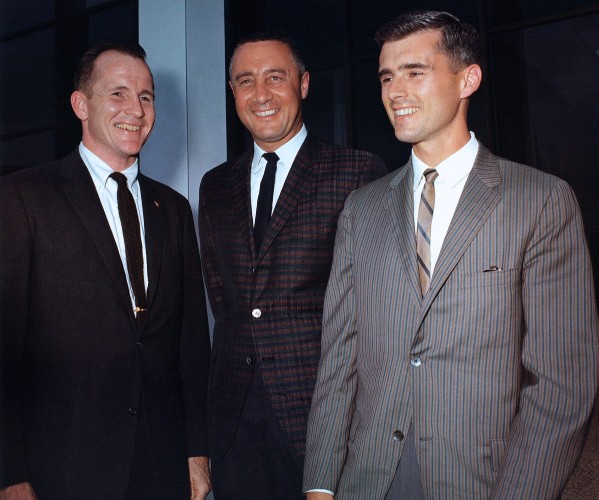
Featured photo credit: White, Grissom, and Chaffee after the March 21, 1966 news conference at Houston, Texas’ Manned Spacecraft Center (now Johnson Space Center).
*****
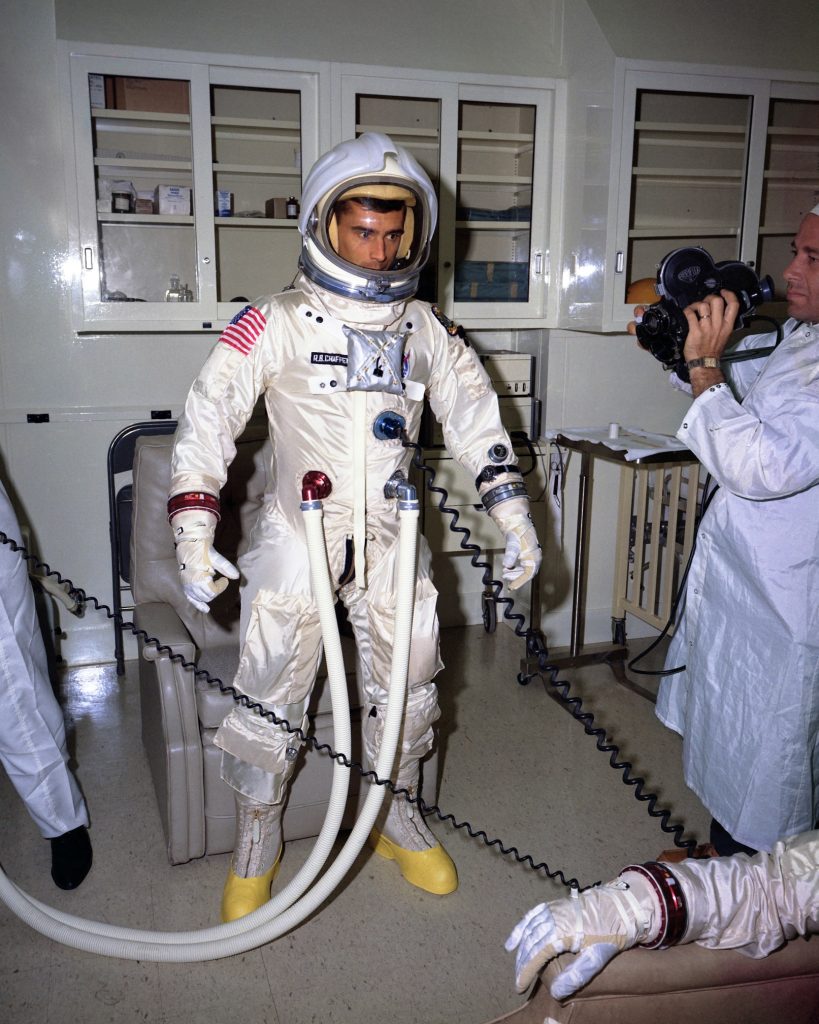
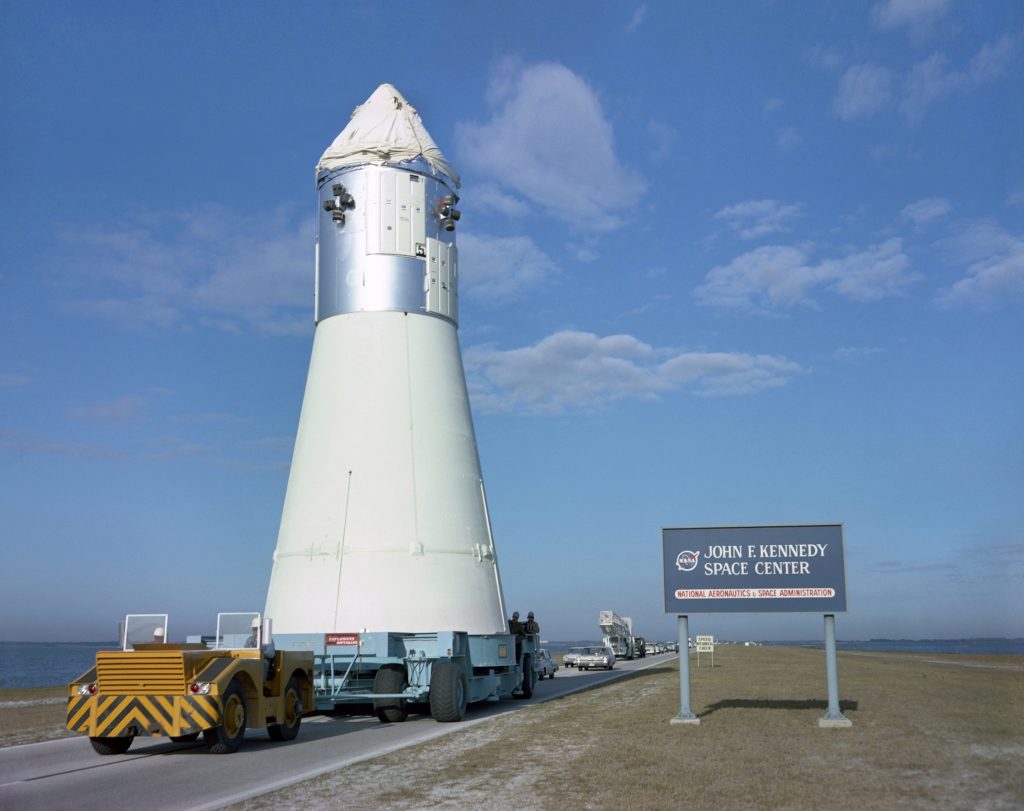
Here is a selection of photographs with captions from Apollo 1 in Photographs. Many thanks to J.L. Pickering for supplying these.




*****
Emily Carney is a writer, space enthusiast, and creator of the This Space Available space blog, published since 2010. In January 2019, Emily’s This Space Available blog was incorporated into the National Space Society’s blog. The content of Emily’s blog can be accessed via the This Space Available blog category.
Note: The views expressed in This Space Available are those of the author and should not be considered as representing the positions or views of the National Space Society.