| The latest crop harvested from the Garden on the International Space Station is Mizuna lettuce. The lettuce was returned to Earth for scientific research, aboard the Discovery shuttle in April 2010.
The greenhouse, first sent up in 2002, has been used for 20 plant growth experiments so far. Now, a second unit has been added, and the lettuce crop was the first experiment to test different conditions side by side. For many years, the experiments have sought to confirm Earth side results which show that minimizing water usage and salt accumulation would lead to healthier crops. During this experiment, two different root growth mediums were used. One was the traditional root pack used on all the previous tests. The second was the new and improved root pack, with slow release fertilizer. The hypothesis was that the slow release would help reduce salt intake. Science is sometimes best when things go wrong. |
 Mizuna Lettuce On ISS Image Credit: NASA |
| For some reason, the sensor controlling the watering in the first (traditional) module failed. This resulted in “over-watering” the plants. The results were surprising, but microgravity has held many surprises for scientists. First, the seeds that got “too much” water sprouted quicker and developed leaves twice as fast as the second (improved) module. The second surprise was that the plants grown in the slow release fertilizer in the second module had more salt accumulation than the plants in the first module.
The results suggest that plants in space need a larger volume of water and a faster rate of fertilizer than they do under normal gravity. Shane Topham, an engineer with Space Dynamics Laboratory at Utah State University in Logan, said that “the conservative water level we have been using for all our previous experiments may be below optimal for plant growth in microgravity”. Overall, the garden experiments have four objectives:
One additional objective of the experiments is to measure the non-nutritional benefits (stress relief, etc.) that crew members experience working with plants in space. Growing and tending to the crops provides comfort and relaxation to the crew. On a long voyage, this activity may contribute to the success of the mission. |
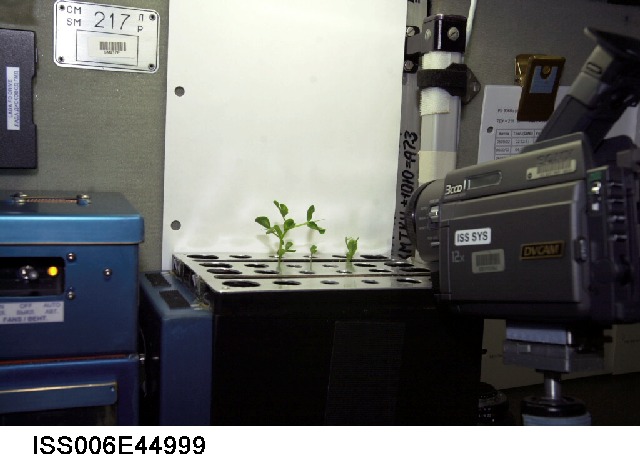 A view of the Russian BIO-5 Rasteniya-2/Lada-2 (Plants-2) plant growth experiment located in the Zvezda Service Module on the International Space Station (ISS). Image Credit: NASA |
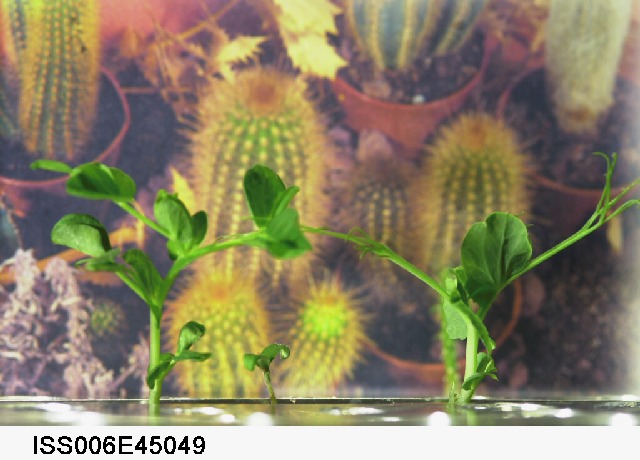 A close up view of sprouts on the Russian Lada-2 experiment. Image Credit: NASA |
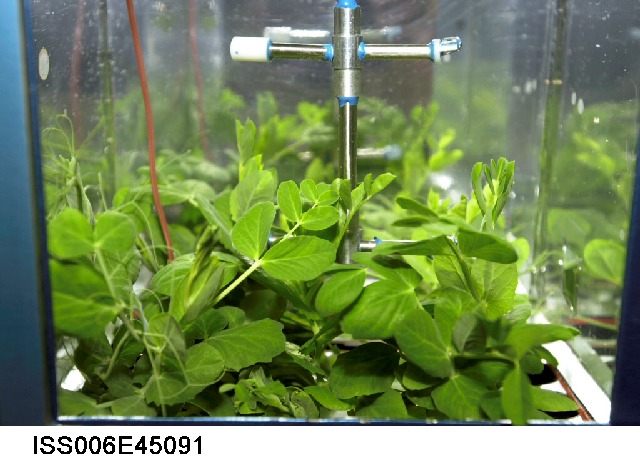 A view of peas growing in the Russian Lada-2 plant growth experiment. Image Credit: NASA |
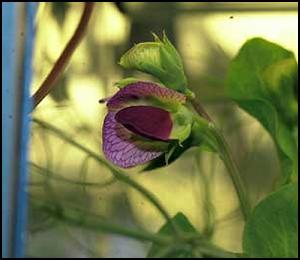 A close up view of a bloom on the Russian Lada-2 plant growth experiment. Image Credit: NASA |