By Joseph M. Rauscher
NSS Board of Directors
NSS Space Solar Power Program Manager
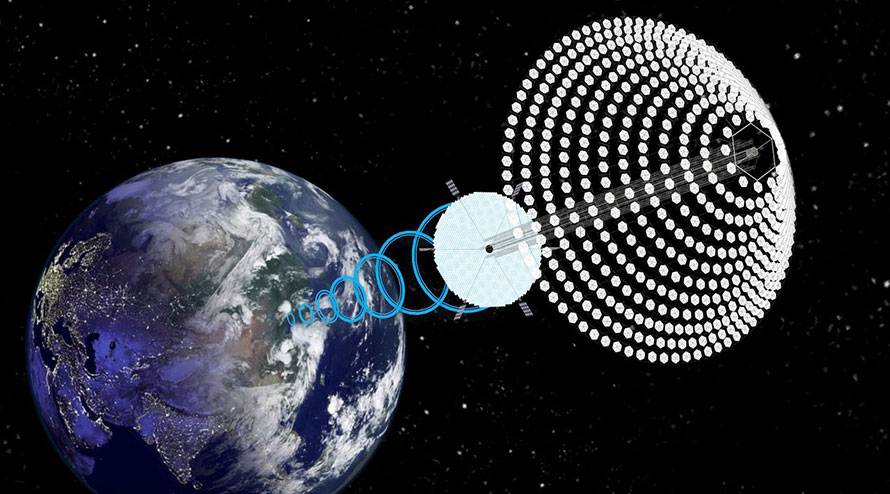
Image: SPS-ALPHA concept courtesy John C. Mankins.
Space Solar Power (SSP) is receiving renewed worldwide attention as the projected cost has dropped by orders of magnitude in recent years due to the pending advent of SpaceX’s Starship, hyper-modular designs allowing mass production of components, and robotic assembly.
SSP was prominently featured throughout the NSS 40th Annual International Space Development Conference® (ISDC® 2022) held at Hyatt Crystal City Hotel, Arlington, Virginia, from May 26-29, 2022. This year’s SSP events included the Space Solar Power Symposium, the International Space Solar Power Student Project Competition, and ISDC Space Solar Power Policy Panel. The SSP coverage included national programs, commercial investments, university research programs, non-profit organization projects, and inspired individuals who bring unique talents/resources.
This year’s Space Solar Power Symposium was organized by Gary P. Barnhard and John C. Mankins. We are pleased to present some of the slide presentations (and some videos) here:
Keynote address:
National Programs:
- USA: Naval Research Lab (NRL) – Elias Wilcoski/NRL
- Video: NRL Video Library (9 Videos)
- USA: Air Force Research Lab (AFRL) – James Winter & Melody Martinez/AFRL
- Video: Space Solar Power Incremental Demonstrations and Research Project (SSPIDR)
- Video: From Science Fiction to Reality with Space Solar Power Beaming (Northrop Grumman) “At Northrop Grumman, we are making the science fiction of the 1940s into reality. Space Power Beaming has the potential to provide power anywhere on Earth at any time by harnessing the Sun’s energy in a new and creative way, ultimately supporting locations around the world that don’t have access to the energy they need. Working together with the U.S. Air Force Research Laboratory and Department of Defense, we are on the leading edge of defining possible and maturing technology to convert solar power to RF energy and transmit it down to Earth.”
- UK: The Space Energy Initiative – The UK approach to developing Space-Based Solar Power – Dave Homfray/Satellite Applications Catapult (reports and additional material at spaceenergyinitiative.org.uk)
- EU: European Space Agency (ESA) – Leopold Summerer
- Japan: Japan Aerospace Exploration Agency (JAXA) – Koji Tanaka/JAXA
- China: China Academy of Space Technology (CAST) – Xinbin Hou
Commercial/Academic Programs & Projects:
- SPS Alpha – John Mankins (see keynote above)
- Cassiopeia – Ian Cash/International Electric Company Limited
- End-to-End Frequency Agnostic Remote Power & Ancillary Services – Gary Barnhard/XISP-Inc
- How to Finance Space-Based Solar Power and the Impact of Blended Financing – Kevin Barry/Light Bridge
- Always On Solar Power – Edward Tate & John Bucknell/Virtus Solis
- Collapsing Electric Power Grid Reliability and Economics – Darel Preble/Space Solar Power Institute
- Space Technology as a Key Element of Rational, Effective Climate Policy – Paul Werbos/Independent Researcher
The International Space Solar Power Student Competition is a global, undergraduate and graduate level annual event, now in its sixth year, presented by SPACE Canada in partnership with the International Astronautical Federation (IAF) Power Committee, National Space Society (NSS), and the Space Generation Advisory Council (SGAC). The 2022 presentations were:
- Indian Team: Assembly of Space Based Solar Power Satellite using Space Robotics – Sejal Jain, Prathmesh Barapatre
- USA Team (University of Maryland): Electric Vehicle Power Beaming – Neil Sorkin
- Scottish Team: Financing Strategy for Phase 1 of the SPG Architecture – Narthana Arumugam
- Portuguese Team (University of Aveiro): Energy Mules: A novel solar power satellite system architecture capable of energy storage – Ricardo A. M. Pereira, Helena Ribeiro, Henrique Chaves, and Matilde Monteiro. Faculty Advisors: Nuno Borges Carvalho, and Sandra F. H. Correia
- Italian Team: Orbital Recharge in Space – Lopez Francesco, Mauro Anna, Monteleone Giuseppe, Sfasciamuro Domenico Edoardo, and Villa Andrea
- Japanese Team: Feasibility study of a large-scale WPT system formed by a modular structure – Yusuke Kishida, Takahiro Ohnisi, Miki Kaneko, Shuji Higashigawa, Tomohiro Ebisawa, Yudia Fujii, and Hotaka Yamada. Supervisor: Koji Tanaka (SOKENDAI, ISAS/JAXA)
“NASA to reexamine space-based solar power”
A Friday morning talk by Nikolai Joseph of NASA’s Office of Technology, Policy and Strategy resulted in the above headline in a Space News article on May 28, which reported:
[Joseph] said the agency was beginning a short-term study evaluating the prospects of space-based solar power, or SBSP, the first by the agency in about two decades. “As the technology has evolved, the feasibility of the system has changed over time,” he said. “This study is going to assess the degree to which NASA should support space-based solar power”…. Advances in several technical areas, Joseph said, give the agency reason to at least reexamine the feasibility of SBSP. “The elephant in the room is launch costs, and launch has become significantly more accessible. That completely changes the way we look at this,” he said. Other areas that have seen advances include thermal systems, electronics, materials and solar panels…. The goal is to finish the study and present it at the International Astronautical Congress in Paris in September.
SSP Background
The ability to provide power and ancillary services when and where needed is essential to virtually all aspects of human endeavor. It is enabling for any form of space development/settlement. Space solar power technology promises to be one of the few energy generation options that can provide dispatchable power that can scale dramatically. While Space Solar Power is not a panacea, it can be an integral part of the mix of environmentally benign solutions needed to meet worldwide electrical energy demand both on the planet and off. Using space solar power and allied technologies to foster an expanding space economy and sphere of human influence – a cooperative, collaborative, and competitive ecosystem of entities engaged in space development – is a path to achieving the “promise of the future.” That sphere of human influence will initially be the “Cislunar Marketplace“.
For more information and support:
- NSS Space Solar Power page
- NSS Space Solar Power Library
- Donate to NSS Space Solar Power advocacy campaign
- Join NSS Political Action Network
Personal observations
- Numerous technical/engineering/design issues will need to be prioritized, addressed, and resolved before international stakeholders can begin to consider SSP transmission frequencies, geopolitical conflict of interests, and consortium management.
- Need one or more government led consortiums to blend and leverage government and commercial financial management, funding, oversight, etc. Initial international consortium could include US, Canada, EU, UK, Japan, and Korea for blending climate change and energy security goals. But innovative program administration features must be required to insure proper program oversight and transparency. Strict controls and oversight will be needed to manage schedules and costs to avoid it being a one of a kind super-expensive project.
- Consider publishing material with build-a-world.org and IEEE PES books (Digital Library on Power and Energy).
- Need intelligent grid controls and energy storage solutions.
- Consider CITIgroup forecast analysis re commercial space, PPP, SSP, etc.
- Logic dictates that we recognize that SSP and the survival of humanity are linked.
- Need U.S. bi-partisian sponsors (e.g., Problem Solvers Caucus) for a Congressional committee to hold SSP hearings, with assurance that the committee membership is diverse and that the hearing witnesses include appropriate stakeholder representatives.
- I suggest launching NSS fundraising and/or strategic planning project to address SSP and related power beaming and cis-lunar issues, as well as look at potential collaboration between NSS and other organizations.
Comments would be appreciated.






4 thoughts on “Space Solar Power Featured at ISDC 2022”
NSS is fortunate to have members with vast knowledge of SSP. Soon the dream will come true.
Thank you for your encouraging comment. I at least hope that a pilot project is launched ‘soon’.
Under “Personal observations” in your post you say “Need one or more government led consortiums to blend and leverage government and commercial financial management, funding, oversight, etc.” Indeed SSP anywhere is a large multifaceted project such that robust consortiums are likely needed to make it happen. You briefly list the Space Energy Initiative (SEI) of the UK. It appears that SEI is one such consortium, formed just within the last couple of years, and focused on developing and implementing SSP for the UK. If you look at their Mission, About Us, and Objectives on the Home page, and scroll down to see the consortium members listing it appears to fit your description of needed consortiums. SEI apparently was launched by the UK government. With SEI the UK might take the lead in SSP development in the West.
https://spaceenergyinitiative.org.uk/
https://www.thebusinessdesk.com/westmidlands/news/2061978-space-based-solar-power-research-launched
Excerpt: The SEI was formally launched at the House of Commons. The project is seen as a moonshot opportunity for the UK by the BEIS Energy Directorate and Energy Minister Greg Hands, the BEIS Space Directorate and the UK Space Agency.
Thank you for your informative comment. I at least hope that a US and/or international pilot project is launched ‘soon’. And I agree with you: “With SEI the UK might take the lead in SSP development in the West.”