By Michelle Hanlon
President, National Space Society
Sunday, June 27 at 1:00 PM Eastern time.
NSS has planned a special program, devoting two hours to explore and answer your questions about the Artemis Accords. I am honored to be joined by Dr. Andrea Harrington, Interim Dean of Space Education at Air University and former Chair of the Department of Spacepower at Air Command and Staff College, Gabriel Swiney, the head space lawyer at the U.S. Department of State, and Memme Onwudiwe, author of “Africa and the Artemis Accords.”

Join the discussion and bring your questions. Register at https://nss.org/isdc-sunday/
Why Are the Artemis Accords Important?
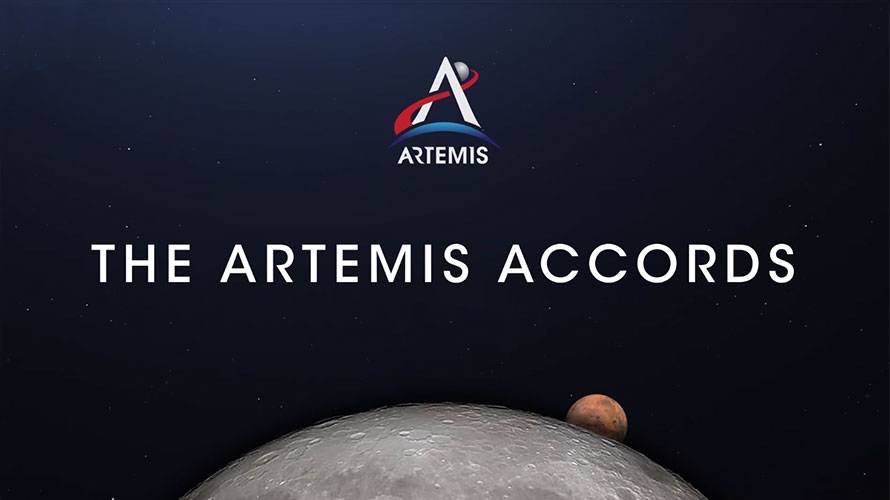
On October 13, 2020, the civilian space agencies of eight nations — Australia, Canada, Italy, Japan, Luxembourg, the United Arab Emirates, the United Kingdom and the United States – announced that they had agreed to 12 Principles for Cooperation in the Civil Exploration and Use of the Moon, Mars, Comets, and Asteroids, known colloquially as the Artemis Accords. The stated purpose of the Accords is to “establish a common vision via a practical set of principles, guidelines, and best practices, to enhance the governance of the civil exploration and use of outer space with the intention of advancing the Artemis Program.” The Artemis Program being, of course, the United States effort to “land the first woman and the first person of color on the Moon and herald a new era for space exploration and utilization.” Since October, an additional four nations have signed on to the Accords – Ukraine, South Korea, New Zealand and Brazil.
However, the Accords have not been entirely well-received.
Some see the Artemis Accords as a unilateral attempt to circumvent a fundamental debate about whether utilizing space resources violates international law obligations that prevent the claiming of territory in space. Others see them as a hegemonic attempt to unilaterally privatize and colonize space. And indeed, whether in response to the Artemis Accords, or as a result of coincidental timing, in March 2021, China and Russia announced their own partnership to support the joint construction of the International Lunar Research Station, a permanent research center on the Moon.
All that certainly begs a wealth of questions:
- What is it about the Artemis Accords that make some so uncomfortable?
- What do the Artemis Accords mean for private companies that are seeking to reach and even utilize resources on the Moon?
- What do they say about property ownership in space?
- Are we headed into another ideological battle that will divide the world?
- The Artemis Accords were created to enhance international collaboration—have they backfired?
- Are Accords open to all countries? What is required from an Artemis partner?
- Are the Accords strengthening or weakening the international commitment to use space exclusively for peaceful purposes?
- Do they apply to other areas of the solar system, other planets and moons?
- What practical effect have they had thus far to support the Artemis Program?
- How were the original signatories selected and approached?
- What can we glean from the list of signatories?
- The US, Luxembourg, UAE and now Japan all have national laws which determine that they view it appropriate for private companies to utilize space resources; does this strengthen the Artemis approach?
And that’s just the tip of the iceberg!
Join us for the answers to these and other questions Sunday, June 27 at 1:00 PM Eastern time. Register here: https://nss.org/isdc-sunday/
Michelle Hanlon, President of the National Space Society, is Co-Director of the Air and Space Law Program at the University of Mississippi School of Law and its Center for Air and Space Law and the Editor-in-Chief of the Journal of Space Law, the world’s oldest law journal dedicated to the legal problems arising out of human activities in outer space. Michelle is also a Co-Founder and President of For All Moonkind, Inc., a nonprofit corporation that is the only organization in the world focused on protecting human cultural heritage in outer space. For All Moonkind has been recognized by the United Nations as a Permanent Observer to the United Nations Committee on the Peaceful Uses of Outer Space.







1 thought on “Perspectives on Artemis Accords at Online ISDC June 27”
No “Accord” or agreement is stronger than the Nations involved. While it’s impressive to see such co-operation on an international scale, it has no force if even one nation, with the technology, ignores it.
It will be interesting to see what comes of the exploration and exploitation of space, since it is large enough to be impossible to patrol or control. I foresee piracy and eventually an actual “Earth Space Navy” of international scope, which is responsible for the patrol and safety of the “space lanes”. It may take many years, but I can see no alternative.