
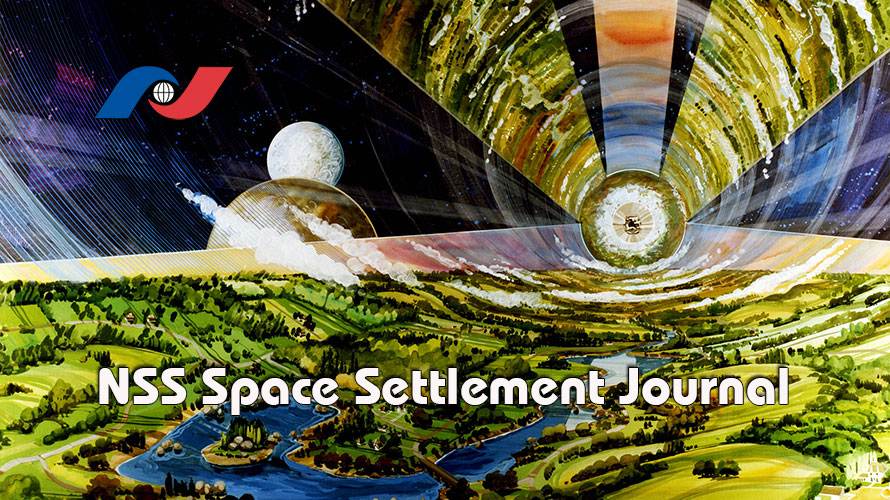
New in the NSS Space Settlement Journal are two articles that deal at least in part with the optimal size for space settlements.
The 5-Kilometer “Sweet Spot”
The first paper by Pekka Janhunen of the Finnish Meteorological Institute deals primarily with illumination in a rotating space settlement, but mentions a significant factor in optimal sizing for orbital space settlements:
There exists a settlement size – the sweet spot – where the wall thickness driven by structural requirements also provides the right amount of radiation shielding. Smaller settlements would need equally thick walls because of the radiation shielding requirement and thus they would have the same cost per inhabitant, if cost is measured by the needed asteroid or lunar mass. Larger settlements, on the other hand, would need thicker walls because of the structural requirements, and thus higher mass expenditure per person…. A 5 km settlement radius corresponds roughly to the sweet design spot where earthlike radiation shielding is produced for free by the required structural mass.
Natural Illumination Solution for Rotating Space Settlements. Pekka Janhunen. September 2018.
Abstract: Cylindrical kilometre-scale artificial gravity space settlements were proposed by Gerard O’Neill in the 1970s. The early concept had two oppositely rotating cylinders and moving mirrors to simulate the diurnal cycle. Later, the Kalpana One concept exhibited passively stable rotation and no large moving parts. Here we propose and analyse a specific light transfer solution for Kalpana One type settlements. Our proposed solution is technically reliable because it avoids large moving parts that could be single failure points. The scheme has an array of cylindrical paraboloid concentrators in the outer wall and semi-toroidal reflectors at the equator which distribute the concentrated sunlight onto the living surface. The living cylinder is divided into a number of ‘-sections (valleys) that are in different phases of the diurnal and seasonal cycles. To reduce the mass of nitrogen needed, a shallow atmosphere is used which is contained by a pressure-tight transparent roof. The only moving parts needed are local blinders installed below the roof of each valley. We also find that settlements of this class have a natural location at the equator where one can build multi-storey urban blocks. The location is optimal from the mass distribution (rotational stability) point of view. If maximally built, the amount of urban floorspace per person becomes large, up to 25,000 square meters, which is an order of magnitude larger than the food-producing rural biosphere area per person. Large urban floorspace area per person may increase the material standard of living much beyond Earth while increasing the total mass per person relatively little.
A settlement the size of a large cruise ship.
Settlements in Equatorial Low Earth Orbit would get their radiation shielding from Earth’s magnetic field, so can be optimally sized much smaller. How small could a nicely livable habitat be?
How Small of a Free-Space Settlement Can People Be Happy Living In? Al Globus and Tom Marotta. September 2018.
Abstract: We conducted an Internet survey of 1,075 subjects to shed light on their views regarding the desirability of living in a small space settlement in orbit close to the Earth. This was motivated by studies suggesting that early space settlements can be significantly smaller than previously believed and located very close to Earth, making construction, occupation, and operation vastly easier to execute. The primary goal of the survey was to determine how small, both in land area and population, a settlement could be and still attract a sizeable number of potential settlers. Roughly 6% of all respondents said they could be happy living in a space settlement no bigger than a large cruise ship with no more than 500 people and they would be willing to devote at least 75% of their wealth to be able to live permanently in orbit. While this is a small fraction of the subjects surveyed, when expanded to all space enthusiasts world-wide it should be more than enough to populate a number of small settlements.







2 thoughts on “Optimal Size for Space Settlements: New in the NSS Space Settlement Journal”
Regarding Pekka Janhunen’s colony, am I correct in understanding it’s a hollow cylinder, and people would live in the walls of this cylinder?
Reading further, it appears that this design has a large volume around the “semi-toroidal reflectors”, and this volume is proportional to the rural space. Since this area is otherwise unused, it can be used for urban area. This is in the thick part of the cylinder walls, so that’s why there’s so much urban area compared to the number of settlers. Not because the settlers need that much space (as your other study proves), but because the design of the walls make it so.
It would be interesting to see if the lighting for the rural (food-producing) areas can be better used, perhaps in multi-level crops, and of course use hydroponics and high-intensity agriculture, allowing more people per unit of illuminated rural wall. Also, sunlight in space at 1 AU is much more intense than on Earth’s surface, because of the lack of clouds and atmosphere, so it may even be necessary to diffuse this light that’s been gathered.
Yes, it is hollow. Actually it has three walls and people live on the interior of the middle wall. Plus the transparent roof of the rural wall which is close to it (nominally 50 m separation): it can be considered the fourth “wall” (in reality it would probably consist of domelike structures however).
Regarding the urban volume: yes. One thing to note is that the urban floorspace area is proportional to urban volume, which scales with the volume rather than area of the colony. Hence, large colonies tend to contain a lot of room for windowless multi-storey floorspace area.
I assume it would be possible to increase the population density by increasing the areal efficiency of agriculture by using technical solutions you mentioned. In our lighting solution, light is first concentrated, then diffused by multiple reflections and then limited by controllable blinders to simulate the wanted temporal cycle.