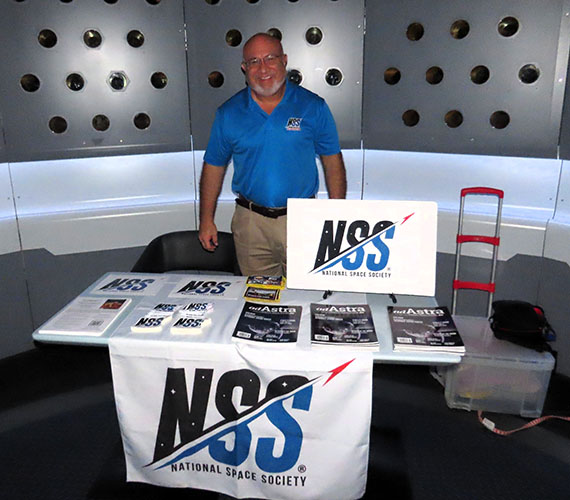
On September 12, the 50th anniversary of President John F. Kennedy’s “We Choose to Go to the Moon” speech, members of the National Space Society (NSS) went to Capitol Hill and urged Congress to support our nation’s space program in a Legislative Blitz that was co-organized with Explore Mars, Inc. (see Blitz Talking Points).
Kennedy’s famous speech, given at Rice University on September 12, 1962, issued a challenge to our nation’s people, to American ingenuity, and to our technological prowess in space, to land a man on the Moon before the end of the 1960’s – a goal that was achieved with the Apollo 11 mission in 1969. NSS and Explore Mars adopted the theme of “We Choose to Explore Space” in recognition of Kennedy’s speech, which inspired our entire nation to provide broad support for the development of our space program.
“During our September 12th visit to Capitol Hill, we found broad bi-partisan support for our space program, yet our space program continues to be subject to the budgetary pressures of these difficult fiscal times. With the ever increasing threat of the implementation of further budget cuts, members of the space advocacy community must continue to speak out in order to have their voices heard,” said NSS Executive Vice President Rick Zucker. Mr. Zucker chairs the NSS Policy Committee and is the primary coordinator for such NSS grassroots efforts, including the two-day, annual Legislative Blitz, usually held in late February.
NSS advocated for the following major components of a well-developed U.S. space program:
Development of the next generation of launch vehicles that are mission-enabling and mission-enhancing, while at the same time focused on efficiency, affordability, safety, reliability, and sustainability;
Full support by Congress for the commercial launch industry in its efforts to restore American access to the International Space Station, with NASA focusing its resources on exploration;
Establishment of timelines and goals for future human space activities, including at least one intermediate destination beyond Low Earth Orbit (LEO), such as an asteroid or the Moon, as well as a plan to land humans on Mars;
Support for robotic missions that will push the boundaries of knowledge and pave the way for human space exploration;
The definition and prioritization by NASA of the most promising advanced technology concepts, which will not only provide the means to explore and develop space, and a sustained human presence in space, but also to develop new applications to improve life on Earth; and
A sustained generational commitment to NASA’s mission that transcends partisan politics and election cycles, as well as provides incentives for private sector participation and international partnerships.
NSS Executive Director Paul E. Damphousse said, “NSS will continue to lead the space advocacy community in calling on Congress and the Administration to work together to leverage the necessary partnerships between the public and private sectors relative to space. We recognize the fiscal times that we live in today, but our future depends on a strong commitment to our nation’s space program.”
These grassroots visits to Washington unite individuals from all walks of life and with diverse political beliefs to meet with members of Congress and/or their staff to stress the importance of space exploration and development.