Noted Astronomer was a Motive Force Behind the Search for Extraterrestrial Intelligence
The National Space Society mourns the passing of noted astronomer and astrophysicist Frank Drake, who died on September 2. Drake was a major figure in astronomy and cosmology, and a friend to NSS.
Widely known for his famed Drake Equation, which attempted to estimate the possible number of intelligent species in our galaxy, Dr. Drake was responsible for Project Ozma, the earliest search for extraterrestrial intelligence (SETI) program that was started in 1960. He was also a major force behind the creation of the SETI Institute, which opened in 1984 in cooperation with NASA.
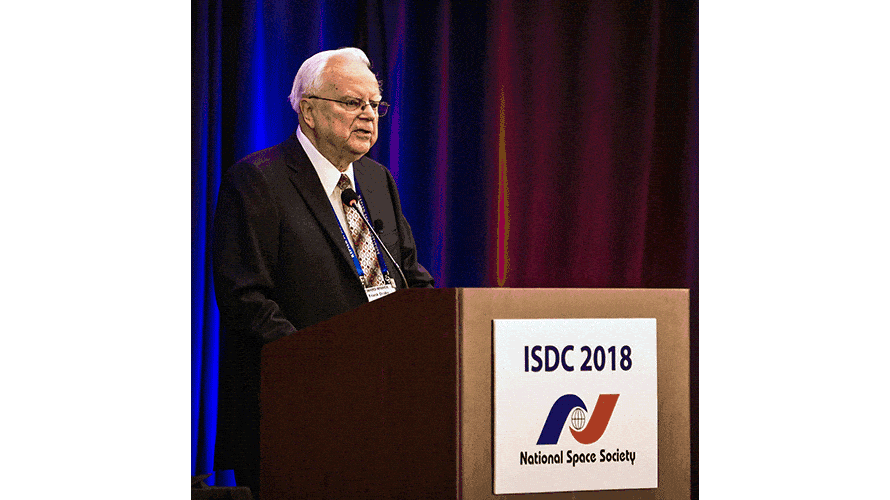
“Frank Drake was a man of great intelligence and curiosity, and was one of the first to conceive of extraterrestrial intelligences in objective terms,” said Dale Skran, NSS COO. “His seminal Drake Equation remains a bellwether in SETI research. The National Space Society was honored to award him its Space Pioneer Award in 2018 for his long and forward-looking career. His insights and pioneering spirit will be missed.”
Drake worked at the National Radio Astronomy Observatory at Green Bank, West Virginia, after earning a Ph.D. from Harvard University. He dictated the observatory’s first research program, christened Project Ozma, which investigated two nearby stars, Tau Ceti and Epsilon Eridani, for artificially created microwave signals, possibly indicative of extraterrestrial intelligence. This was one of the first SETI experiments and led to a request from the National Academy of Sciences that he assemble a conference to discuss such experiments. For the resulting conference, Drake conceived what became known as the Drake Equation, consisting of seven mathematical terms whose product would be the estimated number of extraterrestrial societies in our galaxy who were producing signals that humanity might, theoretically, discover.
Drake held academic positions at Cornell University and the University of California, Santa Cruz, and conducted research on pulsars and planetary radio astronomy, among other important areas of astrophysics and cosmology. He also served as the director of the Arecibo Observatory while a professor at Cornell.
Drake’s efforts to make “first contact” included work on the “Golden Record” that was affixed to NASA’s twin Voyager spacecraft (on which he collaborated closely with Carl Sagan), and creating the “Arecibo Message,” an engineering experiment that beamed an authored message to globular cluster M13 in 1974. In 1984, he became president of the SETI Institute in Northern California. On the occasion of his retirement from that position in 2010, he said, “I’m never going to retire from SETI.” True to his word, he continued working with the organization for the rest of his life.
“Dr. Drake was a courageous voice in the astronomy community, and he followed his curiosity into SETI research at a time when it was quite controversial,” said Rod Pyle, Editor-in-Chief of Ad Astra magazine, the print quarterly of NSS. “The spirit of his vision is reflected in the Space Pioneer Award, which has been presented to some of the top leaders in space science, engineering, and business—a diverse list that includes astrophysicist Kip Thorne, Elon Musk, astronauts John Glenn and Eileen Collins, NASA executive Kathy Lueders, and actor Tom Hanks.”