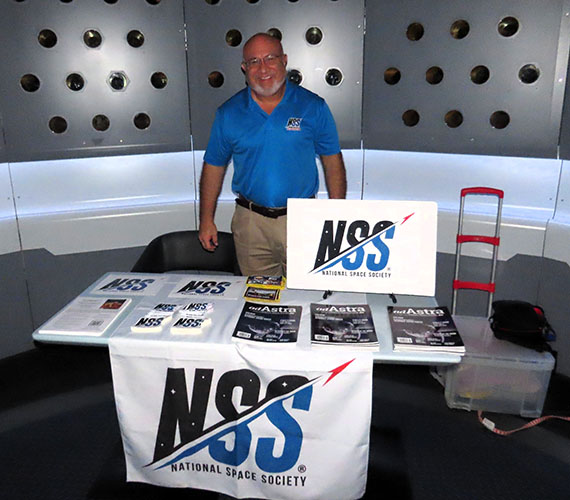
The Economist magazine has conducted an open, on-line forum on the topic, “Can Solar Energy Save the World,” which concluded on Friday, November 8, 2013. The Washington DC-based National Space Society (NSS) has voted “YES” in this debate.
NSS urges that the European Union (EU) allow Space Solar Power to be given equal treatment with other sources of renewable energy as part of the European system of feed-in tariffs, which have worked for ground-based solar power to create a viable new market for energy. Feed-in tariffs are a guaranteed offer of a price and a market to generators of renewable electricity and not a tax on imported goods.
Dr. Paul Werbos, Chair of the NSS Policy Committee, said “What are some good strategies to really help develop space resources? The best strategy is one which tries to ‘kill two or three birds with one stone.’ And so, at nss.org/EU [and reproduced below], you will see a new position statement aimed at three goals — to create new jobs where they are badly needed in the EU, to accelerate low-cost forms of solar farms on Earth, and to set the wheels in motion for serious market-oriented investment in space solar power.”
=======================
National Space Society Statement on Space Solar Power (SSP) and Feed-In Tariffs
Germany has long had a feed-in tariff system (EEG), which, among other things, guarantees a market and a price for large scale wind and solar farms. Some critics argue that these should simply be abolished, because of the damage they claim has been done to the German economy; however, the German economy seems to be doing quite well, compared to other major developed economies on Earth. The feed-in tariff is not a tax or a tariff like the tariffs we pay for imported goods; it is essentially just a guaranteed offer of a price and a market to generators of renewable electricity.
Just as we urge opening up the launch services market to more competition and new technologies, the National Space Society (NSS) also urges opening up the European electricity market to more large sources of renewable electricity. For the sake of lower energy prices, greater competition and greater economic stability, we propose that the feed-in tariff for large solar farms be extended to all solar farms in the European Union, and also to all rectennas to be located in the European Union supplying electricity from energy beamed from space.
Even just a year ago, the possibility seemed to be remote that industry might build such rectennas; however, the new design and analysis at www.nasa.gov/pdf/716070main_Mankins_2011_PhI_SPS_Alpha.pdf, combined with potentially useful efforts on key technologies to reduce the cost of access to space such as the DARPA XS-1 program and private sector efforts like SpaceX and others, suggest that we should not rule out such a development.
In the market based approach, we do not choose which technology we believe in more; rather, we offer the same incentive to all forms of benign solar energy anywhere in the EU, and let suppliers decide for themselves what to invest in and where. A firm price guarantee can be very useful in stimulating the kind of private sector investment and jobs which all major economies need today. For the EU, especially, a new supply of renewable electricity would be a great thing for consumers, who otherwise would be paying for more expensive offshore wind or imported natural gas — so long as solar suppliers on Earth or in space can meet the offer price. As in the past, this should be a standing law, allowing suppliers to decide on their own schedule for deployment.