
|
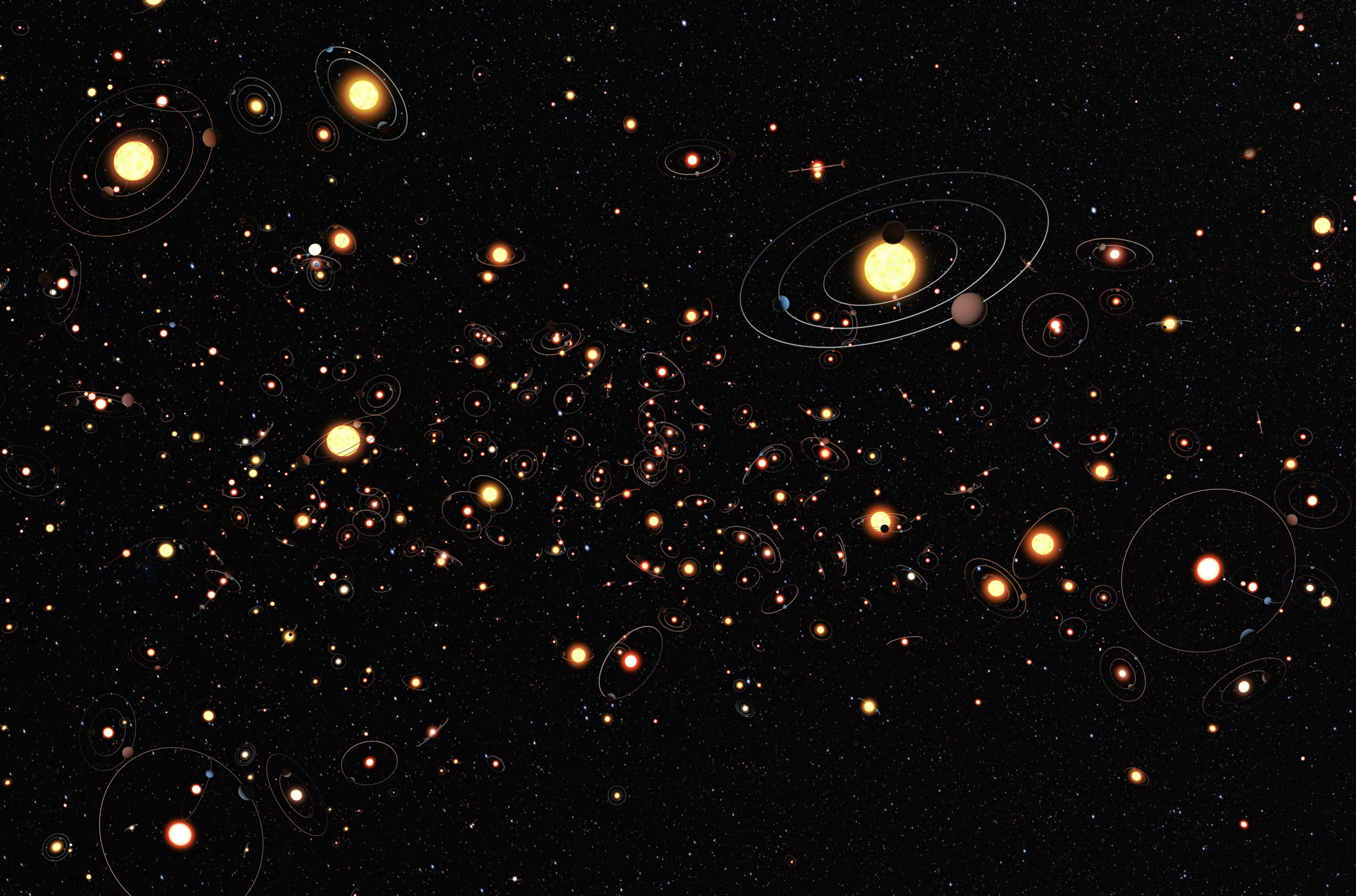
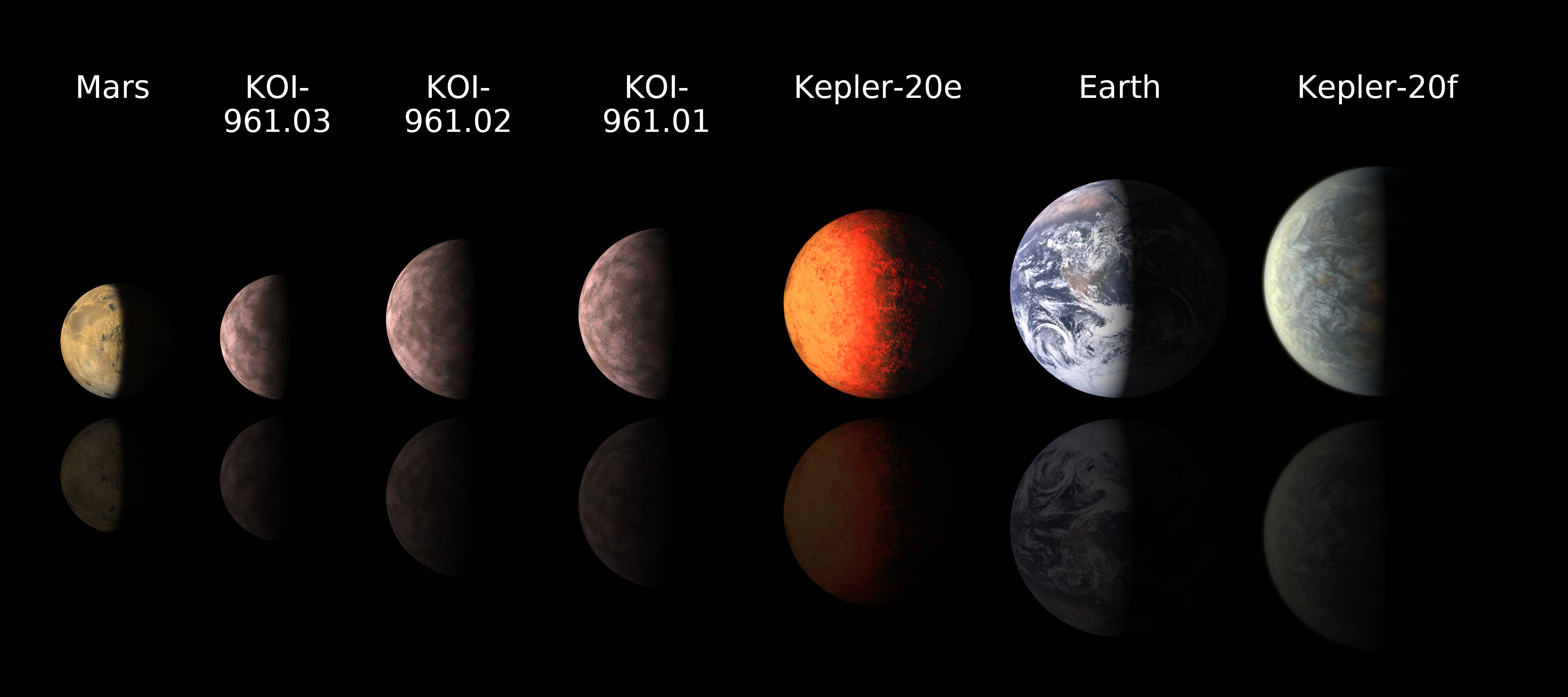
With the forthcoming publication in the journal Nature on 12 January, it is estimated that there are more than 100 billion planets in our Milky Way galaxy. That means more than one planet per star, and results show that there are more rocky small Earth-like planets than giant Jupiter-size gas planets. Most recent discoveries have come from the Kepler Observatory using transit observations. Some of the earliest confirmation of gas giants came from radial velocity Doppler observations. The conclusions in the Nature article are based on micro-lensing studies. Recent results from the Kepler Observatory have shown the existence of three small, rocky planets around the star KOI-961, a red dwarf. These three planets, named KOI-961.01, KOI-961.02 and KOI-961.03, are 0.78, 0.73 and 0.57 times the radius of Earth. The smallest is about the size of Mars (see below). Follow-up observations were made by the Palomar Observatory, near San Diego, and the Keck Observatory atop Mauna Kea in Hawaii.
Since it is now clear that rocky planets exist around millions, if not billions, of stars, the question arises as to whether there is life on them, and whether it may resemble life on Earth. Whether a planet exists in the “Goldilocks” region around a star depends on many factors. Three factors include the type of star, how far away from the star the planet resides and the atmospheric pressure of the planet. A red dwarf, such as Gliese 581, means the planet has to be closer than the Earth to our Sun. A white hot star means the planet has to be farther away. And if the atmosphere is low, like Mars, or to high, like Venus, liquid water is not likely. A fourth factor is axial tilt. If a planet has no axial tilt (the spin axis is perpendicular to the plane of its orbit around the star) then the polar regions freeze and the equatorial regions bake. There is little exchange between these regions due to atmospheric circulation. Axial tilt, such as the Earth has, allows distribution of heat between the equator and the poles. Even if a planet has axial tilt, a recent study shows that interaction at a close distance (within the “Goldilocks” region) with red dwarf will eliminate axial tilt in less than 100 million years. Bacteria on Earth required 1,000 million years to evolve. Theoretically, a planet with no axial tilt could possess bands between the equator and the poles where liquid water would exist. But, it is quite possible the atmosphere would collapse, with gases being driven off into space at the very hot equator, and freezing solid on the ground at the poles. Such a possibility faces the planets around KOI 961. Systems with stars like our Sun present better possibilities. The “Goldilocks” conditions exist much farther out, and axial tilt is eliminated much more slowly, as our Earth is witness. Systems such as Kepler-22b are good candidates. The conclusion drawn from these studies is that systems similar to our Solar System present the best opportunities for life. |



Look Back in Anger: 15 Years Since Falling to Earth
This Space Available By Emily Carney “You know who I am,” he said The speaker was an angel He coughed