
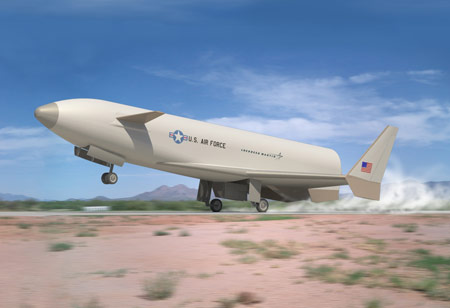
Lockheed Martin has been selected by the U.S. Air Force for a contract award to support the Reusable Booster System (RBS) Flight and Ground Experiments program. The value of the first task order is $2 million, with a contract ordering value of up to $250 million over the five-year indefinite-delivery/indefinite-quantity contract period. The Air Force Research Laboratory (AFRL) and the Air Force Space and Missile Systems Center are developing the RBS as the next generation launch vehicle that will significantly improve the affordability, operability, and responsiveness of future spacelift capabilities over current expendable launchers.
Initial RBS Flight and Ground Experiments task orders will provide for an RBS flight demonstration vehicle called RBS Pathfinder scheduled to launch in 2015. The RBS Pathfinder is an innovative reusable, winged, rocket-powered flight test vehicle that will demonstrate the Reusable Booster Systems’ “rocketback” maneuver capabilities and validate the system requirements that will drive refinements in the design of the operational RBS.
For the RBS Pathfinder program, Lockheed Martin has also entered into an agreement with the New Mexico Spaceport Authority to conduct flight test operations from Spaceport America, the nation’s first purpose-built commercial spaceport, located in southern New Mexico.
The vehicle would be launched vertically and landed horizontally. Further details, such as booster lift capability, are unavailable.











2 thoughts on “Lockheed Martin Reusable Booster System”
Is this not just a worrying continuation of the ridiculous excuse to use of the military complex as a means for advancing technology? Why isn’t this in NASAs hands rather than the USAF? Doesn’t USAF have clearly worrisome priorities? Makes to me little sense, since the cold war has been over for a while.
While people may think that it’s just a means to an end or something in that fashion, it should clearly work in another way and is just opening the potential for more resources getting thrown into useless astronomically expensive military projects with little to no civilian benefit.
Hi Bann,
Let’s be realistic. NASA can’t even fund CCDEV the way it needs to be funded. It is too much in the stranglehold of Congress, which has mandated the development of the expensive and ultimately to be cancelled jobs program called the Senate Launch System (SLS). The Air Force has a much easier time getting done what needs to be done. Congress doesn’t micromanage the DOD the way it does NASA. Contrary to your last comment, this is clearly a case where a military project can be easily convertable to a civilian product with great benefit to the civilain economy.