 |
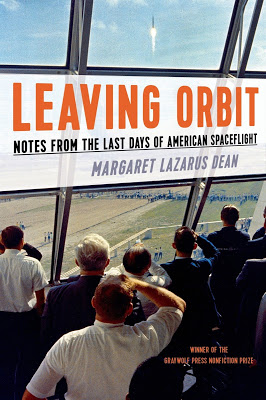
| Cover of Leaving Orbit. Image Credit: Amazon.com |
Occasionally, this blog features other contributors; on this occasion we are happy to host this review by space historian and author Francis French of Margaret Lazarus Dean’s recently-published book, Leaving Orbit: Notes from the Last Days of American Spaceflight. Read more after the jump…
A Masterful Meditation on a Poignant Pause: A Review of Leaving Orbit: Notes from the Last Days of American Spaceflight by Margaret Lazarus Dean
With Leaving Orbit, Margaret Lazarus Dean opens with one of the best-written space musings I have ever read. It may be because the author and I are about the same age, with the same experiences of walking into space museums as a child, but she nails, absolutely, how those of us who grew up with the space shuttle perceive the last few decades of space flight. The book is worth purchasing for the prologue alone.
Can the book sustain that feeling for the next three hundred pages? Well, of course not. That would be almost impossible. And there are times in the middle of the book where I feel the pace has slowed a little too much, and the musing is repeating a little. Nevertheless, at the end, I am sorry when the book is over.
Dean does, better than anyone, stake claim to a new niche in what she correctly identifies as a literary field all to itself: that of space reporting, and observing the sweep of human spaceflight. Not the recollections of the astronauts, but instead the more difficult task of witnessing and describing from the ground. She reflects often on those who came before her – not so much on the well-worn-Tom Wolfe style, so emulated now as to be cliché, but the lesser-known work of Oriana Falacci [author of the 1966 book If The Sun Dies] and Norman Mailer.
Fallaci’s work in particular is unfamiliar to many, but her determination in the 1960s to thrust herself as a foreign woman into a world of American military men and tell it as she saw it is wonderfully illuminating. Mailer was able to capture his total confusion at the anodyne boredom of the public face of Apollo 11, but to my mind then bloviated for hundreds of pages to little end. Dean is able to tease the good strands of thoughts from Mailer’s self-absorbed, wasted opportunity, and place herself deservedly as the new voice of a tradition of watching the space program unfold, close by, but not so close as to be involved. The reader is thus able to feel, as a fellow outsider, events take place in what Dean correctly describes as a turning point in history. While chronologically impossible due to their age difference, I wish Dean had been there in 1969 to slap Mailer around a little and say “Focus! Look at what you are missing! Look at THAT!”
Dean tells us what humans have accomplished in space, and the awkward pause we find ourselves in now, better than any writer ever has. It’s fresh, and most intriguingly – because it is still taking place – the questions are startlingly relevant. What is next for America’s space program? Dean does the toughest job of all. She doesn’t advocate, she doesn’t try and answer questions that cannot yet be answered. Instead, she captures that sense of unease, that sense of wondering, better than any. It’s a poignant elegy by a smart, inquiring mind. She is careful to always ask the questions as one thoughtful, outsider individual, not try and widen the scope. She captures a culture, which in many ways is much harder than capturing a history on the page. She asks “why,” more than telling us “what.” In doing so, she tells a wonderfully crafted, personal story that should draw in every reader.
By now, you’ve guessed that I think that she is a darn good writer…there are turns of phrase here and details that caught me thinking, “I know that feeling exactly, and no one has ever captured it on a page like that before.” Such books are rare. And Dean does it despite this book having one of the most divisive, potentially confusing, argument-inciting subtitles ever. Putting an image of an Apollo launch on the cover of a book about the last shuttle launches seems puzzling enough, but subtitling a book Notes From the Last Days of American Spaceflight made my fists clench. Wait a minute, I thought when first seeing it, there have been Americans permanently living in space since the year 2000, including the many post-shuttle years. Want to tell the current crew that they are living AFTER the last days of American spaceflight? It’s one of those “I know what they mean, but…” titles that is pointlessly provocative for a book deserving of a better title. Dean’s writing is much, much more nuanced and thoughtful than such sloganeering.
Such things are minor, however, compared to the overall scope of the book. Rather than amped-up hyperbole of questing for the heavens, or surrendering to melancholy, Dean fully captures a sense of a curious young woman standing on uneven, swampy ground, sweating in the humidity, irked by mosquitoes, waiting for a shuttle launch that might take place in minutes, or be postponed for months. If you missed seeing the final shuttles launch in person – read this book. And you’ll be there.
Francis French is the author of space books such as Into The Silent Sea and In the Shadow of the Moon.
Emily Carney is a writer, space enthusiast, and creator of the This Space Available space blog, published since 2010. In January 2019, Emily’s This Space Available blog was incorporated into the
National Space Society’s blog. The content of Emily’s blog can be accessed via the This Space Available blog category.
Note: The views expressed in This Space Available are those of the author and should not be considered as representing the positions or views of the National Space Society.