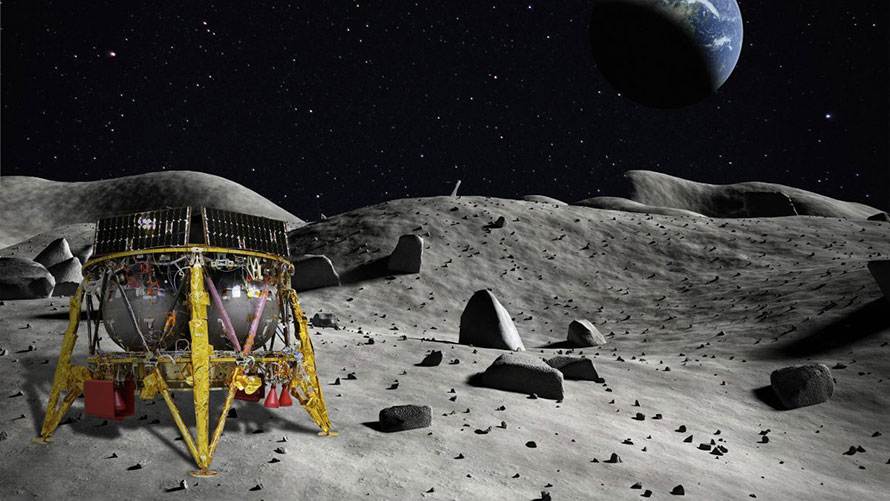
Image: Artist concept of the Beresheet lander on the Moon. Credit: SpaceIL.
By Dale Skran, NSS Executive Vice President
Rather than repeating the facts about this launch, which you can easily find on other sources on the net, I would like to emphasize the “firsts” associated with this launch:
- Organized by Space Flight Industries, this mission was the first geosynchronous “ride-share” carrying three craft: An Indonesian communications satellite, Nusandtra Satu, the Israeli Beresheet lunar lander built by SpaceIL, and the U.S. Air Force S5, a space situational awareness demonstrator. This is a key milestone in supporting lower-cost access to higher orbits.
- The Beresheet lander, if successful, will mean that Israel will become the fourth nation to land on the Moon, following the Russia, the U.S., and China, narrowly edging India which will shortly make its own lunar landing attempt.
- SpaceIL/Beresheet is the first commercial attempt to land on the Moon.
- The F9 first stage, numbered 1048, flew for the 3rd time, making it only the second F9 first stage to fly and land three times. It was announced that it will fly for a fourth time in April, setting a new record for F9 first stage re-use.
- This was reported to be the most challenging F9 first stage recovery yet in terms of returning from a higher velocity.
- This mission is of special interest since the Nusandtra Satu and the S5 are headed for geosynchronous orbit, whereas the Beresheet enters a highly elliptical orbit that will eventually allow it to reach the Moon after additional engine burns.
- The Beresheet will be, at 600 kilograms, or 1,322 lbs, the smallest lunar lander yet.
- SpaceIL/Beresheet will be, if successful, the first former Google X-prize contender to reach the Moon.
- The Nusandtra Satu, which will provide communications services to a “third world country” marks a significant step in the democratization of space technology enabled by the lower cost of reaching space resulting from SpaceX innovations.
Perhaps most significantly, none of these firsts were funded by NASA. Launches like this one will form the basis of a truly sustainable space program, one that is not impacted by the vagaries of Congressional funding or government shutdowns.