
By Dale Skran
Chair of the NSS Executive Committee
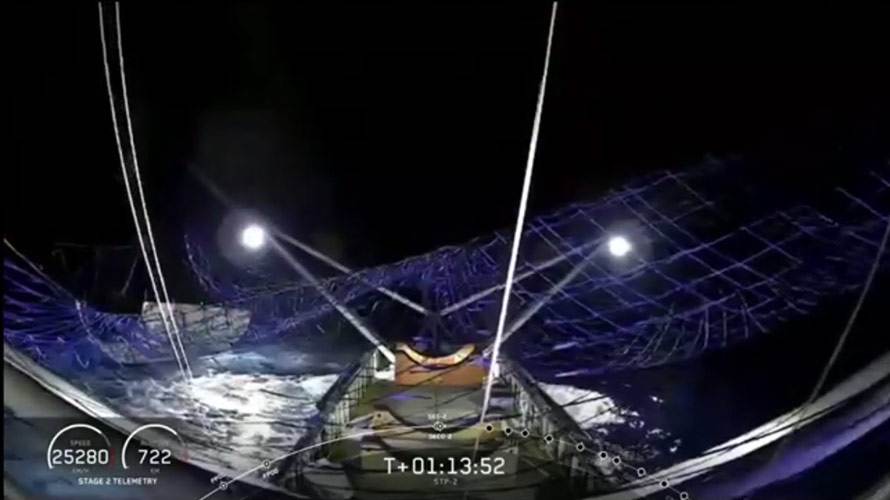
Image: First SpaceX recovery of payload fairing
In March of 2019 I wrote a Dragon 2 focused update on the “SpaceX Triple Trifeta.” In that article I reviewed the status of SpaceX’s three ambitious goals for 2018:
• Bring the Falcon Heavy (FH) to operational status
• Bring the Dragon 2 crew capsule to operational status
• Bring the Falcon 9 (F9) Block 5 to operational status
At the time, the Falcon 9 Block 5 part of the trifecta was clearly complete, and the crewed Dragon 2 had just experienced a huge success with Demonstration Mission-1 (DM1). However, since then a major testing “anomaly” (explosion to the rest of us) of the Dragon 2 capsule targeted for the in-flight abort test has set back the crewed flight of Dragon 2 until at least November 2019, if not later.
The great thing about a plan with three parts is that—there are three parts! If one has problems, the others can still usually move forward. On June 24, 2019 with the successful launch of the Department of Defense Space Test Program-2 (STP-2) by the Falcon Heavy, the FH part of the trifecta can be declared complete. There have now been three successful FH launches:
• Musk’s Red Tesla Roadster toward Mars on 2/6/18
• Arabsat 6A on 4/11/19
• STP-2 on 6/24/19
These launches have included the following milestones:
• Three sets of side boosters safely flown back to the launch site
• First re-use of a set of side boosters (STP-2)
• First “dry” recovery of a payload fairing (STP-2) (see photo above)
• First time the F9 second stage has fired four times to deliver a total of 24 satellites (STP-2)
• Launch of the Planetary Society’s experimental lightsail (STP-2)
• First use of a FH by the Air Force (STP-2)
• First use of “flight proven” side boosters by the Air Force
Sadly, for all three flights the center core was not recovered:
• The first core ran out of igniter fluid
• The second core landed on the drone ship successfully, but then tipped over due to high seas
• The third core apparently just came in too hot to land since this was the most extreme recovery yet attempted by SpaceX.
Although it may take a while for SpaceX to fully master center core recovery, the FH is clearly “ready to rumble.” It would not be surprising if multiple orders for this impressive vehicle started to appear in the near future.
With 2 of the 3 parts of the “Trifecta” well in hand, it is time to look forward to SpaceX’s next set of goals. At this time, there appear to be three new visions on the SpaceX horizon:
• Replace the F9 and FH with a single, much cheaper to operate Starship/Superheavy vehicle using the new Raptor engine.
• Launching the 12,000 LEO datasats needed by the Starlink system, initially using the F9/FH and later Starship/Superheavy.
• Using Starship/Superheavy to provide point-to-point travel on the Earth.
As the Raptors roar out Texas way, all three of the legs of the new Trifecta are visibly under construction, with shiny stainless steel Starship orbital prototypes rising in both Texas and Florida. Stay tuned for exciting times!








1 thought on “Falcon Heavy Update on SpaceX’s “Triple Trifecta””
Starship is too much, too soon. But build the darned thing anyway. I want to be proven wrong.