A Magazine Review by Dale L Skran, NSS Executive Vice President
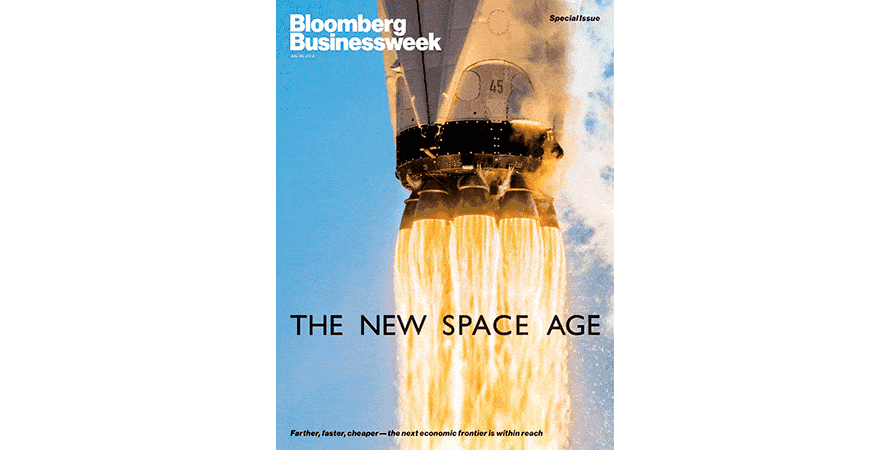
The July 30, 2018 issue of Business Week is a special issue devote entirely to space. For the most part the articles are serious and interesting, with one glaring exception. NSS and its International Space Development Conference (ISDC) are mentioned twice in the article that focuses on Jeff Bezos, a clear example of how NSS is having a greater impact on the public. You can find the articles on-line at: www.bloomberg.com/2018-new-space-age-issue.
The issue is organized into four sections:
- Countdown
- Launch
- Orbit
- Far Out
Launch is the strongest section, starting out with “Meet the woman making SpaceX Soar,” an homage to Gwen Shotwell that also manages to give a good picture of just how far SpaceX has come. This is followed by “How’s that other billionaire rocket maker doing?” which updates the reader on Blue Orgin and Jeff Bezos, including references to NSS and the ISDC. The next article “Masters of the Stratosphere” covers Worldview’s balloons under the leadership of Jane Poynter, a former Biospherian. “A Cancer Cure could Start in the Thermosphere” gives a good sense of how important research on the ISS may become.
The paper version concludes the “Launch” section with “Forgotten Images from the Shuttle’s Glory Days” but the on-line version adds a more substantial article “The New Rockets Racing to Make Space Affordable.” The main message of this article is contained in the following quote:
These innovations for very small and very large payload vehicles have led to lower costs for the launch industry as a whole. Carissa Christensen, founder and chief executive officer of consulting firm Bryce Space and Technology, which compiled the FAA report, says there’s been a 10 percent to 15 percent drop in launch costs in real terms since 2010, driven in part by SpaceX.
The company “has dropped launch prices by something around 25 percent,” Christensen says, saving customers as much as $10 million to $20 million, and putting pressure on rivals. Christensen has since seen prices drop at both Europe’s Arianespace and the Atlas V program of United Launch Alliance (ULA), a joint venture of Lockheed Martin and Boeing that’s been a regular provider of launches for the U.S. government.
Among geostationary or geosynchronous transfer (GTO) missions, which need to achieve a specific orbit of around 36,000 kilometers and are therefore better suited for direct comparisons, average launch costs are down about 20 percent from five years ago, according to Carolyn Belle, a senior analyst at space consultancy Northern Sky Research. Here again, the Falcon 9 leads the pack.
With the exception of one article on an investor who uses astrology to pick stocks, the rest of the issue is worth taking a look at.