Category: Non-Fiction
Reviewed by: Jim Plaxco
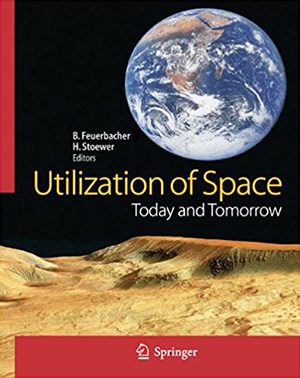
Title: Utilization of Space: Today And Tomorrow
Editors: Berndt Feuerbacher and Heinz Stoewer
NSS Amazon link for this book
Format: Hardcover
Pages: 410
Publisher: AIAA
Date: November, 2005
Retail Price: $84.95
ISBN: 1563477912
Utilization of Space is a book devoted to providing a detailed
explanation of the various scientific and technological fields in which
space based assets, primarily satellites, have either greatly enhanced
our depth of understanding for that field or have created, as a
consequence of humanity’s first steps into the space environment,
entirely new ones. Edited by Berndt Feuerbacher and Heinz Stoewer, the
book is a collection of independent chapters contributed by authors
affiliated with various German education and aerospace institutions.
With contributions from twenty distinguished scholars from a variety of
fields, this book provides a rather comprehensive overview of how space
utilization contributes to the advancement and betterment of human society.
Chapter List:
1 Space Utilization
2 Access to Space – the Prerequisites for Space Utilization
3 The Earth Surface
4 Climate and Environment
5 Weather Observations from Space
6 Geodynamics
7 Astronomy and Astrophysics
8 The Solar System
9 Communications
10 Satellite Navigation
11 Fundamental Physics
12 Materials Sciences
13 Life Sciences
14 Challenges and Perspectives
For each of the eleven different topic areas addressed, the authors
provide a brief introduction to the field; an explanation of the
underlying principles; and the role that space, satellites in
particular, has played in that field. Perhaps most satisfying is that
each of the chapters stands on its own, making it possible for the
reader to focus on those chapters that deal with areas in which they are
most interested. The four main conceptual areas the book is concerned
with are the study of the Earth, the study of the heavens,
communications, and space based experimentation.
Following an introductory chapter, the book dives into the issue of
access to space, the key limiting factor to broader use of space.
Perhaps the most interesting aspect of this chapter is its coverage of
project management, systems engineering, and product assurance as they
relate to the design of space missions.
The next four chapters of the book deal with observing Earth from space.
Since 1960, when the first satellite to simply “look” at clouds was
launched, great strides have been made in the technology and data
processing necessary to provide humanity with essential information
regarding the state of the planet. Space based observations are
especially important when it comes to collecting data over the oceans
(70 percent of the Earth’s surface) and remote areas that lack local
observational stations. The availability of high quality global data
sets from satellite instruments is crucial in building climate models
and numerical weather prediction models. The four chapters that deal
with these issues do an excellent job of providing both an introduction
to the associated sciences and an overview of the satellites and
instrumentation.
My favorite quote about the importance of space utilization comes from
one of the two chapters devoted to the study of the heavens. In the
chapter “The Solar System”, the author states that “It can be said
without any doubt that space exploration has turned dim discs in the sky
observable with telescopes into worlds in their own right waiting for
further, perhaps eventually human, exploration.” The knowledge acquired
from just 40 years of space missions has revolutionized not just our
understanding of the solar system, but the universe as a whole. Given
broad concerns about global warming and humanity’s possible impact on
the Earth’s climate, the book’s coverage of planetary science enhances
those chapters dealing with the study of the Earth.
In terms of commercial space, the next two chapters are devoted to using
space assets for world wide communications and satellite-based
navigation. GPS, satellite television, and global telecommunications are
the aspects of space utilization with which people are most personally
familiar.
The final chapters of the book are devoted to the use of space as a
laboratory: a setting for conducting experiments impossible to perform
in a terrestrial environment. One common use is the testing of some of
the basic laws of physics, especially those dealing with gravitation,
the special theory of relativity and the general theory of relativity.
Experiments into materials processing and crystal growth take advantage
of the available microgravity environment which makes possible a
variety of novel experiments. The chapter on life sciences covers not
only questions of the space environment and its affect on human
physiology, but the relatively new field of astrobiology as well.
The book’s editors, Feuerbacher and Stoewer, bring the book to a close
with a chapter that summarizes the positive impact that space
utilization has had on humanity. In their opinion, “in order to respond
to fundamental demands of human society, space activities have to
concentrate on: human welfare and sustainability of life; economic
development and security; culture and knowledge.”
Utilization of Space is well illustrated and each chapter ends
with a list of references: both print and electronic. This book makes
for an excellent reference and I can heartily recommend it to anyone who
is interested in understanding space utilization and its impact on
humanity.
© 2007 Jim Plaxco
NSS Featured Review for August 2007
Please use the NSS Amazon Link for all your book and other purchases. It helps NSS and does not cost you a cent! Bookmark this link for ALL your Amazon shopping!