Category: Nonfiction
Reviewed by: Casey Suire
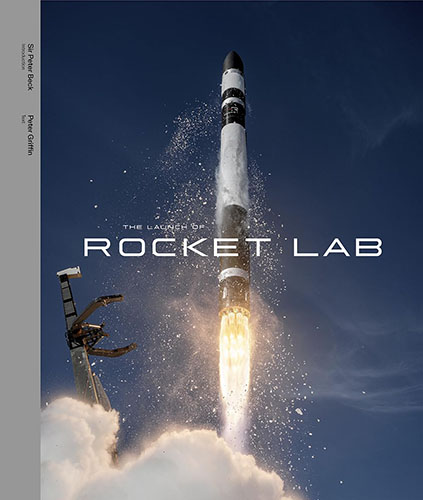
Title: The Launch of Rocket Lab
Author: Peter Griffin, with introduction by Sir Peter Beck
Format: Hardcover/Kindle
Pages: 300
Publisher: Blackwell & Ruth
Date: November 2025
Retail price: $60.00/$31.10
ISBN: 978-0473741228
Find this book
Sir Peter Beck and the Rocket Lab team had an outstanding 2025. Their workhorse Electron rocket successfully delivered numerous customer payloads to either low Earth orbit or sun-synchronous orbit. In August, the company unveiled a brand-new launch facility, Launch Complex 3 (LC‑3), in Wallops Island, Virginia. Launch Complex 3 will support launches of Neutron, the company’s upcoming medium-lift, partially reusable launch vehicle. In the weeks following LC-3’s opening, Rocket Lab signed Electron launch contracts with Japan’s Synspective, iQPS, and JAXA. Consequently, Rocket Lab (RKLB) stock is performing exceptionally well.
Also in 2025, The Launch of Rocket Lab was published. This coffee table book, authored by journalist Peter Griffin, covers the entire history of Rocket Lab (2006-present). Even at a young age, Beck was obsessed with rocketry and spaceflight. His high school guidance counselor recommended to his parents that, “Your son needs to have more realistic expectations.” After all, Beck’s native New Zealand had zero space industry. Nevertheless, the young Kiwi rocket enthusiast followed his passion.
Fast-forward to today, Beck’s rocket company is among the most successful space companies on the planet. Rocket Lab’s many impressive accomplishments include the first private rocket to reach space from the Southern Hemisphere (Ātea-1), the first orbital carbon fiber rocket (Electron), the first 3D-printed rocket engine (Rutherford engine), the first electric pump-fed rocket engine (Rutherford engine), the first private orbital launch site (Launch Complex 1 on New Zealand’s Māhia Peninsula), the first launch of NASA’s Artemis program (CAPSTONE), and the fastest space company to launch 50 rockets.
Readers will quickly discover that the book is not stingy with pictures. Beautiful photos occupy almost every page; many pages just have pictures and no text. Photos of Electron, both on the factory floor and clearing the launch tower, are plentiful. Launches from the scenic Māhia Peninsula are quite picturesque. Other pics are from past Rocket Lab missions, such as the Humanity Star and Varda W-series missions. The detailed photographs of spacecraft components, such as star trackers and reaction wheels, effectively showcase Rocket Lab’s engineering capabilities. Additionally, informative illustrations, such as different configurations for HASTE military missions, are included. Other illustrations depict future Rocket Lab projects, such as Neutron and Flatellite. Overall, the book is quite aesthetically pleasing.
One noteworthy section of The Launch of Rocket Lab presents mission patches from the first 50 Electron missions. Since Electron’s maiden launch in 2017, Rocket Lab has adopted the practice of giving each flight a playful and colorful name. For example, the first Electron mission patch reads “It’s a Test.” Here are a few other past mission names: “Running Out Of Fingers,” “Pics Or It Didn’t Happen,” “Return To Sender,” “Virginia Is for Launch Lovers,” and “Live and Let Fly.”
Due to the generous quantity of photographs, only a fraction of the book’s pages include text. This makes The Launch of Rocket Lab a fast read. In addition to Sir Peter Beck, the book includes interviews with several Rocket Lab employees. Reading about their experiences at the company is compelling. For example, many characterize Electron launches as very stressful events. This includes Beck. In the book, he states, “I hate launch day.” Normally, he elects to watch launches from his desk instead of mission control. According to him, “they’re not for fun.” Noticeably, nobody in the book is addressed by a title or their last name; everyone is called by their first name. Peter Beck is simply “Peter,” not “Sir Peter Beck” or “Mr. Beck.”
One flaw of The Launch of Rocket Lab is repetitive information. Frequently, the book repeats details about many of Rocket Lab’s programs. For instance, readers will learn about the Neutron rocket’s innovative Hungry Hippo fairing design on both pages 156 and 286. It’s as if the first explanation is forgotten. Furthermore, one paragraph claims that “since 2022, Rocket Lab has recovered dozens of Electron first stages from the water.” Actually, only a handful of Electron boosters ever parachuted into the sea. In the future, Neutron will perform propulsive landings either at LC‑3 or on a barge. Initially, Beck didn’t plan to reuse his company’s rockets; he even promised to eat his hat if he broke his word. Eventually, he changed his stance on recovering Rocket Lab boosters. There’s a hilarious YouTube video of him eating pieces of a Rocket Lab baseball cap.
Rocket Lab’s ambitions extend beyond low Earth orbit. Beck’s space company designs and manufactures lunar and interplanetary spacecraft. In June 2022, Rocket Lab launched the CAPSTONE lunar mission for NASA. The tiny spacecraft was inserted into a near-rectilinear halo orbit (NRHO) around the Moon; NRHO is the same orbit planned for NASA’s proposed Lunar Gateway. Reading how the tiny Electron became a Moon launcher was quite fascinating. Tolerances were extremely tight; there even was an argument over whether a NASA decal added too much weight to CAPSTONE.
For Mars, Rocket Lab manufactured the Blue and Gold spacecraft for NASA’s ESCAPADE mission. ESCAPADE is unique since Blue and Gold won’t use a Hohmann transfer window to reach Mars. Rocket Lab also expressed interest in NASA’s troubled Mars Sample Return Program. Additionally, the company is currently working on Venus Life Finder, the first private space mission to another planet. The 2020 discovery of phosphine in the Venusian clouds grabbed the attention of astrobiologists. Sir Peter Beck believes Venus is the best place in the solar system to search for extraterrestrial life.
What does the future hold for Rocket Lab? How will Neutron perform? Will the company ever pursue human spaceflight? What will be discovered at Venus? Will Rocket Lab return Martian rock samples to Earth? How high will RKLB stock rise? Will Sir Peter Beck have to eat another hat? Stay tuned. Rocket Lab shows no signs of slowing down anytime soon. Whether you’re new to space, one of Rocket Lab’s 200K YouTube subscribers, or just a space enthusiast in general, this book is an excellent read.
© 2025 Casey Suire