
Category: Non-Fiction
Reviewed by: Steve Adamczyk
Title: The Apollo Guidance Computer: Architecture and Operation
Author: Frank O’Brien
NSS Amazon link for this book
Format: Paperback
Pages: 439
Publisher:
Springer-Praxis
Date: July, 2010
Retail Price: $44.95
ISBN: 1441908765
Frank O’Brien has created a comprehensive masterpiece chronicling the computer that made the Apollo lunar landings possible. The author notes that most of the books written on the space program describe the massive rockets, complex spacecraft, and amazing astronauts and engineers who made the missions happen, although something has been missing. The Apollo Guidance Computer: Architecture and Operation not only fills in the historical gaps, but completes the story and legacy of Apollo.
From bits and binary format, fixed memory and banking registers, to the software and hardware driving the guidance and control system, the complex ideas and descriptions are presented in a highly readable way that is understandable for anyone interested in computer design or Apollo history.
The Apollo Guidance Computer (AGC) had 38K of memory divided into 2K (2,048) words of erasable memory and 36K (36,864) words of fixed or read-only memory. The author relates the AGC to the present day by pointing out the inaccuracy in popular statements such as “a watch or calculator or microwave today has more computing power than the AGC.” These are mainly single task devices. A better comparison would be a current “smart phone” running several applications: camera, Internet, phone call, battery, antenna, and touch screen.
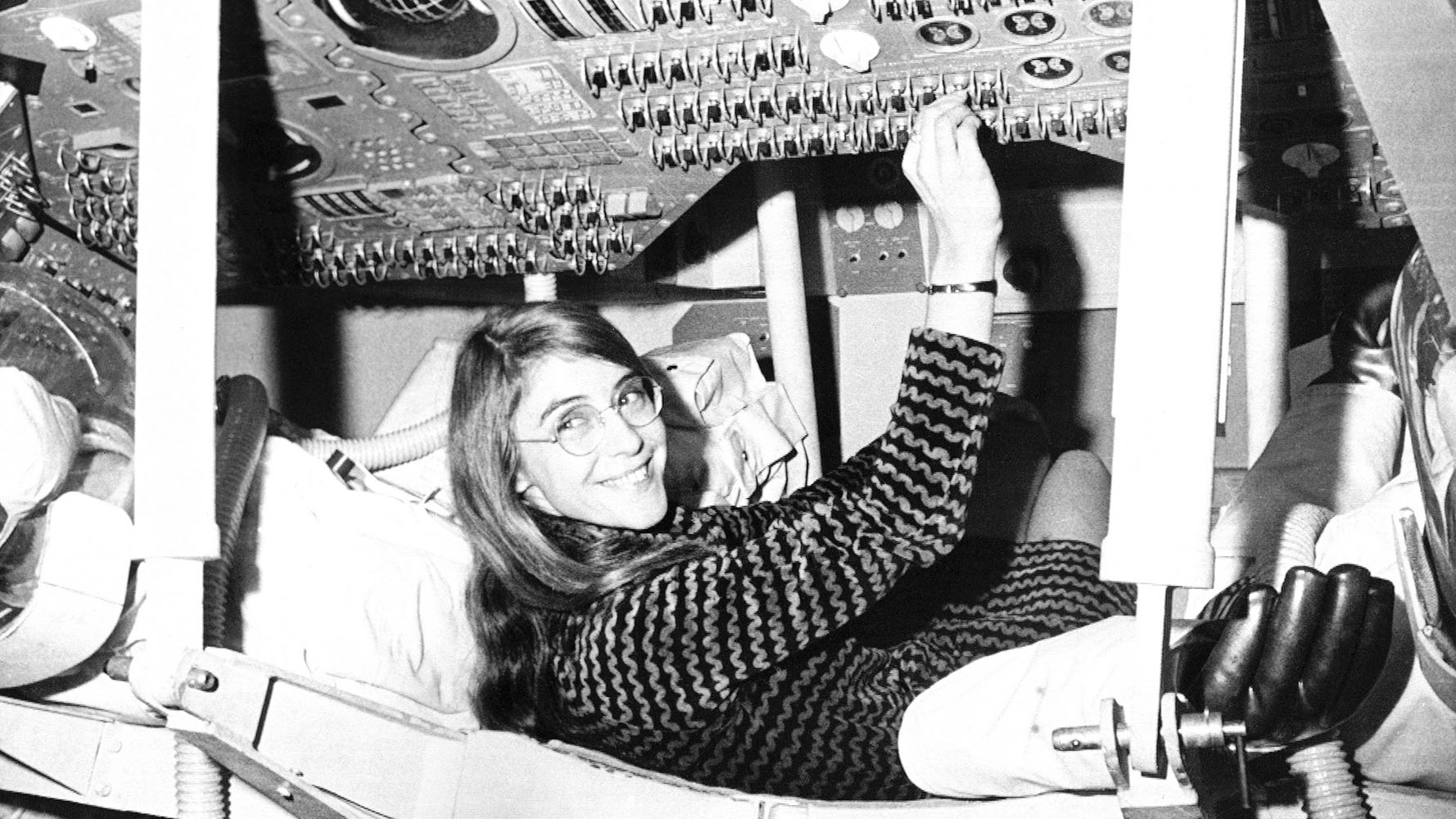
The Apollo Guidance Computer was essential to completing the lunar landings. It controlled firings of the service propulsion system engine as well as the lunar module descent and ascent engines. The reaction control system jets were computer commanded for spacecraft attitude and translation control. These propulsion systems were directed by the digital autopilot which is an essential piece of the AGC software. The rendezvous radar (RR), landing radar (LR), and all flight indicators were processed by the AGC.
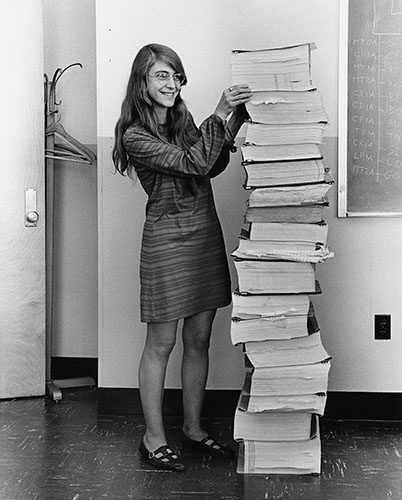
These systems demanded huge amounts of computing cycles from limited AGC memory and power. To accomplish the enormous computational tasks required for a lunar landing, the software engineers developed a new operating system called the Executive. Much of the programming was written in the assembler language and run on an innovative program known as the Interpreter, which reduced memory requirements and allowed the AGC to perform its critical functions with its limited resources.
This book is not a surface overview of the AGC, but a grand tour of the ground-breaking system. From the EBANK memory and data registers to the instruction sets and lunar landing programs, Frank O’Brien guides the reader through entering verbs and nouns into the display and keyboard (DSKY) updating the spacecraft state vector for guidance and navigation.
Many people think that computer control and updating from a remote location was invented in the age of the Internet and twitter messaging. In this book we learn that ground controllers could use the AGC INLINK register to update navigation data through the Manned Space Flight Network, from 240,000 miles away.
Since the AGC must have real time information on which to act, the author flawlessly explains the functions of Input-Output (I/O) devices such as the inertial measurement unit (IMU), RR, LR, and DSKY. Through the clear and concise descriptions it is easy to understand the concept, and dangerous results of gimbal lock in the IMU, or the elegantly simple conversion of analog measurements to digital input for the AGC.
After providing this monumental analysis of the “Architecture and Operation” of the AGC, the author integrates this information into a detailed description of a “standard” Apollo mission, from launch at Kennedy Space Center, to landing on Luna, and splashdown in the Pacific. This is not a typical mission overview, but an all-encompassing virtual journey to the Moon and back. All phases of the lunar landing and ascent from the surface are described in detail. From powered descent initiation to the fly-by-wire manual control of final touchdown, and lunar liftoff to docking with the command module, each phase is discussed and the roll of the AGC is highlighted.
As a bonus, an interesting description of the computer problems during Apollo 11 and Apollo 14 is included. It took the computer designers and programmers great effort to diagnose these difficulties, although it is easy to follow the author’s explanation of the Apollo 11 program alarms and the Apollo 14 abort discrete bit.
To complete this thorough work, the appendixes contain listings of everything from address instructions, interrupt vectors, I/O channels and registers, to lunar landing nouns, verbs and program alarms.
This comprehensive volume displays the achievements of Apollo through the brains of what made the human lunar landings successful, and shows the effects the AGC has had on computer evolution ever since. The Apollo Guidance Computer: Architecture and Operation introduces this iconic computer system, and takes the reader on a guided tour of the spacecraft operations, all the way to a landing on the Moon. It should be considered essential reading for any computer engineer/programmer, while historians and space enthusiasts will enjoy a real treat.
© 2010 Steve Adamczyk
Please use the NSS Amazon Link for all your book and other purchases. It helps NSS and does not cost you a cent! Bookmark this link for ALL your Amazon shopping!