
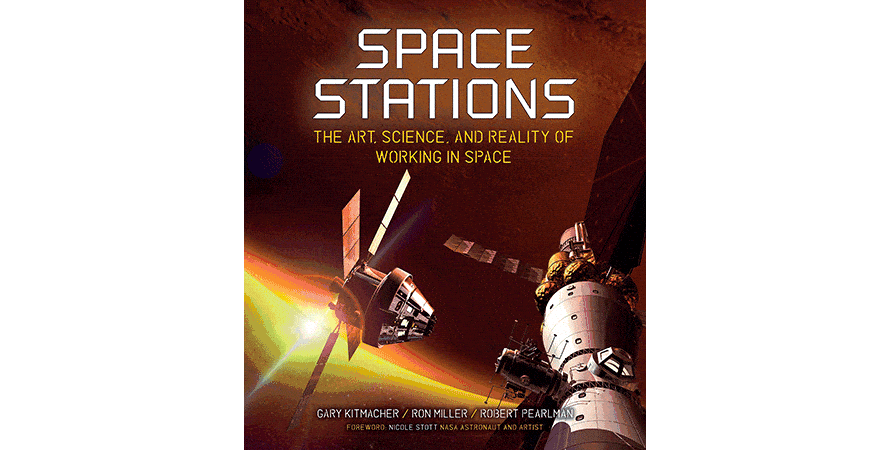
Category: Nonfiction
Reviewed by: Ted Spitzmiller
Title: Space Stations: The Art, Science, and Reality of Working in Space
Authors: Gary Kitmacher, Ron Miller, and Robert Pearlman
NSS Amazon link for this book
Format: Hardcover
Pages: 240
Publisher: Smithsonian Books
Date: October, 2018
Retail Price: $34.95
ISBN: 978-1588346322
The book opens by reviewing the ideas that define the essential scientific foundations for our physical world. All the familiar names and their roles are succinctly and effectively defined (Newton, Copernicus, etc.). The thoughts of the early space visionaries (Tsiolkovsky, Oberth, et al.) are likewise revealed and condensed to an appropriate level of detail.
The authors next relate that the early space station conceptual designs of the 1950s were based on a rotating wheel to provide gravity. This gave way to embracing a weightless environment in the 1960s when the initial human space flights of Mercury and Vostok revealed a degree of tolerance for the “zero-G” situation.
The description of the first Soviet and American satellite programs is truncated to a few paragraphs and leaves the novice reader in Limbo. The same is true for the first concepts of manned spacecraft. Authors often must make difficult choices as to what to include and what to leave out.
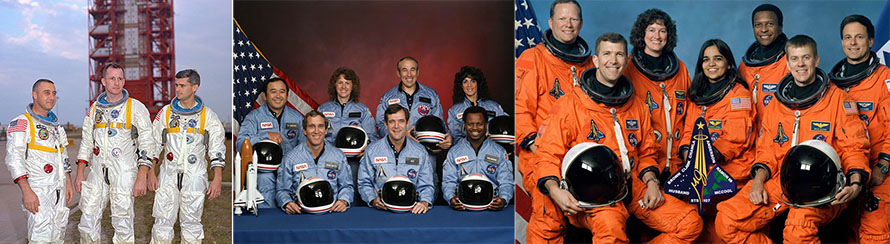
The tragedy of the first successful space station visit to Salyut 1 is described. It was during the return of its three-man crew that they experienced hypoxia/suffocation from an inadvertent opening of a valve that vented their air into space during the return to Earth. It is referenced in the book as “… the only time a crew has ever died in space”—neglecting the seven members of STS-107 that died during their reentry of the Shuttle Columbia in 2003.
President Reagan’s commitment to achieving a permanent presence in space and the many iterations of space station Freedom (as it was then named) are examined. Of interest, over the period from 1984 to 1994, is the addition of Russia (primary survivor of the fall of the USSR) to an international consortium who would become partners in the International Space Station (ISS), as it then became known. The authors point out that the ISS program brought many diverse cultures together to achieve its goals and to develop a space-based culture of its own.
The text notes that the ISS was declared completed in 2011, following more than 100 rocket launches and the efforts of 200 astronauts. A total of 50 pages are dedicated to the design, construction, and operations aboard the ISS. The authors mention that more than 2000 scientific experiments from more than 100 countries have been run in the first two decades of its existence.
The book is profusely illustrated with excellent pictures and associated captions. Unique about its layout is that a topical discussion is introduced and concluded on facing pages—with a few exceptions.
Towards the end of the book, a chapter provides insight into the impact of the space station on pop culture—movies, TV, comic books, and plastic scale models. The book concludes with a brief look at the future of space stations to come.
I did not feel the book handled the topic well. Yes, it covers a lot of territory, but the redundancies, often poorly worded descriptions, and numerous errors do not bode well for a book authored by three individuals with exceptional credentials. Its somewhat disjointed presentation makes comprehension awkward. The smallest of the three primary size fonts, along with a shaded background of the Table of Content, makes for challenging reading.
© 2020 Ted Spitzmiller
Please use the NSS Amazon Link for all your book and other purchases. It helps NSS and does not cost you a cent! Bookmark this link for ALL your Amazon shopping!





1 thought on “Book Review: Space Stations – The Art, Science, and Reality of Working in Space”
The only ‘error’ you seem to point out is the loss of the Columbia crew during STS-107 because it was stated in the book that the only death in space was of the Salyut 1/Soyuz 11 crew. Soyuz 11 depressurized in the vacuum of space, at an altitude of about 100 miles and a velocity of about 17000 miles per hour, during module separation, shortly after retrofire. The Columbia broke up at an altitude of only 39 miles and a velocity of about 12500 miles per hour, so well below orbital velocity and well under the 62 or 50 mile altitudes at which space is recognized to begin; likewise the earlier death of Komarov on Soyuz 1 also took place during the landing phase within the atmosphere.