Dual book review by Mark Lardas
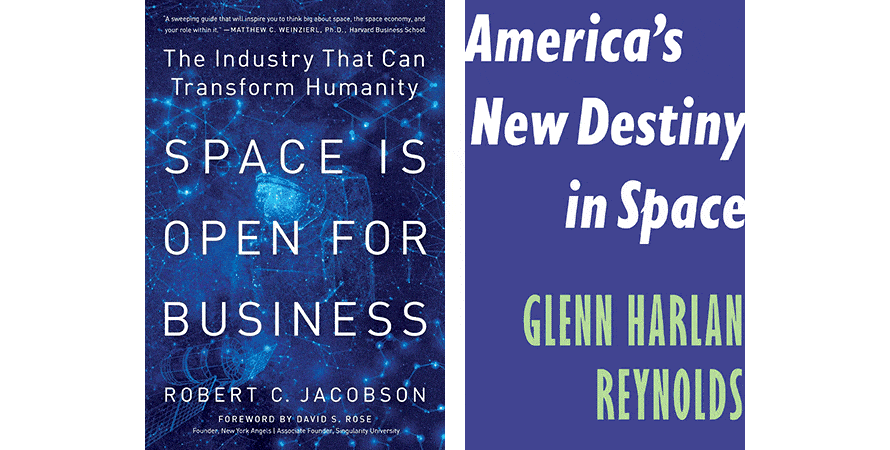
Title: Space Is Open for Business: The Industry That Can Transform Humanity
Author: Robert C. Jacobson
NSS Amazon link for this book
Format: Hardcover/Paperback/Kindle
Pages: 420
Publisher: Robert Jacobson
Date: September 2020
Retail Price: $49.99/$32.99/$14.99
ISBN: 978-1734205107
Title: America’s New Destiny in Space (Encounter Intelligence Book 7)
Author: Glenn Harlan Reynolds
NSS Amazon link for this book
Format: Paperback/Kindle
Pages: 54
Publisher: Encounter Books
Date: October 2020
Retail Price: $9.99/$8.99
ISBN: 978-1641771825
Growth is rarely linear. Usually it is either exponential or logarithmic, with unexpected inflection points. Space illustrates this. Space exploration experienced explosive growth for the decade following Sputnik I. Growth trailed off logarithmically after Apollo. The Shuttle and ISS spurred new exponential growth spurts before becoming logarithmic again.
Space appeared to be experiencing another period of logarithmic growth as we entered a new century, flat lining with the end of the Shuttle program. But it really just seemed flat during the opening of a new period of exponential growth. In 2020, with multiple new space firsts, including a first commercial manned spaceflight, another exponential growth spurt has become apparent.
Two books released this year, America’s New Destiny in Space by Glenn Harland Reynolds and Space Is Open for Business: The Industry That Can Transform Humanity by Robert C. Jacobson, capture the transformation occurring in space, especially in commercial space. Written independently, they form a greater whole. Reynolds gives the executive summary. Jacobson provides the detailed report.
America’s New Destiny in Space is a pamphlet with less than 50 pages of text. Yet in those pages, Reynolds outlines where we are going in space and why it is happening. Reynolds identifies trends. He divides space development into the visionary phase (Verne, Tsiolkovsky, and Goddard), the command-economy phase (run by government space agencies like NASA and Kosmicheskaya) and the sustainable phase (SpaceX, Virgin Galactic, et. al.). Reynolds asserts we have entered the sustainable phase.
The key to sustainability is cost. Reynolds identifies how much the cost has dropped: from $57,000 per kilogram to $2700—with indications it could be as low as $250 per kilogram in a few years. To put it in a historical perspective, that represents a percentage cost drop analogous to what was seen in shipping when the shipping container was introduced in 1956, creating the global economy. Similar drops in launch costs will transform space.
While Reynolds provides the broad strokes in a book that can be read in an hour, Jacobson fills in the details. Space Is Open for Business takes readers on a step-by-step analysis of virtually every aspect of twenty-first century space, with an emphasis on commercial applications.
Each chapter goes into a detailed examination of some phase of today’s space industry or the infrastructure required to have a space industry. This includes history, with chapters involving both “traditional” space history (such as Apollo) and lots about the early history of commercial space. He details the failures as well as the successes, showing the lessons failure offers. Jacobson also has chapters on commercial launch systems, cubesats, massive satellite constellations, Earth observation, data mining, communications, space-based energy and resource extraction, and much more.
Jacobson also looks at soft topics, such as the legal and regulatory environment, financing and investment, business models, and everything that goes into supporting space industry. He even examines the role science fiction and the arts have played and will play in space.
Some surprising players are revealed. Places like Luxembourg, the Island of Mann, and Dubai are positioning themselves to play the same role in the Space Age as Amsterdam, Singapore and the Azores played during the Age of Exploration.
The chapters include one-paragraph thumbnail biographies of today’s major players in space. These go beyond just those making hardware. Players include venture capitalists, lawyers, lobbyists, entrepreneurs, scientists, and visionaries. They are the types of people who provide the infrastructure needed for a mature space industry.
Even after finishing the main part of the book, Jacobson continues with sections that serve as appendices, even if they are not explicitly labeled as such. These include a section of interviews with space industry leaders, brief case studies on space development, a list of key factors enabling or retarding development of space industries, and a list of resources where readers can go to further research the topics presented. In some ways, Space Is Open for Business serves the same role for those aspiring to become part of New Space as the Boy Scout Manual serves for those aspiring to become Eagle Scouts.
While both are excellent, the two books are better taken together than taken separately. Reynolds provides a grand vision that shows how everything fits together, but spends little time outlining how we get there. Jacobson provides everything you need to know to get there, but the details lack focus. Together they yield both vision and grounding.
Both books illustrate the potential space offers mankind. Both authors show that we can extract enough energy and resources from space that we can discontinue many environmentally-dirty industries on Earth. As costs tumble, access will increase, creating a virtuous circle. Both authors also reveal the main danger posed to that promise lies mainly in government policy that could stifle innovation.
America’s New Destiny in Space and Space Is Open for Business are two books which illustrate how bright our future could become through space development that is emerging today.
© 2020 Mark Lardas
Please use the NSS Amazon Link for all your book and other purchases. It helps NSS and does not cost you a cent! Bookmark this link for ALL your Amazon shopping!