Category: Children’s Book
Reviewed by: Marianne Dyson
Title: Robots Slither
Author: Ryan Ann Hunter
Illustrator: Julia Gorton
Reading Level: Ages 4-8
NSS Amazon link for this book
Format: Hardcover
Pages: 40
Publisher: Putnam
Date: September, 2005
ISBN: 0399237747
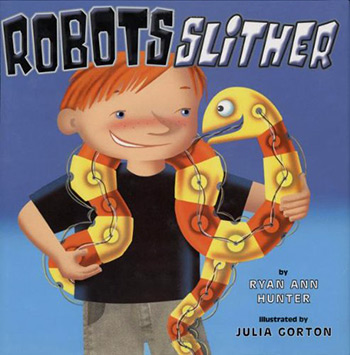
Robots Slither is a rhyming picture book that provides an overview of the types of modern robots. Details about actual robots are provided in illustrated sidebars on most pages. A short history and some websites are listed in the back.
As a recovering poetry editor (who still shudders when reading bad rhyme and meter), I was pleasantly surprised that this books rhyme and meter were nicely done. There were a few places with awkward multiple stresses in a row such as “what these robots.” But usually, a comma was deftly placed between the words, as in “clamp, drill, weld” that offered a rest for the voice. The only line I really didn’t like when I read it out loud (a test I always apply to poetry) was “Look for danger, put fires out!” I wanted to say “put out fires.” The awkward rearrangement was to force out to the end of the line to rhyme with “about” in the previous line. When I find these forced rhymes in critique groups, I always suggest the poet find another way to say this that preserves the natural sentence structure. I think this is particularly important for young listeners who are learning about rhyme and rhythm. If they hear too much of this kind of forced rhyme, they will likely decide that rhyme trumps meaning or meter (and join the swelling ranks of bad poets). But this book only had one of these out of 22 lines that all had consistent meter and made sense, and did not interfere with the story. Impressive!
The sidebars and “Robonote” in the back were full of interesting tidbits. I did find them somewhat distracting the first time through, though I stopped to read them before going on to the next page, and thus lost the rhythm of the main text. I recommend adults read the main text straight through and then go back and read the sidebars. It will be difficult to do this because the illustrations are so inviting.
I really loved the bold and colorful illustrations in this book. I want one of those robopuppies! (My cat might not….) The only illustration that has a technical problem is on the “hundreds whirring over Mars” page. The sidebar explains that tiny helicopters would explore Mars, but the main illustration shows two green Martians looking at the black sky that has a big orange ball in it. What is that orange ball? It was way too large to be the Sun as seen from Mars, and the sky is orange during the day, not black (like on the Moon). The moons Phobos and Deimos are tiny and look white, not orange. Also, I would have preferred that the astronaut in the ship not have on a bubble helmet, and the PSA be solid. Astronauts don’t wear helmets indoors, and the PSAs do not have a jaw. The sidebar shows how it actually looks, so I’m willing to pretend the main illustration is showing a future version, and the astronaut has donned her helmet because she is preparing for a spacewalk.
Robots Slither is a fun book to read, and the sidebars provide plenty of facts that should entice kids to embrace a future full of friendly robots.
© 2006 Marianne Dyson
Please use the NSS Amazon Link for all your book and other purchases. It helps NSS and does not cost you a cent! Bookmark this link for ALL your Amazon shopping!