Category: Non-Fiction
Reviewed by: Marianne Dyson
From Ad Astra Spring 2009
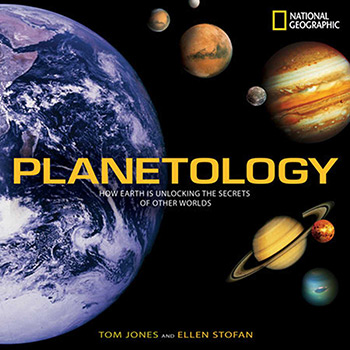
Title: Planetology: Unlocking the Secrets of the Solar
System
Author: Tom Jones and Ellen Stofan
NSS Amazon link for this book
Format: Hardcover
Pages: 218
Publisher: National Geographic Society
Date: November 2008
Retail Price: $35.00
ISBN: 1426201214
Venus has more volcanoes than any other known world, and the largest, Maat Mons, may still be active. Uranus’s moon Miranda has cliffs three miles high. The largest living organism is a four-square-mile underground fungus in Michigan. What do these facts have in common? Each can be studied to determine how different environmental conditions create features, and possibly creatures, on a variety of worlds.
Planetology: Unlocking the Secrets of the Solar System, by Tom Jones and fellow planetary scientist Ellen Stofan, is full of examples of how impacts, quakes, volcanoes, water, ice, and wind on one world can be used to identify and explain features on another — this is the science of comparative planetology. “On a dynamic world like Earth, change is a constant,” the authors explain. “We are compelled by our survival instincts to understand the forces that drive that change, in hopes of adapting to new conditions, or, as with the threat from cosmic collisions, using our technology to prevent a catastrophe we cannot survive.”
Published by National Geographic, the book naturally is packed with compelling images, including some from Jones’s four shuttle flights. Large images are paired with small insets showing a similar feature on another world. The stunning two-page spread of ice sheets in New Zealand, coupled with an inset of polar ice on Mars, may stimulate interest in both Earth and space tourism. Some space images may already be familiar to space enthusiasts. But the comparison of those images with others, such as one of Titan’s “Kissing Lakes” to lakes in Florida, deepens understanding of the connection between worlds by adding a new perspective — the whole point of planetology.
The text is informative, but the individual spreads do not always follow a logical progression. Thus, some information is repeated and other data, especially scientific terms such as tuya and yardangs, are introduced, defined, and not used again (there is no glossary). For example, the first chapter, “Earth: Key to Knowing Other Worlds,” begins with a history lesson and map of the solar system, but is followed by a spread about moons, close-ups of a city, a canyon on Mars, an eruption, the Hubble Space Telescope, a timeline of space exploration, and a photo of Saturn. However, this somewhat random organization does allow a casual reader to flip to an enticing photo and find a stand-alone explanation of the image and topic — an ideal feature for a coffee-table book.
The authors also share engaging personal experiences in “Fieldwork” sidebars throughout the book. In one of these, Jones writes, “We were 200 miles up, but we wanted to go beyond: To know what was out there among the thousands of glowing stars in the black velvet sky. Our imaginations couldn’t help but race out into that fantastic universe.” Until technology allows us to take those journeys in person, readers can enjoy exploring and imagining exotic off-this-world locations through the beautiful images and informative text of Planetology.
© 2009 Marianne Dyson
Please use the NSS Amazon Link for all your book and other purchases. It helps NSS and does not cost you a cent! Bookmark this link for ALL your Amazon shopping!