Category: Nonfiction
Reviewed by: Loretta Hall
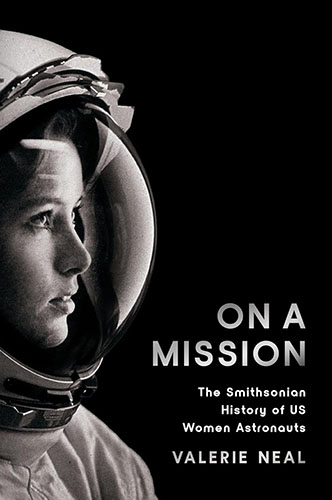
Title: On a Mission: The Smithsonian History of US Women Astronauts
Author: Valerie Neal
Format: Hardcover/Kindle
Pages: 360 pages
Publisher: Smithsonian Books
Date: October 2025
Retail Price: $29.95/$17.99
ISBN: 978-1588347763
Find this book
Reading On a Mission is like watching a baseball double-header. The book weaves together two complementary historical topics: the United States crewed space program in general and its women astronauts in particular. Either topic is significant, but the combination of the two is particularly informative.
Valerie Neal tells the story in six chapters. The first four focus on the female astronaut theme, moving chronologically in steps of progress. The opening chapter relates the early attempts of women to break into the ranks of NASA astronauts. In the early 1960s, the Mercury Thirteen proved their physical and psychological fitness. In 1970, five women successfully completed a two-week analog space mission in an underwater research station. In 1975, four women performed a week-long “mission” in the isolation of a Spacelab simulator. In addition to describing these examples, the chapter sets the context of the pre-space-shuttle era of an all-male astronaut corps.
Chapters two, three, and four then describe the sixty-one women who have flown (or are preparing to fly) NASA space missions. The chapters proceed from the Trailblazing Generation (1978-1990) of the pioneering wave, who had the chance to prove themselves as competent astronauts; the Inspired Generation (1992-2000), who joined an astronaut corps more accustomed to being coed; and the Empowered Generation (2004-2021), who were born in the aftermath of the women’s lib movement of the 1960s and ’70s and represented a more gender-balanced phase of American society. The major portions of these three chapters are short biographies of the women who joined NASA during the respective eras. Each bio consists of a description of the educational background of the individual, how she became an astronaut, and what jobs she performed during her tenure with NASA, both in space and in Earth-bound supporting roles. These descriptions give readers insight into the varied responsibilities of all astronauts and the kinds of work they do.
Chapter five, “Astronauts at Work: From the Ground Up,” expands that discussion of the broad range of astronaut roles, both during and in between missions. Although it is told from the perspective of women who did the jobs, the information is just as relevant to male astronauts and the work assignments they are expected to fulfill. Examples range from the familiar CAPCOM (capsule communicator) in Mission Control to making public appearances on behalf of NASA anywhere between Congressional committees and local schools.
Chapter six, “Balancing Acts: Risks and Rewards of Being an Astronaut,” gives a fascinating look at the physical and psychological challenges of the job. Many health aspects affect men and women similarly, but some differ between the sexes. These last two chapters will benefit both young men and young women who are considering spaceflight as a career. Knowing what the job entails and how it affects the people doing it is crucial information for potential employees and just plain interesting reading for the rest of us.
The dual nature of On a Mission begins with the title. The women profiled in the book were on a mission to prove that women were capable of being effective astronauts, and the book describes what is involved with anyone participating in a space mission, whether on board the spacecraft or in a support role on the ground. The book’s dual nature is reinforced in its final paragraph:
When asked what they most want people to know about women who are astronauts, the women presented in this history have an emphatic answer: “We are astronauts. Period.”
As a book about women in the U.S. space program, On a Mission is an important chronicle of societal evolution. As a book about astronauts and how they do their jobs, On a Mission is informative for everyone.
© 2025 Loretta Hall