Category: Nonfiction
Reviewed by: Peter Spasov
Title: Life in Space: NASA Life Sciences Research During the Late Twentieth Century
Author: Maura Phillips Mackowski
NSS Amazon link for this book
Format: Hardcover, Kindle
Pages: 392
Publisher: University of Florida Press
Date: May, 2022
Retail Price: $35.00/$26.49
ISBN: 978-1683402602
When space travel initially captured the public imagination, there were many unknowns about whether people could survive in the vacuum. NASA bore the responsibility for ensuring the first American astronauts could live in an unknown environment devoid of the essentials for biological life. Mackowski’s Life in Space documents the efforts of NASA to understand this unknown world.
This book’s focus is on organizational matters, objectives, and some results of experiments launched into space during the period of 1980 to 2004. The introduction, the extensively-cited ten chapters, and the parting thoughts total 274 pages. Additional pages of supporting materials include an extensive list of abbreviations and acronyms, seventy-five pages of notes, a bibliography, and index. Diagrams include assorted charts, tables, and photos and illustrations of equipment. Many of these are taken from historical sources. For example, one table tabulates the air contamination concerns of various space shuttle missions, taken from the final report of an orbital medical project.
Mackowski extensively portrays the politicization of setting mission budgets and goals. The trail of abandoned projects vastly outnumbers those actually executed. Most chapters focus on the process and organization of life-science research as it pertains to NASA’s goals for crewed space missions. The beginning chapters cover mostly machinery and crew safety, because, as the author reminds readers throughout the book, life science was always a low priority. For instance, researchers studied improvements in electrophoresis, a process used in antibiotics manufacturing, until advances in Earth-based electrophoresis negated the advantages of zero gravity.
The reader will learn about the numerous studies of working in a space environment. For example, space station engineers considered floors covered with Astroturf for traction in low gravity as well as ceiling padding to accommodate an astronaut’s loping and bouncing gait.
Other areas of research included orthostatic intolerance (the challenge of standing upright in gravity after operating within zero gravity), nausea (space sickness), microsurgery techniques, sleeping cycles, and ship ergonomics, among other topics. Conducting science was often problematic due to the environmental challenges during a space mission. As well, other space crew activities may sometimes interfere with an experiment. Other issues included questionable peer review and statistically questionable results. Among the most challenging were animal experiments, such as keeping test subjects healthy and alive. Animal rights groups protested.
Radiation was a significant concern, justifying a chapter devoted to it and its risk mitigation. Researchers found that flying particles with high atomic number and high energy were particularly destructive. Early international partnerships, such as both American Shuttle and Soviet Mir missions, collected radiation data.
Another chapter covers studies for space station designs. Typically these were subject to more restrictive requirements due to budget changes and outright cancellation imposed by the politics at the time. A grand vision for a centrifuge was never implemented due to budget cuts, despite consensus from scientists concerning the critical need for a centrifuge in orbit.
The author also covers the impact of the cold war and how missions changed after relations between America and the Soviet Union improved. By the 1990s other nations joined the USA and USSR in fielding astronauts, resulting in the challenges of running missions with international crews. Afterwards, Mackowski offers her parting thoughts concerning the entire era of life-science investigations in an orbital environment.
Thoroughly researched and referenced, Life in Space is an extensive history of NASA as it pertains to the life sciences, written by a historian. Alas, the writing style is often dry from sources such as NASA administration or scientists. For example, in a sentence about advancing the interests of the United States and its allies, Mackowski writes: “If that came to pass, where would the components of what had always been a loosely conglomerated space life sciences program go besides into the history books?” In this manner she concludes her argument as to why space-program life-science research is important.
Although the technical issues of some experiments are highly informative, this reviewer would have preferred more about how to live in space and what was discovered by the research. However, on occasion, the author does delve into the challenges of running experiments in outer space.
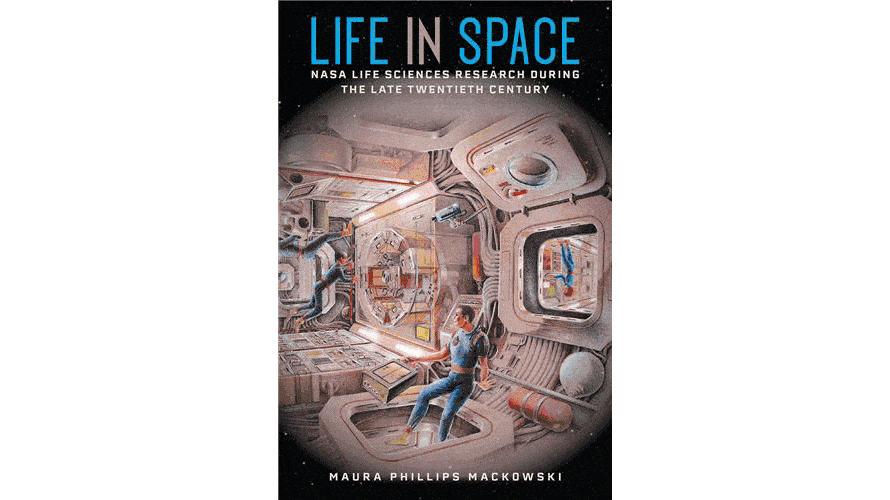
The cover art is a whimsical portrait of astronauts, dressed in Star Trek style uniforms, working in what could be a the next generation of the ISS, hence luring the reader into discoveries of a new world. And some sections do offer insight into the experience of living in space. Alas, the overall narration lacks the exciting stories and experiences of astronauts, and instead, focuses on the challenges of operating within a supersized government-funded organization subject to politics.
If one desires a thorough knowledge of NASA organizational history regarding the life sciences, this is the book to read. For a more entertaining expose of discoveries concerning how one can live in space, other books may offer more.
© 2022 Peter Spasov
Please use the NSS Amazon Link for all your book and other purchases. It helps NSS and does not cost you a cent! Bookmark this link for ALL your Amazon shopping!