Reviewed by: Brian Enke
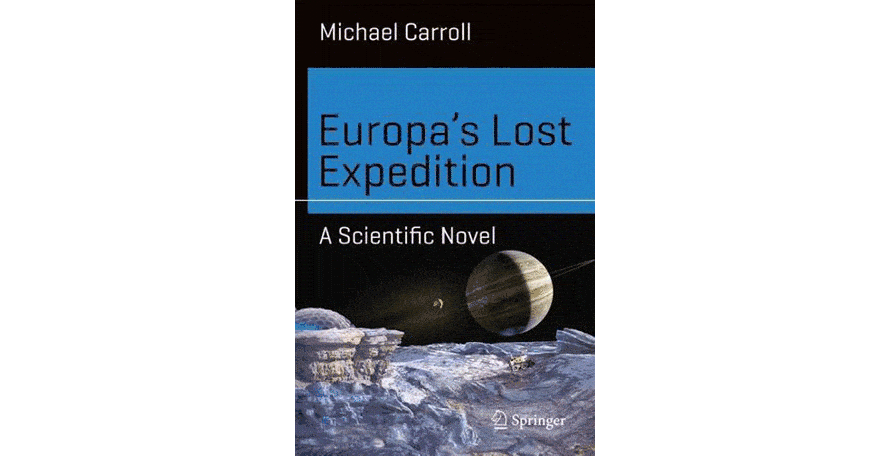
Title: Europa’s Lost Expedition
Author: Michael Carroll
NSS Amazon link for this book
Format: Paperback/Kindle
Pages: 224
Publisher: Springer
Date: September 2016
Retail Price: $19.99/$9.99
ISBN: 978-3319431581
Since his Voyager art debut in 1981, master artist and storyteller Michael Carroll has dazzled his audiences while expanding their scientific horizons. His latest science fiction novel, Europa’s Lost Expedition, continues his recent outer-planets series as part of Springer’s growing “Science and Fiction” collection. Carroll’s story fits perfectly into Springer’s goals for this collection: thoughtful storytelling extrapolated from real science.
While Carroll’s writing and artwork has spanned the Solar System, his latest works focus on the moons of the giant planets. As the title of the novel suggests, Europa’s Lost Expedition folds the events of a previously failed “lost” mission into a current expedition to one of Jupiter’s moons, Europa. Carroll’s technologies suggest an early 22nd century setting.
An immersive writing style brings both missions to life, interweaving them into a tapestry of murder and intrigue. The main character, volcanologist Hadley Noble, leads a nine-person science team through launch, landing, and exploration. She intends to use tele-robots and a sleek two-person submarine to explore the vast ocean beneath the ice sheets of Europa’s southern pole. Their primary goal is to search for life, yet death becomes their guide as they follow in the footsteps of the failed “lost” expedition over a decade earlier.
What happened to the lost expedition? All that remains from this previous mission is an electronic journal badly corrupted by exposure to the harsh radiation environment on the surface. Did they achieve their goal of finding life on Europa? How did they push through the challenges of their brutal, isolated environment? Fighting her own issues and obsessions, Hadley and her old friend, Gibson, race to learn about the ultimate demise of the lost expedition so they can prevent history from repeating itself.
Beneath Carroll’s main story lies yet another fascinating story, the taming of one of the harshest environments in the Solar System for human explorers. Previous settlers have established a tenuous foothold on that unforgiving moon, a small settlement named Taliesin Base. The current mission, as well as the “lost” expedition, heavily depend on logistics and support from Taliesin.
The “science behind the story” section at the end of the book is more than just an appendix. It includes a global map and closeup images of the exploration zones in the story, as well as detailed explanations of the latest scientific reports about the surface of Europa and speculations about the interior ocean deep under the ice. Some readers may appreciate this very readable overview of Europa more than the fictional story itself!
Ultimately, the author’s greatest contribution in Europa’s Lost Expedition may come from the interactions between his characters and the qualified support teams at Taliesin Base. Considering today’s efforts to establish a tentative foothold on another distant and unforgiving world, Mars, Carroll offers a roadmap to success while warning of messy baggage along the way. His “settlement enabling exploration” pathway is lined with fatal accidents, errors, suspicions, illnesses, murders, and even war. Space is not for the timid. Yet Europa is worthy of the peril, as are other destinations.
This reviewer recommends Europa’s Lost Expedition to readers of all ages, especially those who enjoy Agatha Christie mysteries. Michael Carroll turns Europa into a real place, filled with real issues and opportunities. By linking the explorers of the past to the explorers of the future, the reader gains a better understanding and appreciation for the deep, primal drives that push us ever forward and outward.
© 2017 Brian Enke
Please use the NSS Amazon Link for all your book and other purchases. It helps NSS and does not cost you a cent! Bookmark this link for ALL your Amazon shopping!