Category: Nonfiction
Reviewed by: Casey Suire
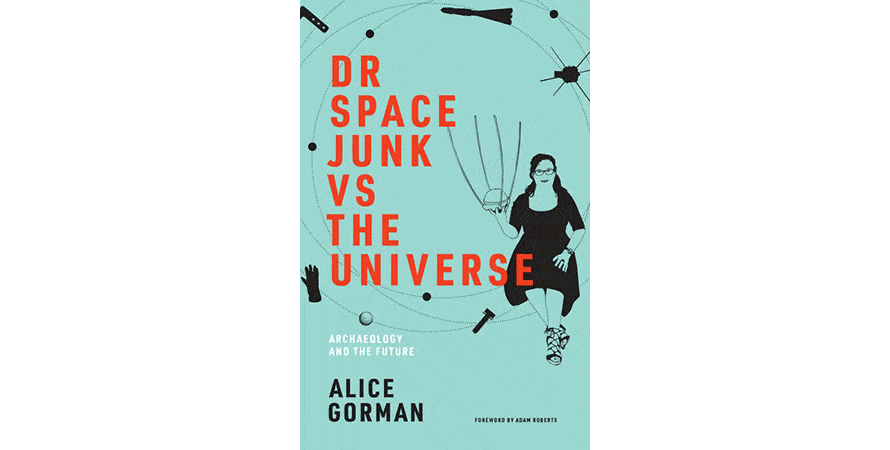
Title: Dr Space Junk vs The Universe: Archaeology and the Future
Author: Alice Gorman
NSS Amazon link for this book
Format: Hardcover/Paperback/Kindle/Audio
Pages: 304
Publisher: MIT Press
Date: October, 2019
Retail Price: $27.95/$16.95/$13.99/$18.37
ISBN: 978-0262043434
Archaeology and spaceflight are two things most people rarely ever mention in the same sentence. One is associated with excavating the ground below to learn about humanity’s past. The other involves reaching beyond the sky for a better human future. Nothing in common, right? Not if you read Dr. Alice Gorman’s book, Dr Space Junk vs The Universe: Archaeology and the Future.
Gorman, known as Dr Space Junk, is a Senior Lecturer at Flinders University in Adelaide, South Australia. She is an authority on the emerging field of space archaeology. This involves studying how humans interact with the remnants of old space missions. What is the meaning of these objects? How do they influence human culture and behavior? Throughout her book, Dr Space Junk answers questions like these as she applies archaeological principles to spaceflight.
Examining space exploration through the perspective of archaeology makes Dr Space Junk vs The Universe a somewhat unconventional book. Space is interpreted in ways different than most other books. Some of Gorman’s opinions on space policy will no doubt be challenged by many space enthusiasts. For example, she approves of the Moon Treaty, to which her native Australia is a party. Most major spacefaring nations, including the United States, are not parties to the treaty, and many (including this reviewer) are concerned that the treaty would impair the development of space resources.
Some of her other views, however, are more in line with the NSS vision. Becoming a spacefaring species is mentioned as a possible future for humanity. At one point, there is the prediction that the future will include settlements on the Moon, Mars, and other solar system bodies. Notably, though, the author does not mention O’Neill settlements in the book.
Australia figures prominently in the book. Early Australian satellites such as WRESAT 1 and Australis Oscar 5 plus the Woomera launch range are just a few examples. The spelling of many words, most notably “artefact” instead of “artifact,” is a noticeable effect as well.
The story of how Gorman became Dr Space Junk is interesting in itself. Growing up in Australia, she was interested in becoming an astrophysicist. Instead, she entered archaeology after many adults erroneously claimed her mark in physics wasn’t good enough. Years later, her interest in space was reawakened. One night, Gorman realized that the points of light she noticed in the sky were not all stars. Some were satellites and space junk. Like stone tools at archaeology sites, these objecst were built and discarded by human cultures.
Soon, she discovered that others had similar thoughts on the relationship between space junk and archaeology. In April 2003, Gorman presented two papers at the World Archaeological Congress. It was the first conference session ever devoted to space archaeology. Gorman would resign from her job and become a space archaeologist. She eventually earned the nickname Dr Space Junk.
One interesting aspect of the book is how space archaeology actually begins on Earth. An example is how early Sputnik satellites influenced food and drink in the late fifties. There was the Sputnikburger, which featured a cocktail hotdog (to represent Laika the space dog), an olive (to represent the shape of Sputnik 1), caviar, and Russian dressing (which was actually invented in America). For drink, Dr Space Junk includes a recipe for a Sputnik cocktail. Children were also affected by the early Space Age. During this period, several rocket themed parks were constructed in the United States, Soviet Union, Eastern Europe, and Australia.
Dr Space Junk also discusses the meaning and importance of many old spacecraft that still reside in space. Famous ones such as Vanguard 1, the oldest satellite still in space, and lesser known ones, such as the two stylish LAGEOS satellites, are profiled. On the subject of orbital debris, Dr Space Junk notes that the Kessler Syndrome could have devastating implications for the future of space exploration. She does not, however, believe that all space junk should be destroyed. Many historic spacecraft, it is argued, should be left alone in their natural space environment.
In one chapter, Dr Space Junk describes how both Apollo and numerous robotic landings have created multiple archaeological sites on the Moon that should be protected. Some past objects could even teach humanity how to explore the Moon in the future. A good example is how many pieces of Surveyor 3, returned to Earth by Apollo 12, were heavily pitted following over two years on the lunar surface. All equipment placed on the Moon will be subjected to harsh conditions, including abrasive lunar dust. Dr Space Junk notes that any human settlement on the Moon will have to take lunar dust into consideration.
Dr Space Junk vs The Universe, while not your typical space book, connects the past of space exploration with the present and future. Some of the “stars” you see at night were actually built by humans like you and have an amazing backstory.
© 2020 Casey Suire
Please use the NSS Amazon Link for all your book and other purchases. It helps NSS and does not cost you a cent! Bookmark this link for ALL your Amazon shopping!