Category: Non-Fiction
Reviewed by: Al Globus
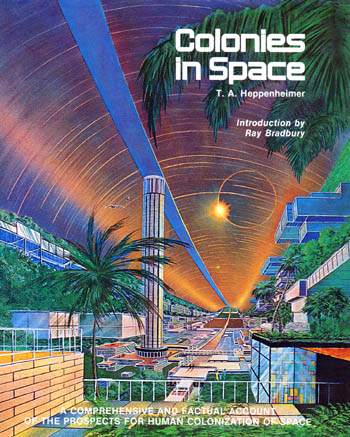
Title: Colonies in Space
Author: T. A. Heppenheimer
NSS Amazon link for this book
Format: Hardbound / Paperback
Pages: 224
Publisher: Stackpole / Warner Books
Date: 1977 / 1980
ISBN: 0811703975 / 0446955590
Complete online copy of this book
Colonies in Space by T. A. Heppenheimer is, quite simply, the best book on space settlement written to date. It covers essentially the same ground as the much better known The High Frontier, by Gerard K. O’Neill, but it is much better written. Colonies is full of colorful narrative and satisfying, but clearly explained, technical detail.
Dr. O’Neill was a brilliant physicist and will forever be remembered for his vital role in developing the first more-or-less practical space settlement designs, but he wasn’t a top-notch popular science writer. By contrast, Colonies is an easy, informative and exciting read and it is little wonder that Heppenheimer, a good scientist in his own right, went on to a successful career as a popular science writer.
The heart of Colonies is an excellent description of the essentials of the space settlement ideas largely developed by O’Neill. Heppenheimer describes, in eminently comprehensible terms, the construction shack to house those working on the first settlement, the lunar mine to gather materials, the mass driver catapult to send lunar materials into orbit, the catcher to gather the materials and control them, the major settlement designs of the times, and the solar power satellites to pay for it all. He extends O’Neill’s work with an extensive discussion of high-intensity agriculture and discovers a better location for the first settlements, a high Earth orbit rather than L5. There are also unique details such as the low-g swimming pool.
Chapter five, “The First of the Great Ships,” is unintentionally poignant, through no fault of the author, for it explains why space settlement has failed to make much progress since Colonies was written. In this chapter Heppenheimer traces the development of the not-yet-flown NASA space shuttle and describes how space settlement concepts were absolutely dependent on the promise of fifty flights a year and $500/lb to orbit – targets the space shuttle missed by a factor of ten or more. Reading this chapter makes it crystal clear why space settlement is stuck in the high-level design stage and emphasizes the criticality of the crucial first step towards space settlement: cheap and safe Earth to low-Earth-orbit transportation.
One might ask, if Colonies is the better book, why is The High Frontier so much better known? The simplest answer is that Colonies was a commercial endeavor that went out of print when sales dropped off (though you can still find copies easily on Amazon from used book stores). By contrast, The High Frontier has been thankfully republished by the Space Studies Institute for outreach and educational purposes, granting it much greater staying power.
I’ll leave you with a portion of Ray Bradbury’s introduction:
Colonies in space?
The question really shouldn’t be raised… Yes, of course. Why not? Let’s move. Let’s go there. Let’s do the job.
But scores of millions of doubting Thomases repeat the question. Mr. Heppenheimer answers it on many levels in this book. Up front, I must make do with some sort of literary/aesthetic defense….
Why? Because, wouldn’t it be terrible to wake one morning and discover, without remedy, that we were a failed experiment in our meadow-section of the Universe? Wouldn’t it be awful to know that we had been given a chance, a testing, by the Cosmos, and had not delivered – had, by a loss of will and a flimsy excuse at desire, not won the day, and would soon fade into the dust – wouldn’t that be a killing truth to lie abed with nights?….
Mr. Heppenheimer is keeper of the key, opener of the gate, tender of the gardens we will toss to space and inhabit with proper proportions of sorrow and joy. He offers you citizenship in the Universe.
How can you refuse?
© 2006 Al Globus
Complete online copy of Colonies in Space by T. A. Heppenheimer
Please use the NSS Amazon Link for all your book and other purchases. It helps NSS and does not cost you a cent! Bookmark this link for ALL your Amazon shopping!